


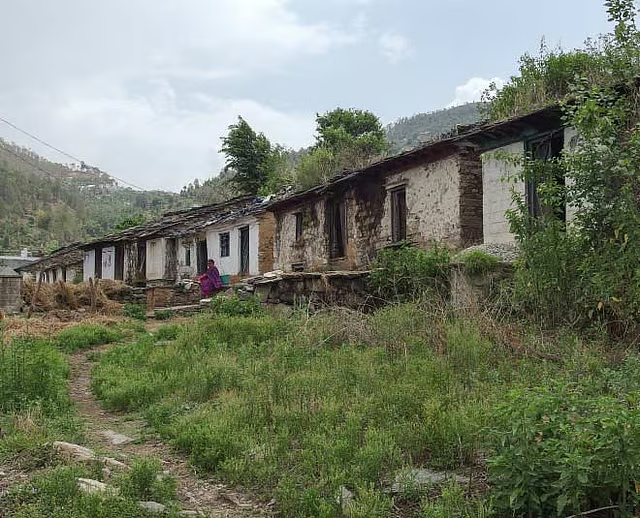
Across the remote hinterland, villages that have sustained communities for generations are steadily losing their people. Migration to towns and cities has left thousands of rural settlements sparsely populated, with many now reduced to ‘ghost villages’
The first thing to disappear from a village is not its people, but its sound. The laughter of children fades from winding paths. Cowbells become less frequent. Schools close for want of students. Terraced fields lie uncultivated, homes remain locked for years, and only a handful of elderly residents are left in settlements that once bustled with life.
Across India, this quiet exodus is reshaping the countryside. It forms part of wider demographic shifts, raising difficult questions about development, livelihoods, climate resilience, border security and the future of rural communities.
The Great Himalayan Exodus
“Devbhumi” Uttarakhand presents one of India’s most acute and extensively documented cases of rural depopulation. Government data paints a stark picture. The Uttarakhand Rural Development and Migration Prevention Commission, popularly known as the Palayan Aayog, recorded approximately 8.35 lakh temporary and permanent migrations from the state’s villages between 2008 and September 2022, leaving hundreds of settlements virtually uninhabited. Around 5.02 lakh people migrated between 2008 and 2018, followed by approximately 3.3 lakh during 2018–22.
The 2011 Census recorded 1,034 uninhabited villages in Uttarakhand. The Commission identified another 734 by 2018 and 24 more by 2022, taking the reported total to 1,792. Many more villages remain inhabited but have lost much of their working-age population.
For Chandan Nayal, a social and environmental activist from Nainital district, the term “ghost village” tells only part of the story. Based on his experience, many villages he knows have lost nearly 30 per cent of their residents. The settlements still exist on the map, but their farms lie neglected, schools have emptied, and community life has steadily ebbed away.
Commission data show particularly severe rural depopulation in Pauri Garhwal, Almora, Chamoli, Tehri Garhwal, Pithoragarh, Bageshwar, Rudraprayag, Uttarkashi and Champawat, although their scale and pattern vary between districts. The 2018 assessment recorded 186 revenue villages and hamlets in Pauri Garhwal that had become uninhabited after 2011, followed by 77 in Bageshwar, 75 in Pithoragarh and 70 in Uttarkashi. During 2018–22, however, Almora recorded the highest temporary and permanent migration. Depopulation in border districts such as Chamoli and Pithoragarh has also raised strategic concerns, particularly where settlements close to the international frontier have become uninhabited.
People leave for many reasons. Livelihoods become unsustainable, schools and healthcare remain inadequate, disasters destroy homes, and land is acquired for dams, mines, industries, infrastructure projects and protected areas. Increasingly, climate change is compounding these pressures, making migration not merely an economic choice but, for many, a necessity.
More than half the migrants surveyed by the Commission cited employment as the primary reason for leaving. Around 15 per cent migrated for education and nearly 9 per cent for healthcare. Nayal believes the trend can be slowed—and even reversed—through sustained support for local enterprise. The problem, he argues, is not a lack of potential but the absence of conditions that can turn local opportunities into dependable livelihoods.
Beyond Uttarakhand
Uttarakhand is the most visible example, but it is far from unique. Across India, villages are emptying in different ways. In Bihar and eastern Uttar Pradesh, men often migrate seasonally while their families remain behind. In parts of Maharashtra, Gujarat and Rajasthan, drought, debt and repeated crop failures drive workers into construction, brick kilns and sugarcane harvesting. In the Northeast, education and employment pull people away, while floods, landslides and river erosion force entire communities to relocate. In Assam alone, government estimates show that the Brahmaputra and its tributaries have eroded more than 4.27 lakh hectares of land since 1950.
For many Adivasi communities, migration begins with the loss of ancestral land. Studies from Jharkhand have documented how mining and industrial projects sever people’s ties with their farms, forests and customary institutions. India has no comprehensive official count of development-induced displacement, but researcher Walter Fernandes estimates that around seven crore people were displaced between 1947 and 2010, largely from poor and marginalised communities. Although Adivasis constitute less than nine per cent of India’s population, his research suggests they account for nearly 40 per cent of those displaced.
The Farmer Who Couldn’t Stay
Education illustrates how the cycle deepens. Schooling expands opportunities for rural children, yet success is often imagined away from the village. A study of farming families in Telangana and Tamil Nadu found that more than 90 per cent of parents preferred secure salaried jobs for their children over farming. As Manmohan Singh, a young man from Nainital district, put it: “Farmers do not want their children to become farmers.”
Migration and declining school enrolment then reinforce one another. Official UDISE+ data shows that 5,663 schools across India had no students in 2025–26. In Uttarakhand, figures presented in the Assembly in March 2026 revealed that 826 government primary schools had closed over the previous five years, including 262 in Tehri Garhwal. The state also had 4,745 vacant secondary-school lecturer posts. When the nearest school shuts, families have yet another reason to leave.
The National Curriculum Framework for School Education 2023 offers an alternative vision by encouraging learning rooted in local culture, ecology and livelihoods, with vocational education integrated into schooling. If accompanied by viable local employment, this approach could help young people imagine futures within their own regions.
Manmohan Singh’s own journey illustrates how difficult rural entrepreneurship can be. The 27-year-old from Okhalkanda block tried to build a future in his village. In 2017, he trained in mushroom cultivation, beekeeping, polyhouse farming and animal husbandry. His organic farming model won recognition, but after his brother left for higher studies, managing the enterprise with hired labour became increasingly difficult.
Wildlife added to the burden. Monkeys and langurs damaged crops by day, while wild boars raided fields at night. Government schemes existed, but banks imposed conditions that poorer farmers struggled to meet. Subsidised projects required upfront investment, technical support was limited, and delayed MGNREGA payments made even a rainwater-harvesting project financially unviable.
In 2023, Manmohan left farming to work as a financial consultant in Haldwani. He finds fulfilment in his new profession but still misses his village. His story underlines a larger truth: training, subsidies or a single government scheme are not enough. Sustainable rural livelihoods also require affordable credit, skilled labour, crop protection, reliable transport, processing facilities and assured markets.
Climate’s Quiet Push
Climate change is increasingly turning migration from a choice into a compulsion. A 2026 study in Uttarakhand found that erratic rainfall, rising temperatures and shrinking water sources were reducing agricultural productivity and driving migration. The state’s vulnerability is particularly acute because nearly 55 per cent of its agriculture is rain-fed and about three-quarters of its farms are smaller than one hectare.
The pattern extends well beyond Uttarakhand. Rising temperatures and declining winter chilling are shifting suitable apple-growing conditions towards higher elevations in Himachal Pradesh, while floods in Assam and cyclones and saltwater intrusion in the Sundarbans continue to undermine rural livelihoods. Across India’s drought-prone regions, thousands of families migrate seasonally simply to survive. Climate change rarely drives migration on its own, but it magnifies existing economic and social pressures until leaving becomes the only viable option.
Migration takes away more than people. It erodes the cultural and ecological knowledge rooted in village life. Local deities, sacred groves, festivals, oral traditions and folk songs have long bound communities to the land while passing on knowledge of farming, water conservation and forest stewardship.
As villages empty, dialects fade, oral histories disappear and traditional farming practices decline. What is unfolding in Uttarakhand and many other parts of India is therefore far more than a demographic shift. It is the slow unravelling of rural communities and centuries-old ways of life.
##
CHRONICLERS OF THE HIMALAYAN EXODUS
In the summer of 1974, four young men set out on foot to understand the mountain villages of what is now Uttarakhand. Encouraged by environmentalist Sunderlal Bahuguna, Shekhar Pathak, Shamsher Singh Bisht, Kunwar Prasun and Pratap Shikhar walked from Askot, near the Nepal border, to Arakot, close to Himachal Pradesh.
Living with village families, listening to their stories and documenting everyday life, they laid the foundation for the “Askot-Arakot Abhiyan”, organised subsequently every decade by the People’s Association for Himalayan Area Research (PAHAR). Covering nearly 1,150 km, around 350 villages over 45 days, the expedition has become a unique 50-year record of change in the central Himalayas. Environmentalist Chandi Prasad Bhatt aptly described it as a jangam Vishwavidyalaya, a “walking university”.
Across six expeditions, the walkers have witnessed one of independent India’s quietest yet most profound transformations: the gradual emptying of Uttarakhand’s villages. For them, the Askot-Arakot Abhiyan has become far more than a trek. It is a living record of a Himalayan society in transition—documenting not only the disappearance of villages but also the enduring possibility of their revival.
When they began in the 1970s, migration was largely seasonal. Men left for work but usually returned home. Farms were cultivated, schools were full and village life remained vibrant. Each subsequent journey told a different story. Roads reached deeper into the mountains, but schools, hospitals, transport and livelihoods failed to keep pace. Young people left permanently, families followed, houses were locked, fields were abandoned and village schools emptied.
The team returned in 2024 and found the pace of change had accelerated sharply. During the 45-day journey, they encountered forest fires on 28 days. Flames had spread beyond chir pine into oak forests, while road construction had destabilised hillsides, sending debris into fields, streams and rivers. For mountain communities, drying springs, erratic rainfall and failing harvests are making migration less a choice than a necessity.
The expeditions have also documented quieter losses: fading farming traditions, disappearing local foods and weakening village crafts. Yet Pathak remains optimistic. He believes the mountains can retain their people if education reconnects young people with their environment, ecological restoration revives natural resources and local economies create dignified livelihoods.
GFX 1
Uttarakhand’s Migration Hotspots
| Pauri Garhwal | Highest number of ghost villages; farming abandoned, jobs scarce |
| Almora | Hundreds of settlements left with only elderly residents |
| Chamoli | Remote villages emptied as farming declined |
| Tehri Garhwal | Generations have left in search of livelihoods |
| Pithoragarh | Depopulation along the India–China and India–Nepal borders |
| Bageshwar | Homestays and eco-tourism offer a lifeline |
| Rudraprayag | Young people migrate for jobs, leaving ageing communities behind |
| Uttarkashi | Remote villages continue to lose population |
GFX 2
WHY PEOPLE LEAVE
💼 No Jobs
The biggest driver of migration.
🎓 Better Education
Students leave for colleges and rarely return.
🏥 Poor Healthcare
Quality medical care is often hours away.
🛣️ Poor Connectivity
Remote villages lack reliable roads and transport.
🌾 Declining Agriculture
Low returns and labour shortages make farming unviable.
GFX 3
UTTARAKHAND IN EXODUS (2008–2022)
👥 6.9 lakh+
Migrated temporarily
🏠 1.47 lakh+
Migrated permanently
🚶 8.3 lakh+
Total people who left rural Uttarakhand
📉 10%+
Of the state’s rural population migrated
🏚️ 758 Villages
Have become virtually uninhabited (‘ghost villages’)
⚠️ Thousands More
Now have fewer than 100 residents
Source: Uttarakhand Rural Development & Migration Prevention Commission (Palayan Aayog)
