

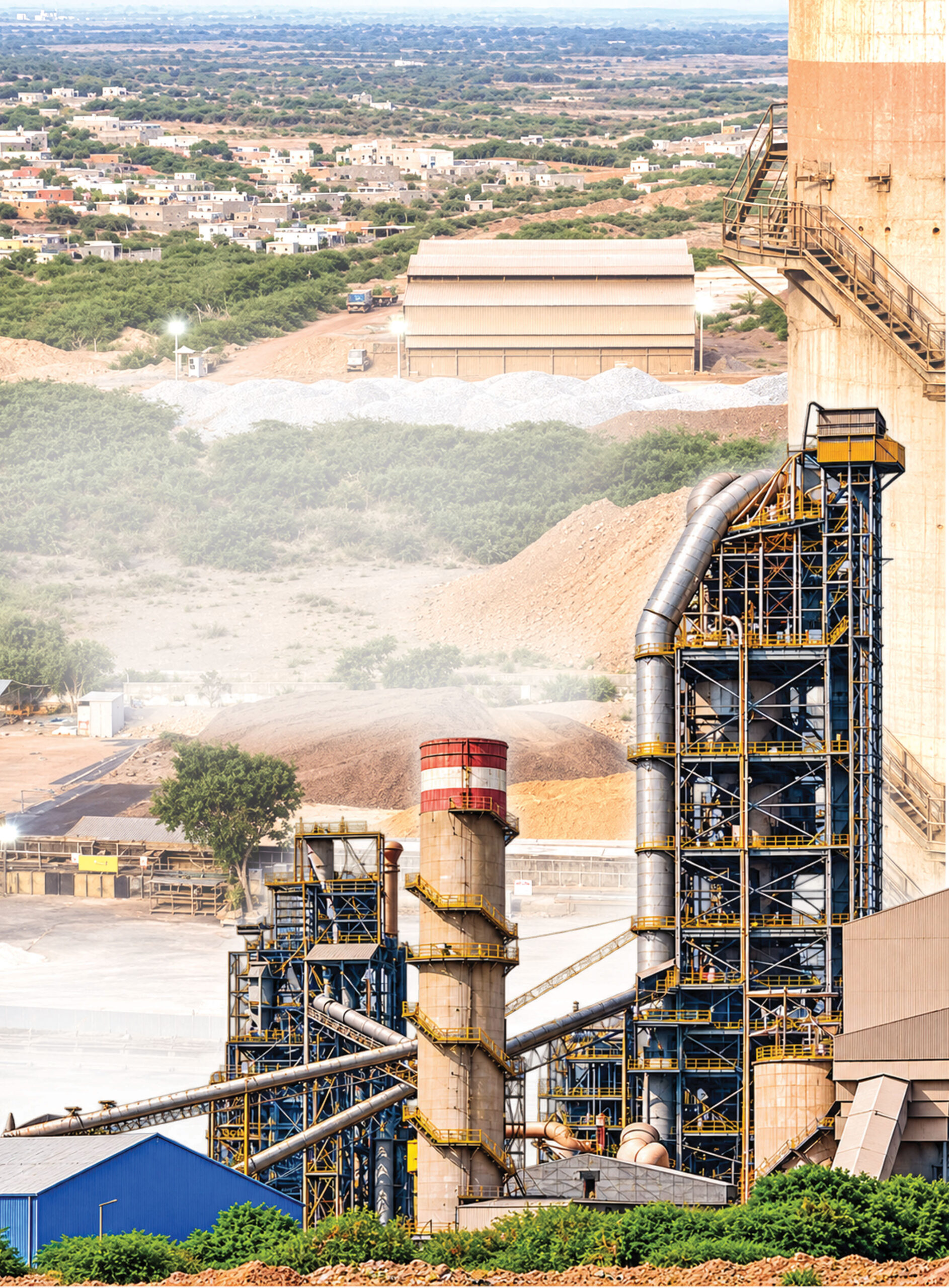
In February 2026, the National Green Tribunal (NGT) passed an order putting cement and chemical companies associated with the Adani, Aditya Birla, Tata, Dalmia and other major business groups under scrutiny. It directed them to disclose details of their limestone suppliers. Limestone is an essential raw material used in cement and soda ash manufacturing.
The order was part of an ongoing case filed in November 2019 by two Gujarat residents, Sayyed Mohammed Shabir Usman and Modhvadia Dilipbhai Bhurabhai. They alleged that 11 companies, most of them cement manufacturers, had encouraged illegal limestone mining by knowingly purchasing the mineral from mines operating in violation of the law and causing environmental damage in ecologically sensitive areas. The mines were operated by individuals as well as standalone companies.
The applicants asked the NGT to direct the companies to pay “special environmental damages” for allegedly promoting and encouraging illegal mining activities.
The tribunal held that a proper assessment of the allegations required access to “full evidence”. It therefore directed the cement companies, along with a Dalmia Group-owned soda ash manufacturer, to disclose their limestone suppliers. In April 2026, Frontline magazine published a detailed analysis of the order and the circumstances surrounding it.
However, a review of previously unreported records has now revealed that at least five of the 11 cement companies acknowledged before the tribunal that they had sourced limestone from mines accused by the applicants of illegal extraction.
The five companies are Ambuja Cements Limited of the Adani Group; UltraTech Cement Limited and Narmada Cement Company Limited of the Aditya Birla Group; Shree Digvijay Cement Company, associated with the India Resurgence Fund, a partnership between the Piramal Group and Bain Capital; and Hi-Bond Cement of the Kishan Group.
The records also reveal that some companies initially sought modifications to the NGT’s February order to avoid disclosing their suppliers. Although their arguments differed in presentation, the central contention was that they could not be held responsible for alleged illegal mining by the leaseholders from whom they purchased limestone.
The tribunal rejected their attempts and insisted on disclosure of the sources of procurement.
Uncomfortable truths
Legal and company records reviewed show that the five companies had purchased substantial quantities of limestone from several mine leaseholders in coastal Gujarat, some of whom were accused of operating in violation of an environmental law.
Ambuja Cements Limited disclosed that it had purchased 158,207 tonnes of raw limestone from Dhirajlal P. Vacchani in 2017 and 2018. UltraTech Cement Limited reported purchases of 536,813 (presumably tonnes) from Gatral Minerals over a period extending to the financial year 2025-26. Narmada Cement Company stated that it had purchased more than 7,000 metric tonnes of limestone from Gatral Minerals over three years in the present decade.
Shree Digvijay Cement Company and Hi-Bond Cement (India) Private Limited acknowledged in submissions to the tribunal in August 2023 that they had purchased limestone from some of the mine leaseholders accused of illegal mining. Unlike the three other companies, however, they did not provide detailed figures for their purchases from the mines under scrutiny.
The controversial mines were operated by companies or individuals allegedly without the requisite Environment Clearance (EC). Mining limestone without a valid EC is illegal under the Environment Impact Assessment (EIA) Notification, which requires prior environmental clearance for mining major minerals such as limestone.
The allegations concern not merely the conduct of individual mine operators but also the sourcing practices of companies that purchased their limestone, as the latter have been accused of being beneficiaries of illegalities.
Why Cement Biggies Denied Responsibility
Although the two Gujarat residents filed their application in 2019, the case gathered momentum only after November 2022, when the NGT directed cement manufacturers, a soda ash producer and the mine leaseholders to respond to the allegations. Until then, the proceedings had primarily focused on the mine operators and their environmental compliance.
From early 2023, several companies filed intervention applications and affidavits seeking their removal as respondents. New Delhi Post reviewed these submissions and found that UltraTech, Narmada Cement, Hi-Bond and Shree Digvijay were among the first cement companies to seek deletion from the proceedings.
Their arguments were broadly similar, although they offered different justifications.
UltraTech Cement argued that it was a “bona fide purchaser” of limestone and was “neither obliged to nor was in a position to ascertain whether the limestone purchased” had been “mined with EC or without EC”.
The Aditya Birla Group company also told the tribunal that its contracts with limestone suppliers contained a clause stating that it “shall not be responsible for any violations” of government rules and regulations by the suppliers.
UltraTech further cited provisions of the Mines and Minerals (Development and Regulation) Act, 1957, and the Gujarat Mineral (Prevention of Illegal Mining, Transportation and Storage) Rules, 2017, to argue that it could not be held legally answerable for alleged violations by its suppliers. It consequently requested that its name be deleted from the list of respondents.
Narmada Cement, another Aditya Birla Group company, advanced similar arguments in its intervention application. Hi-Bond and Shree Digvijay also relied largely on the same legal reasoning and sought to be removed from the proceedings.
Ambuja Cement adopted a different approach. In a reply affidavit filed in January 2023, it acknowledged sourcing limestone from Dhirajlal Panchabhai Vacchani, a mine leaseholder in Gir Somnath district, in 2017 and 2018.
Vacchani had been accused of mining without an EC. Ambuja, however, maintained that the leaseholder was legally compliant while supplying limestone to the company because he possessed a valid Consolidated Consent and Authorisation (CCA). The Adani Group company asked the tribunal to dismiss the application with costs.
NGT refuses to back down
The companies’ requests to be removed as respondents were rejected by the NGT in February 2026. “The issue of environment has to be considered by this tribunal in its totality,” the two-member bench observed in its order dated 6 February.
It added that whether the companies were “deliberately purchasing the limestone, which is said to be illegally mined by respondent Nos. 25 to 64 and thereby promoting the limestone mined”, had to be assessed after considering the full evidence placed before it.
Between February and August 2026, several companies, including UltraTech, Ambuja, Narmada and soda ash manufacturer GHCL, approached the tribunal seeking recall or modification of its order. They wanted to be excluded from the obligation to disclose their limestone suppliers. Ambuja also reiterated its request to be removed as a respondent through a separate intervention application.
The NGT rejected these attempts through two subsequent orders, issued on 22 June and 18 August.
In its June order, the tribunal pointed out that the companies had themselves acknowledged that the Gujarat Mineral Rules, 2017, required them to provide information about the source from which minerals were procured or transported.
The bench observed that the companies had been directed only to disclose their sources of procurement. It consequently found no reason to modify its earlier order and dismissed their applications.
By August, the resistance to disclosure had largely subsided. The tribunal recorded commitments from lawyers representing the cement companies that they would provide details of their limestone suppliers.
An October order also recorded an unusual request from GHCL Sutrapada, a Dalmia Group-owned company operating a soda ash plant. It submitted details of its limestone suppliers in a sealed cover, requesting that the information not be made public to “safeguard the commercial interests” of the company.
The NGT accepted the request, but with a caveat. It clarified that it had not yet opened the sealed cover. After examining the information, if it found evidence that the company had purchased mined material from illegal sources, the details could be disclosed to the lawyer representing the two Gujarat applicants, subject to the tribunal’s directions.
Gujarat’s Controversial Limestone Mining
Gujarat’s coastal districts are rich in biodiversity as well as mineral resources, making them attractive to mining companies, cement manufacturers and chemical producers.
Gir Somnath, Amreli and Junagadh are part of the region internationally recognised as the only natural habitat of Asiatic lions. The same region also has substantial limestone and sand reserves, particularly in Junagadh district. These resources have attracted companies that mine limestone as well as manufacturers that use it in their production processes.
Their operations have frequently come into conflict with environmental concerns raised by local activists, who have alleged extensive pollution and irreversible damage to the region’s ecology. Over the past decade, some of these concerns have developed into legal battles involving mining operators and companies using limestone as a raw material.
First Legal Intervention
In July 2018, the Protection of Environment and Public Service Committee, a Gujarat-based civil society organisation, approached the Pune Bench of the NGT.
Its application raised “substantial questions related to environment arising out of large-scale, illegal and unauthorised mining of limestone in districts Gir Somnath and Junagadh in Gujarat without any prior Environmental Clearance from the Gujarat State Level Impact Assessment Authority”.
The organisation alleged that the limestone was being “sold illegally to cement plants in the same districts for industrial purpose”. It identified 14 mines that had allegedly violated the EIA Notification, 2006, by extracting limestone without prior environment clearance. It also accused various Gujarat government departments and agencies of being “a mute spectator to illegal mining”.
In its judgment dated November 14, 2022, the tribunal accepted an important part of the organisation’s argument.
“The position of law makes it clear that since March 2016, it was mandatory for all such mining leases (major or minor), irrespective of the size, whether less than 5 hectares or bigger than that, that EC would be required for all. However, in the present case, it is apparent that none of the respondents…had obtained valid EC,” a two-member bench led by Justice Dinesh Kumar Singh observed.
But the mine leaseholders appealed against this judgment in the Supreme Court, which granted an interim stay on it.
The NGT judgment also did not examine the separate allegation that cement plants were purchasing limestone extracted illegally from these mines. That issue became the subject of the second legal intervention.
Second Legal Intervention
In November 2019, Sayyed Mohammed Shabir Usman and Modhvadia Dilipbhai Bhurabhai filed another application before the tribunal, seeking action against cement and chemical companies allegedly encouraging illegal mining by purchasing limestone from mines operating without environment clearances.
Their application accused 40 mines of violating the EIA notification and 11 cement and chemical manufacturing companies of promoting illegal mining by purchasing limestone from those mines for industrial use.
Of the 40 mines identified, 14 had already been investigated and penalised in the 2018 proceedings and were therefore excluded from further examination. The tribunal found prima facie merit in the new application and directed a committee of experts in Gujarat to investigate the remaining 26 mines spread across several districts.
In early November 2023, the committee conducted field visits in five districts: Porbandar, Rajkot, Gir Somnath, Jamnagar and Devbhumi Dwarka.
It assessed the environment compensation payable by mines found to have operated without the required clearances. In its field investigation report, submitted in December 2023, the committee observed: “Since there is no blasting or large-scale mechanisation requirement, there is no significant pollution potential from these mines, except dust generation from mineral transport activities.”
The committee nevertheless assessed the potential environmental damage in monetary terms to determine the compensation that could be imposed on the mine operators.
What Lies Ahead
The NGT is yet to deliver its verdict on the committee’s findings and recommendations. Nor has it adjudicated the additional allegation that cement and soda ash manufacturers encouraged illegal mining by sourcing limestone from mines operating without the requisite clearances.
In its latest order, dated October 16, 2026, the two-member bench observed that “pleadings in the matter are complete”.
More than seven years after the original application was filed, the tribunal has scheduled the final hearing for February 16, 2027. The proceedings could prove crucial in determining not only the liability of the mine operators but also the extent of accountability, if any, of the companies that purchased their limestone.