
Inside the money trail linking political parties, social media creators and digital influence
In January this year, a food-related controversy at Kolkata’s Olypub restaurant exploded into a political storm. Bengali actor and digital creator Sayak Chakraborty alleged that he and his companions had been served beef instead of the mutton steak they had ordered. The controversy travelled rapidly across social media, drawing political reactions and eventually resulting in the arrest of a waiter.
Months later, after the West Bengal Assembly election, another document put the episode in an entirely different context. The BJP’s election expenditure statement filed with the Election Commission records a payment of ₹2.5 lakh to a person named “Sayak Chakraborty” under its electronic media expenditure. Chakraborty has acknowledged receiving the money from the BJP, saying it was payment for two videos. In all, the BJP’s central office listed 20 Bengali creators, commentators and digital media entities receiving approximately ₹2.73 crore during the campaign period.
The disclosure is striking not simply because influencers were paid. Political parties have been using digital personalities for some time. But what makes the Bengal election filing significant is that, for the first time, social media creators and influencers are formally visible in the election’s financial records.
And that opens a much larger story. Because this is no longer just about the BJP. It is about the transformation of India’s election campaign into a marketplace in which political parties of different ideological hues are competing not only for votes, but for creators, followers, engagement, algorithms and the appearance of authenticity.
>> Creators are the New Media
The West Bengal disclosure offers an unusually revealing glimpse into that new campaign economy.
The BJP’s central expenditure schedule records payments to 20 individuals and digital-media organisations, amounting to about ₹2.73 crore. The list includes Suddhashil Ghosh at ₹51 lakh, Noticias Infomedia at ₹41.3 lakh, Banglahunt Digital Media at ₹22.5 lakh, The News Bangla at ₹22 lakh, Political Daily at ₹20.8 lakh, Madhyom Communications at ₹20.65 lakh, Jyotiraditya Roy at ₹17.8 lakh, Priyanka Sarkar at ₹15 lakh and Shamik Adhikary at ₹13 lakh.
The list also contains smaller payments: ₹9.7 lakh to Moumita Banik, ₹5.25 lakh to Pinak Ki Bolchi, ₹4.5 lakh to Shikha Kundu, ₹3 lakh each to Iti Karmakar and Subrata Kundu, ₹2.5 lakh to Sayak Chakraborty, ₹2 lakh to Sangit Sarkar and smaller sums to other recipients.
The significance lies in the granularity. Traditional election accounts tell us how much a party spent on advertising, vehicles, rallies, printing and media. The Bengal filing begins to identify the people and digital outlets through which political messaging can reach an audience that no longer consumes politics only through conventional media.
That distinction matters because influencer marketing does not operate like conventional advertising. A political party buying a Google or Meta advertisement purchases distribution. A party hiring a creator purchases something else. It buys production, access to an established audience and, potentially, the credibility accumulated by the creator over years. The creator’s audience may have followed one creator for comedy, another for fashion, another for food, another for local news and another for political commentary.
Then politics enters the feed. There is no studio jingle announcing the beginning of an advertisement. There may be no conventional political slogan. The message can be packaged as a conversation, a reaction, a street interview, a meme or a 30-second reel. That is what makes the creator economy different from an ordinary media campaign. The party is not merely purchasing space. It is purchasing access to an audience that has already chosen the messenger.
>> Not Just a BJP Story
The evidence becomes considerably more interesting when the BJP’s Bengal disclosure is placed against data on other parties. The Association for Democratic Reforms (ADR) has examined political parties’ declared spending on virtual and social-media campaigning during the 2024 general election.
According to ADR, the BJP declared ₹187.69 crore in virtual/social-media campaign expenditure, while the Congress declared ₹47.69 crore. Six regional parties in its dataset also disclosed spending: BJD ₹83.03 crore, DMK ₹50.26 crore, AIADMK ₹17.63 crore, YSR Congress ₹8.26 crore, JD(U) ₹7.43 crore and JD(S) about ₹0.34 crore.
Those numbers are not influencer payments. They cover wider digital campaigning. That distinction is essential. But they demonstrate that digital campaigning is no longer the preserve of one political organisation. The infrastructure has spread across India’s political system.
ADR’s analysis of the 2024 election also found that political advertising on Meta involved official party accounts as well as proxy and third-party accounts. Its dataset recorded substantial advertising by BJP, Congress, DMK, TMC, AAP, AIADMK, BJD, YSRCP and TDP-linked accounts, among others. The political internet is therefore not one party’s machine. It is an increasingly crowded marketplace.
>> The Shadow Campaign
The most revealing part of ADR’s research may be what happens outside official party accounts. During the 2024 general election, ADR found 19 proxy or third-party pages among the top 100 spenders on Meta, together accounting for nearly ₹19 crore across 14,982 advertisements.
That is a significant finding because third-party advertising complicates the conventional idea of an election campaign. A party’s official page is easy to identify. A page with no obvious party branding is different.
It may support a political party, attack its opponent, promote a particular leader or amplify a campaign narrative without looking like an official campaign vehicle. And once political messaging is distributed through hundreds or thousands of accounts, the voter can find it difficult to distinguish between party communication, paid advertising, political commentary, supporter activism and commercially sponsored content. That is where the creator economy becomes politically consequential.
Platform advertising alone shows how rapidly political campaigning has moved into the digital economy. ADR’s analysis of the 2024 election found that between March 16 and June 4, BJP advertisers spent approximately ₹85.3 crore on Google platforms, compared with ₹45.3 crore for Congress and ₹19.3 crore for BJD. On Meta, ADR recorded nearly ₹19.4 crore spent by the BJP’s national page on 43,455 political advertisements between March 8 and June 6, while BJP state-unit pages spent another ₹6.1 crore on 11,544 advertisements. Congress spent close to ₹10.8 crore on 845 advertisements in the same Meta analysis.
The point is not that these figures represent hidden money. They are, in fact, evidence of something more basic: political campaigning has become a substantial digital industry. The money is moving through platforms, agencies and increasingly through people whose principal professional asset is an audience.
>> Clues from Bihar, Tamil Nadu
The pattern becomes clearer when the Bengal disclosure is compared with Bihar. ADR’s analysis of the 2025 Bihar Assembly election found that the BJP declared ₹18.99 crore under social-media advertisements and another ₹1.79 crore under virtual campaigning through social media. Together, that amounts to nearly ₹20.8 crore. JD(U) declared ₹16.63 crore under social-media advertisements. Congress declared ₹11.24 crore under virtual campaigning through social media.
Again, these are not creator payments. But the figures demonstrate the scale of the digital campaign economy surrounding an election. The interesting question is what lies inside those broad categories. How much goes to Google and Meta? How much goes to agencies? How much goes to production companies? How much goes to creators? How much is spent on WhatsApp distribution, automated calls and digital mobilisation? And how much reaches third-party pages that do not look like political campaign accounts? The existing disclosure system provides pieces of the answer. It does not yet provide the complete map.
Tamil Nadu provides another glimpse of where this is heading. Reporting on the 2026 Assembly election described an increasingly intense contest for attention on Instagram and YouTube. The Indian Express reported that the DMK, AIADMK, BJP and other political formations had built increasingly sophisticated digital operations, while reels and short-form videos became central to campaign communication. It is the industrialisation of political content.
>> ECI Knows the Creators Exist
The regulatory framework is not technologically blind. The Election Commission has explicitly instructed parties and candidates to account for internet and social-media expenditure. Its instructions cover payments to internet companies and websites for advertisements as well as campaign-related content creation and operational costs.
Political parties are also required to disclose virtual campaign expenditure through Schedules 24A and 24B. The system therefore recognises that the digital campaign has expenses beyond the conventional advertisement. But disclosure is meaningful only if the public can reconstruct the transaction.
A line saying “Electronic Media — ₹13 lakh” tells the voter that money was spent. It does not necessarily tell the voter: What was made? Who commissioned it? Where did it appear? Who saw it? Was it political advertising? Was the audience told? That is the information gap.
Political parties are spending heavily on digital campaigns. Creators and digital publishers are appearing in election expenditure records, while proxy pages buy political advertising. Yet the connective chain remains largely unexplored: Party. Agency. Creator. Content. Payment. Audience. That missing chain could become the defining election-finance investigation of the social media age.
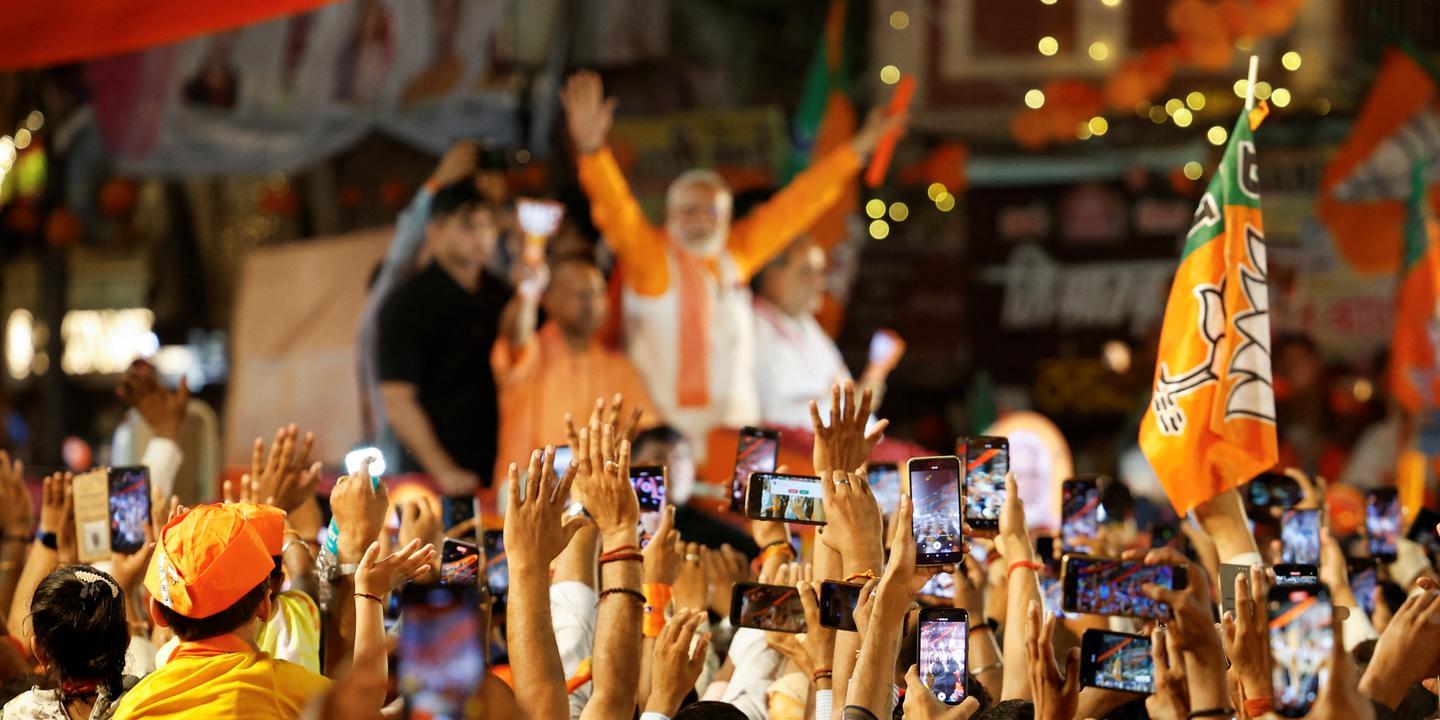
The political campaign of the future may not look like a campaign at all. It could arrive as a 25-second reel from a comedian, podcaster, regional YouTuber or meme page. The old campaign had a stage; the new campaign has a feed. The crucial question may therefore be: Who paid the person whose video you thought you were simply watching?