

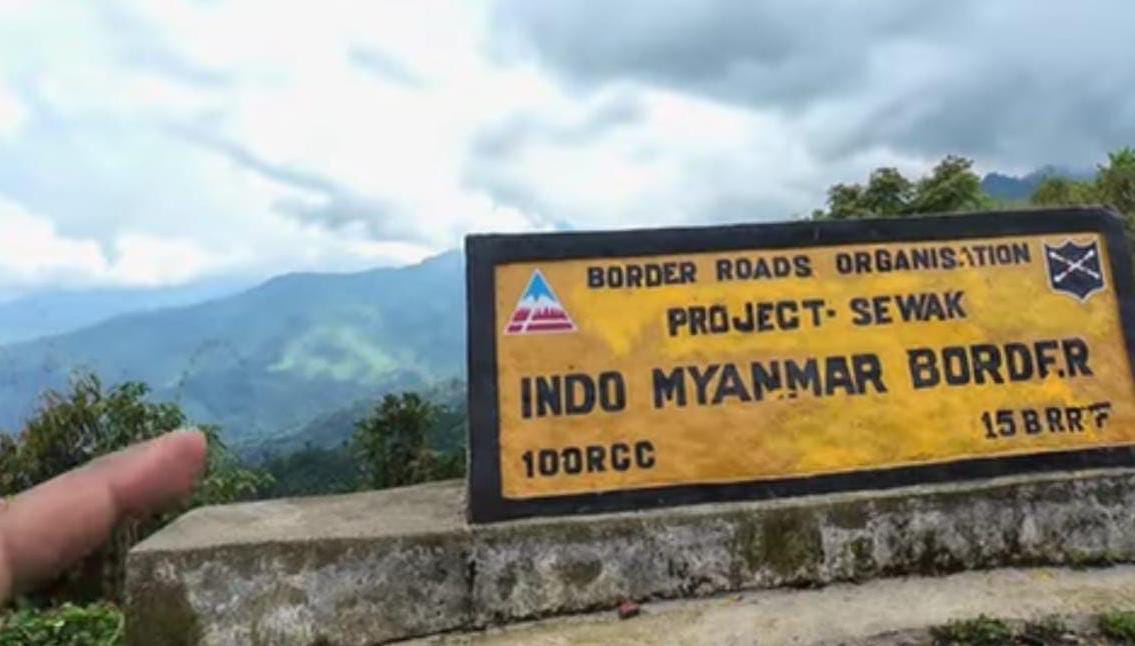
Despite tighter controls, India has yet to establish whether unauthorised crossings along the Myanmar border have fallen. Drugs and arms continue to flow, while border communities face growing restrictions on routes they have used for generations
Two and a half years after India tightened controls along its 1,643-km border with Myanmar, the government can say how many people have entered through designated crossing points, how many have been registered biometrically and how much narcotics security agencies have seized. What it still cannot publicly say with clarity is whether the crackdown has achieved its central objective: has unauthorised movement across the frontier actually declined?
Beyond Formal Routes
A revised border framework, replacing the earlier Free Movement Regime, was declared in February 2024 and formalised in December that year. It was introduced amid concerns over infiltration, trafficking, arms and drugs along a frontier that runs through some of the country’s most difficult terrain and a region marked by ethnic conflict and persistent insecurity.
With the new norms, movement was restricted to 43 designated crossing points. Travellers were required to obtain border passes issued by the Assam Rifles, movement was limited to 10 km and biometric recording was introduced. The official map notably identifies recognised crossings such as Moreh-Tamu in Manipur, Zokhawthar and Zorinpui in Mizoram, Nampong-Pangsau Pass in Arunachal Pradesh and nine points in Nagaland.
Since December 2024, Assam Rifles has mapped approximately 42,000 Myanmar nationals who entered through designated channels. But these figures largely record movement that has entered the formal system, not movement that continues beyond it. Neither the Assam Rifles nor the Union home ministry has publicly offered a consolidated assessment of movement outside designated checkpoints, including how many people are intercepted, turned back or detained.
That leaves a basic question unanswered. If people continue to cross through hundreds of traditional paths, forest tracks and village routes outside designated gates, how much has the new regime actually changed the scale of that movement?
Sources said illegal crossings from Myanmar remain significant despite tighter surveillance, with infiltrators avoiding checkpoints and using unguarded routes. The geography of the frontier makes this particularly difficult to police. In Nagaland, especially in areas inhabited by Konyak and Khiamniungan communities, the international boundary does not correspond neatly to the social geography of the region. Villages, agricultural fields, markets and families exist on both sides, connected by hundreds of paths used for generations.
For residents, crossing the frontier has traditionally been part of everyday life — to farm, attend school, obtain healthcare, visit relatives or reach markets. Some of these routes continue to be used without border passes, yet the official record does not quantify the extent of such movement.
There is also a question about the infrastructure of the new regime itself. In February 2025, Assam Rifles officials said 22 of the 43 designated points were operational, and the others would be activated in phases. More than a year later, as of August 2026, there was no consolidated public government record clearly establishing the operational status of all 43 points.
The Security Test
Drug trafficking, another crucial menace along the India-Myanmar border, has not stopped. Between 2021 and 2025, agencies reported recovering 4,626 kg of amphetamine-type stimulants and 2,652 kg of heroin along the border. Synthetic drugs, particularly methamphetamine and YABA, have emerged as a growing concern.
Recent cases in Nagaland underline the scale of the challenge. On August 19 and 20, 2026, Mon Police, working with Charaideo Police in Assam, recovered about 800 grams of suspected heroin, locally known as “Shan Flower”, and arrested six people. The investigation subsequently uncovered a financial trail. Local newspaper reports said one of the principal accused had a bank account that received at least ₹20 crore over the preceding decade, with unusually large recent credits.
Another operation later in August pointed more directly to the cross-border supply chain. Between August 28 and 31, teams from Naginimora police station, Mon QRT and Mon police station arrested two people at Naginimora. Interrogation led investigators to a concealed cache at Wakching village, where they recovered 14 soap cases containing suspected narcotic drugs. The preliminary investigation indicated that the drugs originated in Myanmar, were collected from a village near the international boundary and brought into Nagaland for onward distribution.
The threat is not confined to narcotics. On August 20, a joint team recovered an arms cache near border pillar 73, including drone bombs and improvised explosive devices. During the same week, 1.8 kg of methamphetamine tablets, estimated to be worth about ₹5.4 crore, were seized near Zorinpui.
The difficulty for enforcement agencies is that traffickers often use the same routes as residents. “The biggest security problem people talk about here is drugs,” said Longkhoi, a resident. “There is also concern about smuggling because the border has many forest paths. Many of these traditional paths are used by ordinary villagers for farming and visiting relatives. So the situation is not always simple.”
Border Is Also a Lifeline
That tension between security and ordinary life is most visible in villages where the border itself is part of the community. Longwa offers perhaps the clearest illustration. About 170 households sit directly on the boundary, while nearly 1,000 households in the wider area straddle it. A house can have one part in India and another in Myanmar. Of the 35 villages under the traditional authority of the Longwa Angh, 30 lie across the border. For generations, residents have crossed it to reach homes, farms, schools, hospitals and relatives.
“We are Indians and we are Burmese. Do not divide us,” said Tonyei Phawang, the 10th-generation Chief Angh of Longwa. “For us, crossing the border is normal,” said Shomwang, another resident. “Our relatives, fields and daily needs are on both sides.”
The new controls have not altered that reality; they have made navigating it more difficult. Children from Myanmar-side villages continue to attend schools in India and patients depend on Indian healthcare facilities. “They won’t stop the kids from studying,” said Shing B, a resident of Noklak and Gender Specialist with the District Hub for Empowerment of Women.
For economically vulnerable families, access to Indian schools and services can be critical. Children living under Myanmar administration generally cannot access welfare assistance available to residents on the Indian side. A restricted route can therefore determine whether a child reaches school, a patient reaches a hospital or a family can attend a funeral.
The dependence extends to livelihoods. Formal cross-border trade through the International Trade Centre at Pangsha has not fully developed, while informal commerce continues to supply essentials to communities across the frontier. Thousands of hectares of ancestral land are also believed to lie on the Myanmar side. In Pounyu, about 15 km from ITC Dan, the road from Lahe has become an important supply route for rice, cooking oil, fuel and other necessities. When a fire destroyed more than 60 houses in Solo/Chiu in February 2023, leaders from New Pangsha and Dan helped send relief supplies across the border.
The terrain makes the restrictions harder still. Along the Pungro-Mimi-Vongtsuvong belt, traditional routes remain the only practical links to some Myanmar-side settlements. Shahoto, a pastor from Vongtsuvong, said one such journey takes about 90 minutes by Burma Bike; ordinary four-wheelers cannot negotiate it. “These people are in dire need of support and humanitarian intervention,” he said.
Fencing could deepen the divide. Of the 1,643-km border, only 9.214 km had been fenced at Moreh at the time covered by the investigation. A ₹31,000-crore, 10-year programme approved in 2024 envisages completing the fencing around 2035-36. No work order had yet been issued for the Nagaland sector.
For security agencies, fencing promises greater control over a largely unfenced frontier. For villagers, it raises the prospect of farms being cut off, traditional paths disappearing and families being separated. “If the fence comes near our fields, farming will become difficult,” said Thango, a Longwa resident. “We want the government to understand our situation also.”
The humanitarian costs have also triggered a political disagreement between the Centre and Nagaland. Chief Minister Neiphiu Rio and the state Cabinet have repeatedly urged the Union home ministry to restore the earlier Free Movement Regime or adopt a more flexible arrangement, arguing that the revised system is causing hardship to border communities.
The security case for tighter controls is clear. Narcotics, arms and trafficking networks remain serious threats. The harder question is whether the new system can distinguish those threats from legitimate movement by people whose lives have historically crossed the boundary. Until that balance is achieved, the border may become more controlled on paper while becoming considerably harder to live with for the people who have inhabited it for generations.