

The group’s aluminium ambitions collide with tribal rights and forest protection
Early in July this year, the Adani Group announced plans to develop a greenfield aluminium project in Odisha with International Resources Holding, part of the Abu Dhabi-based IHC Group, involving an investment of more than Rs 1 lakh crore. The company described it as “India’s largest foreign direct investment in the metallurgy sector”.
The investment will go towards, among other facilities, a 4 million metric tonne per annum (MMTPA) alumina refinery, a 2 MMTPA aluminium smelter and a 1 MMTPA downstream manufacturing park.
The Adani Group said Odisha is already “home to some of India’s largest bauxite reserves” and a major producer of alumina and aluminium. The investment, it said, would “reinforce the state’s position as a global aluminium manufacturing hub” by integrating the entire aluminium value chain, from mining to downstream manufacturing.
The statement did not disclose the source of bauxite, the raw material used to produce aluminium. But multiple company documents reviewed by New Delhi Post indicate that, even before the formal announcement, the conglomerate had zeroed in on two bauxite mines under its control in Odisha, at Ballada and Kutrumali, as potential sources.
Mines Behind Adani’s Aluminium Push
Adani Enterprises Limited’s annual report for financial year 2023 provides an important clue to the significance of the two mines. Through its subsidiary Kalinga Alumina Limited, the company said it was “foraying into the aluminium business” by setting up integrated alumina facilities comprising bauxite mines with a combined capacity of 12 MTPA and a 4 MTPA alumina refinery, along with the necessary infrastructure and utilities.
As the “first step” towards this plan, the report said, Kalinga Alumina won two bauxite blocks in auctions conducted by the Odisha government. The blocks are located at Kutrumali and Ballada.
“Winning these blocks has not only secured raw material requirements for the refinery,” the annual report said, “but provides a significant cost advantage in producing metallurgical grade alumina, in view of the qualitative composition of the bauxite.”
The two mines, along with other bauxite deposits the conglomerate is seeking to acquire in Odisha, are expected to provide the raw material needed to achieve its targeted 12 MTPA mining capacity.
In July 2026, however, Adani Group management was less forthcoming about the role of the two mines. Speaking to Business Standard a day after the announcement, Karan Adani, managing director of Adani Ports and Special Economic Zone (APSEZ), said: “The Odisha government has substantial bauxite resources. We are working with the government on long-term bauxite linkages. We will also work closely with the Odisha Mining Corporation Limited to ensure raw material security, although the exact operational model is still being worked out.”
Karan Adani did not clarify whether the group would source bauxite from Kutrumali, Ballada or both. The two mines, however, are among its most obvious potential sources. The Odisha government ultimately owns them and has allotted them to a company controlled by the conglomerate for bauxite extraction. Kutrumali has already commenced production, while the group has been seeking to operationalise Ballada, which has faced substantial opposition from residents.
Ballada Protests Echo Niyamgiri
Protests against the Adani Group’s efforts to mine bauxite at Ballada appear to have persisted over several years. Reported by local and national media, they have revived memories of the agitation against the Vedanta Group’s controversial bid to mine bauxite in the Niyamgiri hills more than a decade ago. The concerns raised by local communities in the two cases are strikingly similar.
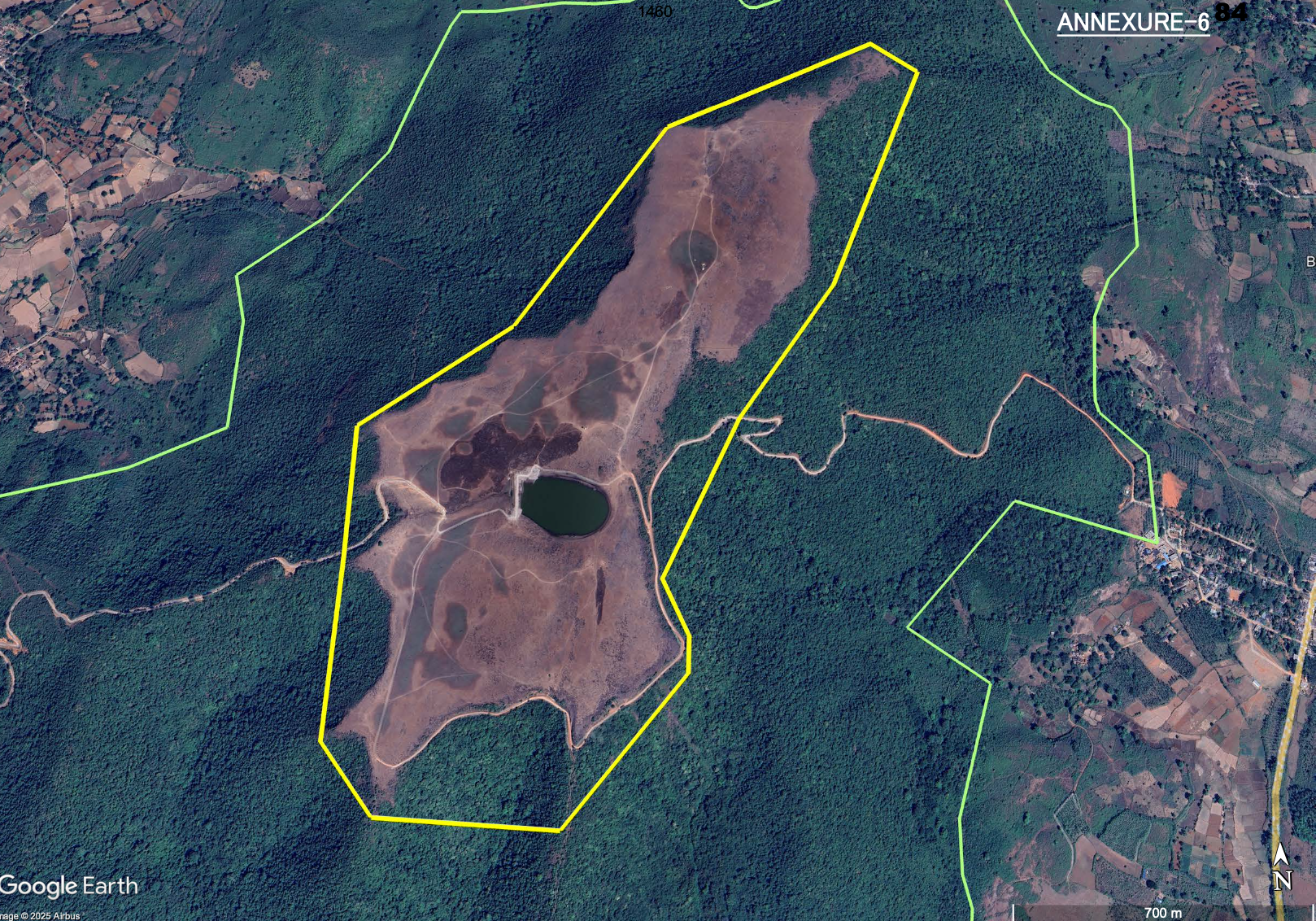
The proposed mining site lies atop Ballada hill. For forest-dwelling communities in villages around the hill, it is a sacred abode of Adivasi deities. Two of them, Nageswari and Mauli Ma, are housed in a cave near the hilltop and are worshipped daily.
The Niyamgiri hills are similarly regarded as the sacred abode of Niyam Raja, an Adivasi deity. Alongside concerns over legal rights to forest land, spiritual beliefs have been a major factor in opposition to bauxite mining. Since 2013, the Dongria Kondh communities living around Niyamgiri have successfully resisted attempts by Vedanta and other companies to mine bauxite in the hills.
Mine Under Legal Scrutiny
Previously unreported official documents and media reports reviewed by New Delhi Post reveal that the Adani Group has faced not only protests but also a series of legal challenges to the forest and environmental clearances granted by the state and Union governments for the Ballada mining project.
Among those challenging the clearances are Adivasi residents of Koraput district, including Ajaya Muduli, Sunadhar Muduli, Rajendra Khara, Gana Limikia, Subhash Sisa and Gora Sisa, as well as Prafulla Kumar Samantra, the Odisha-based activist and Goldman Environmental Prize winner.
The legal challenges include allegations that forest rights of local communities were violated when forest land was transferred for bauxite mining. The outcome could have implications for the Adani Group’s plans in Odisha, particularly its proposed Ballada mining operation, for which the estimated investment is Rs 23,000 crore.
At the Odisha High Court in Cuttack, petitioners alleged that forest land was diverted for the Ballada mine without first settling the forest rights of Adivasis and other traditional forest dwellers in several villages. They further alleged that the consent of local communities was not obtained before the diversion of forest land, as required under the Scheduled Tribes and Other Traditional Forest Dwellers (Recognition of Forest Rights) Act, 2006.
Separately, residents of Koraput filed appeals before the Eastern Zone Bench of the National Green Tribunal in Kolkata challenging the environmental and forest clearances granted to the mining project.
The appeals go beyond forest rights. They contain serious allegations concerning the potential impact of mining on local biodiversity. Several of these claims are supported by documentary material and appear to have received little or no public scrutiny before being placed on the official record.
Ballada’s Hidden Forest Story
Among the most significant allegations before the NGT are:
• Kalinga Alumina Limited, the Adani Group company seeking to mine bauxite at Ballada, “suppressed the presence of the Jeypore Ground Gecko and other endangered species in the area” and “committed fraud on the process” of obtaining forest clearance. The Jeypore Ground Gecko is endemic to the Eastern Ghats and classified as endangered by the International Union for Conservation of Nature (IUCN).
• The discovery of the gecko on Ballada hill was described as “monumental”, with petitioners arguing that its habitat must be protected because the species is “entitled to the same protection in law as the tiger”.
• The presence of 120 bird species, including “ground-nesting threatened birds”, was allegedly “suppressed” during the forest-clearance process.
• The potential impact of diverting forest land for mining on local biodiversity was allegedly “suppressed” during both the forest and environmental clearance processes.
• Ballada Hill was described as an “undisturbed repository of biodiversity” that is “critical to the survival of endangered species” such as the Jeypore Ground Gecko. Petitioners also said the forest is vital to tribal communities for “sustenance” and for preserving their “traditional religious, cultural practices and their way of life”.
• The “religious, cultural and livelihood significance” of the forest was allegedly “suppressed” during the clearance process.
• The Odisha and Union governments allegedly “failed to apply their minds” and granted forest clearance “in a mechanical fashion”, accepting the company’s submissions as “gospel truth”.
• Diverting forest land for mining on Ballada hill “would sound the death knell” for endangered species inhabiting the affected forests and for tribal communities dependent on them.
• The Environment Impact Assessment (EIA) report should have been rejected, petitioners alleged, because it failed to assess or mention the adverse impact of bauxite mining on Adivasi communities dependent on the forest and did not provide accurate baseline data.
• The EIA process was allegedly “vitiated” because it failed to assess “seasonal variation in biodiversity” and “meteorological conditions”.
These remain allegations before the Eastern Zone Bench of the NGT and have yet to be adjudicated. Their significance lies in the potential consequences of mining on Ballada hill, where tribal communities and wildlife depend on the same forest ecosystem.
The NGT has allowed the two appeals to proceed. In separate orders, the tribunal found no grounds to dismiss them at the preliminary stage and admitted them for hearing. It directed the Odisha and Union governments, as well as the Adani Group company, to respond to the allegations.
Evidence Cited by the Petitioners
In submissions to the NGT, the applicants placed on record documents and other material they say support their allegations.
To establish the presence of the endangered Jeypore Ground Gecko within the Ballada mining lease area, formerly a reserved forest, one application cites two research papers based on field studies and published in academic journals.
The more recent paper, published in June 2026 in the German journal Sauria, provides an updated account of the forest in which Ballada hill is located and confirms the presence of the endangered lizard.
“In 2025, we discovered in three groups after heavy rainfall only one specimen in the Balda Hills, marking the third known location in Odisha,” wrote Mirza Shahzad Alam Baig, the paper’s author. He also warned of the potential impact of mining: “The Balda Hills, where the species was recently found, remain relatively undisturbed, providing a safe habitat. However, planned bauxite mining projects pose a significant risk to the area’s biodiversity.”
The applicants also cited a second paper, published in June 2012 in Hamadryad, to support their allegations.
They submitted a geotagged photograph of a Jeypore Ground Gecko taken on March 27 this year on the Balda Cave Road. They cited it as evidence that the area around the proposed mining site provides habitat for the endangered species, which they argue is entitled to the same legal protection as the tiger. They have therefore sought a prohibition on bauxite mining in the area.
The applicants further cited the continued use of the cave housing the local deities Nageswari and Mauli Ma as evidence of Ballada Hill’s spiritual and cultural significance.
Rebuttal of Adani Group
The Adani Group firm termed the allegations of “concealment, suppression and fraud” as “wholly baseless”.
Responding to new findings of more than 120 species of endangered birds and the Jeypore Ground Gecko in the mining lease area, it told the NGT that “scientific publications, independent studies, isolated observations and third-party reports” were not part of the appraisal process before the project received forest clearance. Such material, it argued, “cannot retrospectively convert a duly conducted statutory appraisal into an instance of alleged suppression”.
The company further argued that even if the endangered lizard was found in “portions of the larger lease area”, it “does not automatically render diversion of forest land impermissible”. It said the appellants had not produced any official notification declaring the project area a “notified habitat of the Jeypore Ground Gecko” or a legally recognised critical habitat where diversion of forest land is prohibited. The company repeatedly stressed that the mere occurrence of a species does not “automatically” or “absolutely” invalidate the forest clearance without further consideration.
On allegations that the environmental, religious and cultural concerns of forest-dwelling communities were not considered before mining permission was granted, the Adani firm said the claim was “demonstrably incorrect” based on the record. It said these concerns were considered by the statutory authorities at different stages of the appraisal process.
The company assured the tribunal that its mining activities would remain within the law and the permissions granted to it. It also said it was conscious of concerns relating to the environment, the religious beliefs of local communities and their livelihood issues.
What Government Agencies Said
The Ministry of Environment, Forests and Climate Change (MoEF&CC), representing the Union government before the NGT, told the tribunal that its experts had assessed the Adani Group company’s proposal for diversion of forest land in accordance with the Van (Sanrakshan evam Samvardhan) Adhiniyam, 1980, and the rules and guidelines framed under it.
After the Advisory Committee granted conditional Stage-I forest clearance, the ministry granted Stage-II clearance only after the Odisha government confirmed that the company had complied with the conditions attached to the first-stage approval. The ministry did not, however, respond specifically to the individual allegations concerning the forest and environmental clearances.
The ministry said it had imposed a specific condition requiring compliance with the Forest Rights Act, including settlement of the forest rights of eligible local residents before diversion of the forest land. If any dispute over settlement of forest rights remained, it said, the matter fell within the jurisdiction of the state government under the law.
The State Environment Impact Assessment Authority (SEIAA), Odisha, which processes proposals for environmental clearance, also informed the tribunal about the procedure followed in examining the Adani Group company’s application for the Ballada mining project. It did not respond individually to all the allegations raised by residents.
The authority, however, made one significant observation. According to the regulatory documents prepared during the appraisal process, it told the tribunal, neither the Forest Rights Act nor a Rehabilitation and Resettlement Plan was required because there was “no habitation” in the area and the land was government-owned forest land.
That position appears to directly address the appellants’ contention that the forest rights of local communities had not been fully settled before the project received its clearances.
The NGT has yet to rule on these competing claims. Its decision could have significant implications for the Adani Group’s plans to mine bauxite at Ballada, as well as for the forest-dependent communities whose rights, livelihoods and cultural practices are tied to the area.