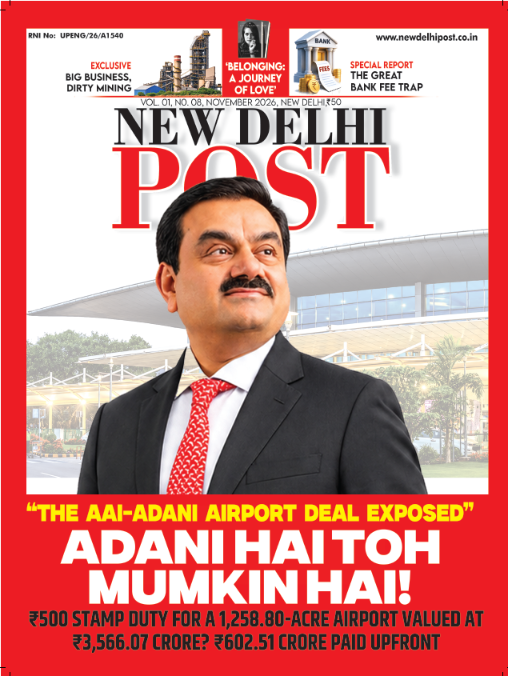

A ₹500 e-stamp, two different land-area figures and a ₹602.51 crore upfront payment. What the records show about the 50-year AAI–Adani concession at Lucknow airport.
The e-stamp certificate for Lucknow airport’s 50-year concession agreement records a payment of ₹500. Uttar Pradesh Stamp Department records obtained by NEW DELHI POST show that revenue officials initially assessed stamp duty at about ₹10.02 crore.
On July 18, 2022, the Additional Commissioner, Stamps, directed action under Section 33 of the Indian Stamp Act, 1899. Subsequently, in the supplementary valuation report dated August 6, 2022, Assistant Commissioner, Stamps, Satish Kumar Tripathi, and Sub-Registrar, Sarojini Nagar, Nirmal Singh, assessed 1,018.835 hectares of land, spread across approximately 1,200 Gata numbers in eight villages, at ₹3,566.07 crore. Based on this valuation, the prima facie potential shortfall in stamp duty was estimated at ₹249.63 crore.
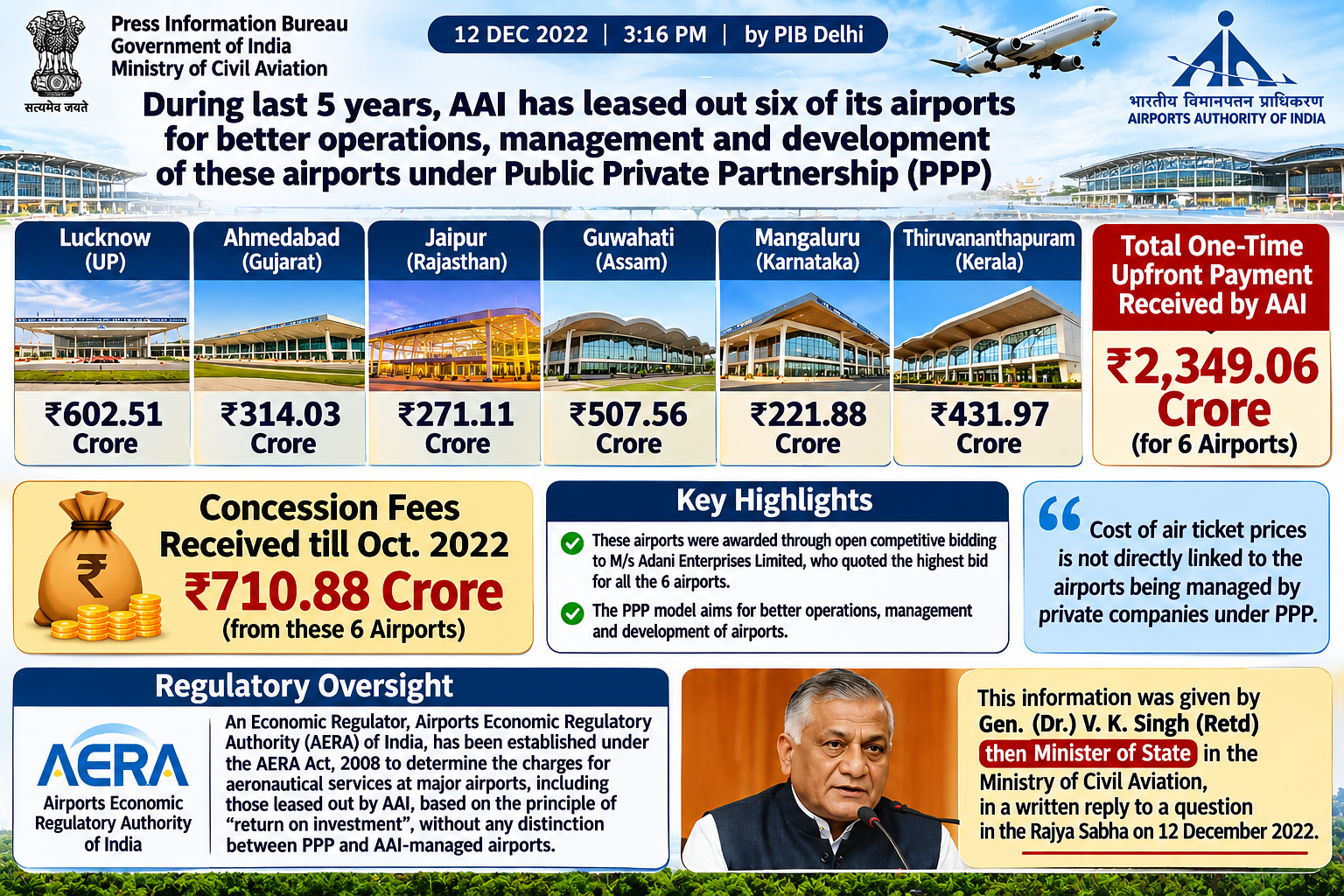
The questions emerging from NEW DELHI POST’s investigation extend beyond Lucknow. In a written reply to the Rajya Sabha, the Ministry of Civil Aviation said the Airports Authority of India (AAI) awarded six airports through open competitive bidding to Adani Enterprises under the public-private partnership (PPP) model. These were Mangaluru, Lucknow, Ahmedabad, Guwahati, Jaipur and Thiruvananthapuram. They were handed over in 2020 and 2021. The ministry reported a one-time upfront payment of ₹602.51 crore to AAI for Lucknow, comprising investment in capital work in progress and in the regulated asset base. Read the Rajya Sabha reply.
Source: Ministry of Civil Aviation, 12 December 2022.
While government documents describe this deal as a lease, an important observation in a letter issued by Ram Krishna, Director (P&S) of AERA, states that the relevant page of the available document mentions only that Master Plans for these three airports were being prepared. However, it makes no mention whatsoever of approval for an Aerocity, transfer of commercial land, grant of Real Estate Development Rights, or permission to develop land outside the airport operational area.
The documents uncovered by NEW DELHI POST’s investigation raise an even more serious question: Were the same procedures and conditions adopted in the privatisation agreements of the six airports as those now being questioned in the case of Lucknow Airport?
On February 14, 2020, in New Delhi, the Airports Authority of India (AAI) and Adani Lucknow International Airport Limited executed a 50-year Concession Agreement for the operation, management and development of Chaudhary Charan Singh International Airport, Lucknow. Under this agreement, a total of 1,258.80 acres (approximately 509.425 hectares) of land was allocated for the development and operation of the airport. However, the documents relating to this agreement have raised serious questions about government revenue and the stamp duty framework.
An important aspect of this 50-year agreement lies in Clause 10.2.2 and Article 25. Under Clause 10.2.2, the Adani company was granted Lease Rights over the designated airport land, while Article 25 provided for commercial rights relating to City Side Development. Despite these provisions, the original e-stamp certificate classified the agreement under Article 5 – General Agreement, with the property description recorded as Not Applicable, consideration shown as zero, and stamp duty amounting to merely ₹500. Meanwhile, government documents refer to the stated value of this agreement as ₹143.19 crore. Read the published concession agreement.
A 50-year agreement, but where is the registration record?
The first significant government report in this matter emerged on May 26, 2022. In his report submitted to the Commissioner, Stamps, Uttar Pradesh, Satish Kumar Tripathi, Assistant Commissioner, Stamps (First), Lucknow, stated that the deed of transfer of rights associated with the Concession Agreement executed for transferring the operational and management rights of Chaudhary Charan Singh International Airport from AAI to an Adani Group company had not been registered at the Sub-Registrar’s office.
According to the report, acting on the instructions of the Stamp Department, the Assistant Commissioner, Stamps, visited the airport on May 25, 2022, along with the Sub-Registrar, Sarojini Nagar, and sought the relevant documents. However, the airport management did not provide the officials with the required documents. The officials consequently raised a fundamental question: When the rights to operate the airport had been transferred for a period of 50 years, and the relevant deed could fall under Article 35 of Schedule 1-B of the Indian Stamp Act, why was it not duly executed and registered?
₹143.19 crore in financial details and ₹125 crore in performance security
Subsequently, on June 4, 2022, the Assistant Commissioner, Stamps (First), forwarded a detailed report to the Commissioner, Stamps, Prayagraj, through Letter No. 499/वै.स.स.म.नि.1/2022. Examining the financial provisions of the agreement, the report recorded the Estimated Deemed Initial RAB, representing the estimated value of aeronautical assets, at ₹143 crore and Initial Non-Aeronautical Investments at ₹19 lakh. The combined stated value of these two components was therefore ₹143.19 crore. In addition, the agreement also provided for a Performance Security of ₹125 crore.
Citing Clause 10.2.2 of the agreement, the investigating officer stated that the Adani company had been granted lease rights over the airport land, buildings and other immovable properties for a period of 50 years. On this basis, the department considered the agreement, prima facie, to be in the nature of a lease deed and raised the question of stamp duty liability under Article 35 of Schedule 1-B of the Indian Stamp Act, 1899.
In this report, the prima facie stamp duty payable was assessed at ₹10,02,33,000, based on the stated value of ₹143.19 crore. After adjusting the payment of ₹500, the department identified a shortfall of ₹10,02,32,500. However, the investigating officer also clarified that a detailed inventory and a report from the valuation committee would be required to determine the actual market value of the remaining airport land, buildings, constructions and underground assets. On this basis, the Collector was requested to initiate proceedings under Section 33 of the Indian Stamp Act and take appropriate action.
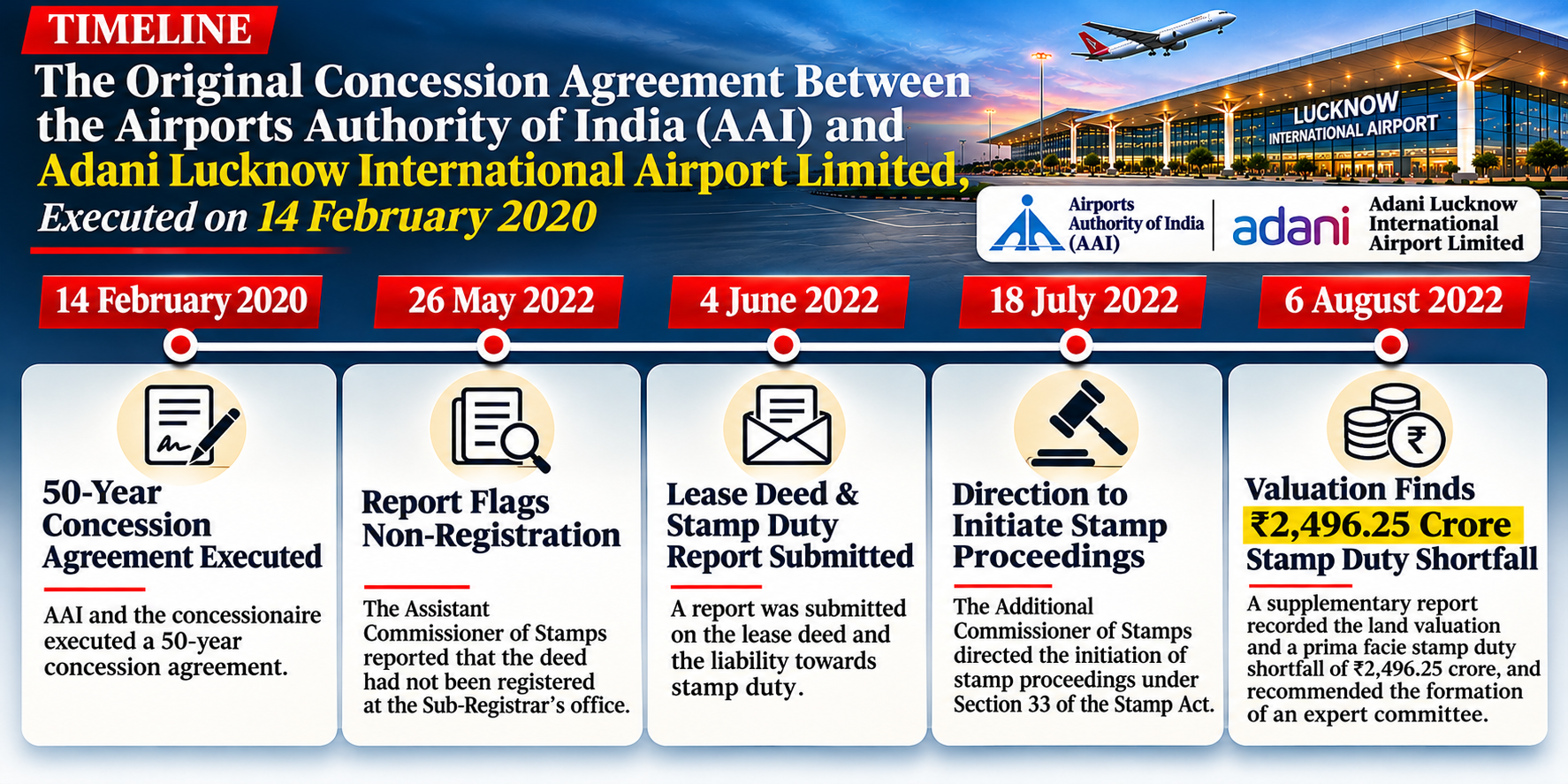
Timeline of the concession and stamp inquiry
| Date | What happened |
|---|---|
| 14 February 2020 | AAI and the concessionaire signed the 50-year agreement. |
| 26 May 2022 | The Assistant Commissioner of Stamps reported that the deed had not been registered at the Sub-Registrar’s office. |
| 4 June 2022 | A report assessed the deed and the potential stamp duty liability. |
| 18 July 2022 | The Additional Commissioner directed proceedings under Section 33. |
| 6 August 2022 | A supplementary report recorded a land valuation and recommended an expert committee. |
Land valuation and the question of ownership
The supplementary report dated August 6, 2022, further widened the scope of the investigation. Submitted to the Collector, Lucknow, by Satish Kumar Tripathi, Assistant Commissioner, Stamps (First), and Nirmal Singh, Sub-Registrar, Sarojini Nagar, the report presented a detailed account of the ownership and valuation of the land within the airport premises.
The report referred to a total land area of 1,018.835 hectares. In addition to 385.25 hectares owned by AAI, it included 229.15 acres of defence land and 31.440 hectares of land belonging to the Uttar Pradesh Government. This detail is particularly significant because it raises questions about the distinct government ownership of the land incorporated into the airport premises and the rights associated with each category of land. A detailed investigation by the Stamp Department brought another significant aspect of land ownership and valuation to light. According to the officials’ report, apart from the land owned by AAI, the airport premises also included land belonging to the Central Ministry and the Uttar Pradesh Government. This land was spread across approximately 1,200 Gata numbers in eight villages—Amausi, Farrukhabad, Chillawan, Behsa, Ibrahim-pur, Bhitakheda, Gudaura and Rahimabad.
The officials questioned why, despite such an extensive land area being included in the agreement, the relevant villages and land details were not clearly specified in the Concession Agreement. Based on the District Magistrate’s circle rate schedule, the total market value of the land was assessed at approximately ₹3,566.07 crore, and on this basis, a prima facie stamp duty shortfall of ₹249.63 crore was identified. The report also clarified that the valuation of airport buildings, constructions and other assets was still pending, for which the constitution of an expert committee was considered necessary.
Separately, another document records the Total Number of Khasra as 32. This is a distinct documentary detail and is not the same as the approximately 1,200 Gata numbers mentioned in the land-related records. This also raises the question of which permissions were obtained to include land separately owned by the Central and State Governments in the 50-year lease arrangement, and whether the ownership of the land, Lease Rights and commercial rights relating to City Side Development were appropriately assessed while determining stamp duty. A further important question arises here: When land belonging to the Central Ministry and the State Government was also mentioned alongside land owned by AAI, were the necessary ownership and transfer-related permissions available to include all these land parcels in the 50-year lease arrangement? Were the Khasra-wise records and complete ownership details of these lands placed before the valuation committee?
Stamp officials direct proceedings under Section 33
Following these objections and valuation reports from the Stamp Department, Ram Krishna Singh, Additional Commissioner, Stamps, Prayagraj, issued directions to the Assistant Commissioner, Stamps (First), Lucknow, on July 18, 2022, through Letter No. 2648. The letter explicitly stated that the contents of the relevant deed were in the nature of a lease deed. The letter stated that for a lease exceeding 30 years, stamp duty was payable on the basis of the consideration or the market value, whichever is higher, in accordance with Transfer Instrument (Serial No. 23), Clause (a). The Additional Commissioner also stated that the applicable stamp duty had not been paid. He directed that proceedings under Section 33 of the Indian Stamp Act, 1899, be initiated to ensure the institution of a stamp case. This direction was significant because the senior official did not merely call for an examination of the documents. He explicitly identified the nature of the deed as a lease, recorded a clear objection regarding the liability to pay stamp duty, and directed that corresponding legal proceedings be pursued.
How much land was leased, and who owned it?
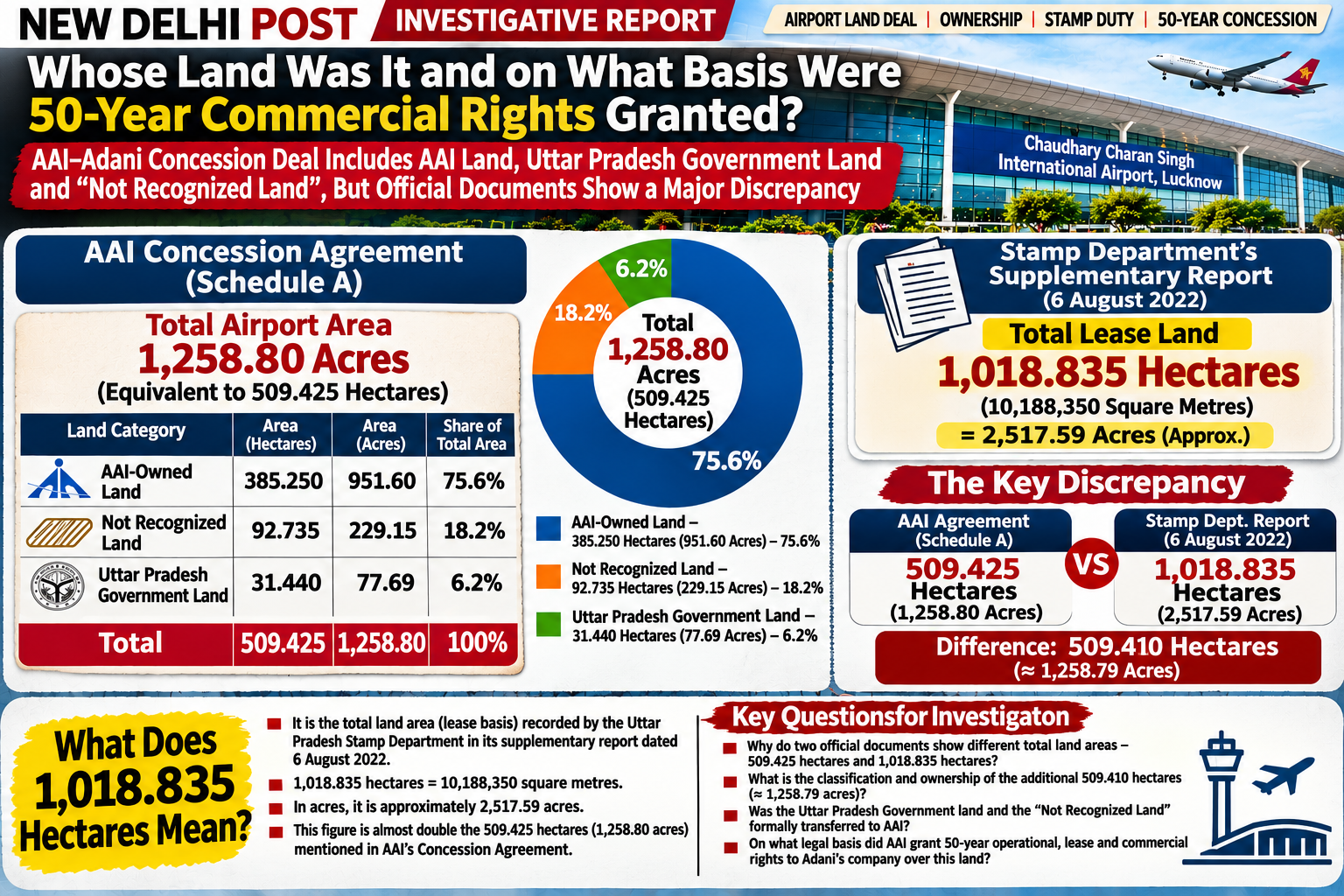
The issue in this entire matter is not limited to the potential shortfall in stamp duty. It also raises serious questions about the ownership, valuation and commercial usage rights over the land handed over for 50 years. According to Schedule A of the AAI Concession Agreement, a total of 1,258.80 acres (approximately 509.425 hectares) of land was allocated to the Adani Group company for the operation, management and development of Lucknow Airport. This included 385.250 hectares (951.60 acres) of land owned by AAI, 92.735 hectares (229.15 acres) described as defence land in Schedule A, and 31.440 hectares (77.69 acres) belonging to the Uttar Pradesh Government. In other words, AAI-owned land accounted for 75.6 per cent of the total area, defence land accounted for 18.2 per cent, and State Government land constituted 6.2 per cent.
However, the Stamp Department’s supplementary report dated August 6, 2022, recorded the total leased land as 1,018.835 hectares (approximately 2,517.59 acres). A comparison of the land-area figures in the two government documents reveals a discrepancy of 509.410 hectares (approximately 1,258.78 acres). This raises the question: Is this discrepancy merely a mathematical or clerical error, or does it include additional land whose actual owners or co-owners have not been identified in the AAI agreement? If this additional land was also part of the 50-year lease arrangement, who owned it, which authority had the legal power to lease it out, and on what basis was permission granted for its commercial use?
| Record | Area reported |
|---|---|
| AAI concession agreement, Schedule A | 1,258.80 acres (509.425 hectares) |
| Uttar Pradesh Stamp Department supplementary report, 6 August 2022 | 1,018.835 hectares (approximately 2,517.59 acres) |
| Difference | 509.410 hectares (approximately 1,258.78 acres) |
Furthermore, were the Khasra-wise revenue records, land classifications and complete details of all relevant landowners relating to the approximately 1,200 Gata numbers across the eight villages, along with the separate record showing a total of 32 Khasra, made available to the valuation committee? On what basis, then, will this substantial discrepancy in the land area and ownership recorded in two government documents ultimately be explained?
The Adani Group’s response
Following our detailed questionnaire concerning the airport concession agreements between the Airports Authority of India (AAI) and the Adani Group’s airport concessionaire companies, NEW DELHI POST received an official response from Mr. Mitul Thakkar, on behalf of an Adani Spokesperson.
In its response, the Adani Group maintained that the airports were awarded through an open and competitive bidding process and that the respective concession agreements were executed between AAI and airport-specific concessionaire companies. The company further clarified that Adani Airport Holdings Limited (AAHL) is not a party to these concession agreements.
The company also asserted that ownership of airport land continues to vest with AAI, while the concessionaires’ rights are restricted to the purposes and duration specified in the agreements. It maintained that City Side Development is undertaken only on earmarked land, subject to contractual restrictions and statutory approvals.
Regarding stamp duty and registration, the company stated that the respective concessionaires are dealing with these matters before the competent authorities in accordance with applicable law. On the issue of the Regulatory Asset Base (RAB), it stated that provisional figures were subject to reconciliation and final determination by the Airports Economic Regulatory Authority (AERA).
The Adani Group also declined to share certain contractual and business records, citing commercial confidentiality. It cautioned against publishing information that it considers unverified, selective or misleading and requested that its response be published in full and without distortion.
What remains unanswered?
NEW DELHI POST has taken the company’s response on record. However, several important questions raised in our investigation require specific documentary clarification.
Corporate Responsibility. While the company has clarified that AAHL is not a signatory to the concession agreements, the precise roles, responsibilities and relationships of the respective concessionaire companies within the Adani Group remain relevant to understanding the contractual and operational structure.
Stamp Duty and Registration. The company’s general assertion of compliance does not provide specific particulars of the stamp duty paid, registration details or the statutory basis for the amounts recorded in the relevant documents. These matters require examination against official records and applicable state laws.
Land Allocation and Utilisation. The company maintains that airport land ownership remains with AAI. However, the precise extent, classification, ownership status and utilisation of the land handed over under the concession agreements remain central to our investigation, particularly in relation to airport operations and City Side Development.
Regulatory Asset Base and Financial Arrangements. Although the company has referred to AERA’s regulatory process, the underlying figures, reconciliation and financial implications of the provisional Regulatory Asset Base require closer examination through relevant regulatory records.
Commercial Confidentiality and Public Accountability. NEW DELHI POST recognises that legitimate commercial confidentiality must be respected. However, the involvement of public assets, government authorities and long-term public-private concession arrangements makes transparency and accountability matters of legitimate public interest.
The editorial position
NEW DELHI POST reiterates that its investigation is based on documentary examination, official records and information obtained from relevant sources. The Adani Group was given an opportunity to present its position before publication, and its response has been duly considered.
We neither presume wrongdoing nor treat allegations as established facts without documentary and legal substantiation. Equally, a general assertion of compliance cannot substitute for specific answers to questions arising from official records and contractual documents.
The subject of this investigation goes beyond the commercial interests of any individual company. It concerns the management, utilisation and long-term contractual control of critical public infrastructure.
When public assets are placed under long-term private concessions, transparency is not merely a contractual formality; it is a matter of public accountability.
NEW DELHI POST will continue to examine the available documentary evidence and report further relevant developments in the public interest.