

“Fulauri bina chutney kaise bani?” now trending across social media and Insta Reels, through the Dhamaal 4 song, is a remarkable example of the migratory soul of Indian music. Completing a 150-year full circle, the Bhojpuri wedding folk song travelled to the Caribbean with indentured labourers, acquired local rhythms and became “Chutney Music” before emerging as a hit pop number in 1969. It has now returned home through a Bollywood remix in 2026.
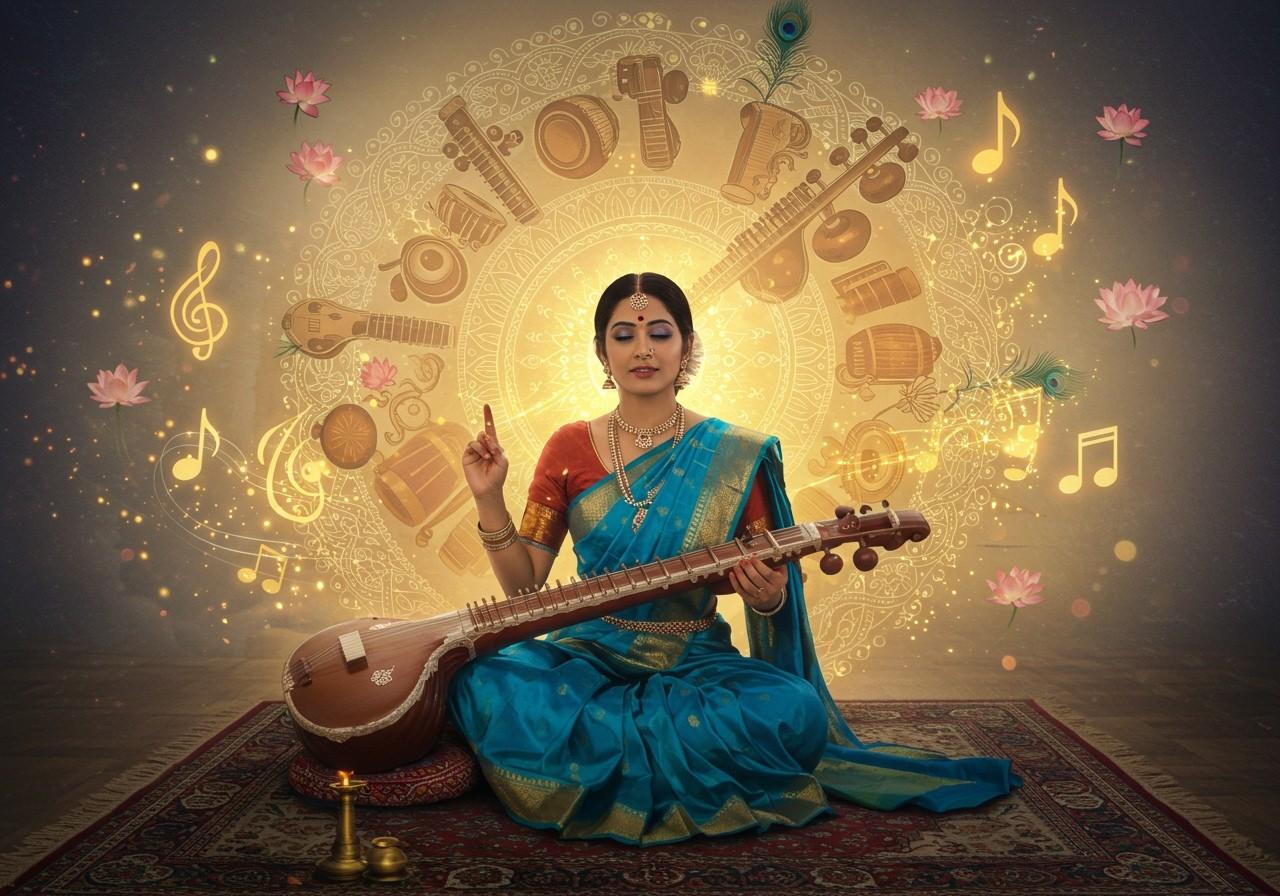
Music transcends borders and migrates across empires and epochs, carrying joy, memory, and resistance. Long before passports and digital streaming, music was already travelling: in the chants of monks, in the laments of refugees, and in the feet of wandering minstrels. Humanity’s most enduring and portable inheritance—music—carries a formidable legacy wherever it goes. And nowhere is this migratory soul of music more evident than in India, a civilisation shaped as much by sound as by script, as much by rhythm as by reason.
India’s musical heritage is as ancient and sacred as it is timeless. But that tells only half the story. The other half is one of flux, of movement, of continual reinvention. Music in India has always travelled—not just across geography, but across caste lines, languages, spiritual traditions, and political frontiers. The Vedic chants that once echoed through forest ashrams migrated orally through millennia, slowly metamorphosing into the intricate grammar of raga and tala in Indian classical music. But this was only the beginning.
With the arrival of Islamic dynasties in North India, particularly during the Delhi Sultanate and the Mughal Empire, came new instruments, ideas, and aesthetics. Persian maqams intertwined with Indian ragas; Arabic percussion traditions merged with the rhythms of the tabla. The very names of Indian instruments—sitar, sarod and shehnai—hint at their hybrid origins. Akbar’s legendary court musician, Tansen, composed melodies that echoed through the centuries, embodying the very idea of musical migration. He was not merely a performer; he was a cultural bridge.
The birth of khayal, qawwali and ghazal during this era reflected not just artistic evolution but civilisational fusion. The devotional intensity of the Bhakti movement met the mysticism of Sufism in compositions that traversed both temple and dargah. Music in India did not just travel across faiths—it dissolved the very notion of separation.
When European colonial powers arrived, they brought their own sounds. The Portuguese introduced the violin and choral harmonies to the shores of Goa, while the British brought the piano, military bands and Western scales. Yet, rather than displacing Indian traditions, these imports were absorbed, bent and reinterpreted. Churches in Tamil Nadu still echo with Carnatic-structured hymns. Indian film music, especially from the mid-20th century, borrowed liberally from jazz, swing, waltz and rock, embedding them into the DNA of Bollywood.
But the migration of music did not end with Empire. It intensified with the diaspora.
As Indian communities moved—first as indentured labourers to the Caribbean and Africa, then as economic migrants to the West—music travelled with them. Bhojpuri folk songs became “Chutney Music” in Trinidad. Bhangra, a Punjabi harvest dance, was transformed in the immigrant neighbourhoods of Birmingham and Vancouver into a club-ready global phenomenon. Generations born abroad used music to navigate their dual identities, fusing dhol beats with reggae basslines or rap verses, creating something entirely new yet deeply ancestral.
Meanwhile, within India’s own borders, internal migration from villages to cities created sonic collisions of another kind. Dalit protest poetry found a new avatar in the hip-hop of Mumbai’s slums. Folk forms such as Lavani and Baul, once confined to regional performances, found their way onto reality television and into indie music festivals. Even traditional ragas are now being reinterpreted on digital platforms with electronic loops, lo-fi beats and ambient textures, making them accessible to audiences from Kyoto to California. This is not dilution; it is expansion.
Today, a Rajasthani Manganiyar can be discovered by a Brazilian listener on Spotify. A Manipuri folk ballad may be remixed by a Berlin DJ. A Kashmiri lullaby might go viral on TikTok, its melody sampled in a global pop hit. In this digital age, music migrates not just through bodies, but through bandwidth.
And yet, amidst this constant transformation, Indian music remains rooted. The foundation of swaras, ragas and talas—the deeply spiritual grammar of Indian music—continues to undergird even its most contemporary expressions. It is what allows an EDM producer to evoke the feeling of monsoon longing, or a jazz saxophonist in Brooklyn to riff on Raga Yaman without losing its soul. A qawwal in Pakistan sings of Kanhaiya, and the Insta generation in India is embracing “bhajan clubbing”.
Music in India has survived invasions, colonialism, Partition and modernisation—not by resisting movement, but by mastering it. At a time when borders are being hardened and cultural identities are being policed, music reminds us of a deeper truth: beauty lies in movement. Tradition and change are not adversaries but partners.
To speak of the migration of music is, in truth, to speak of the migration of people—of longing, belonging, loss and celebration. And in India, a nation of many tongues and timeless journeys, music remains the most honest expression of who we are: never fixed, always becoming.