

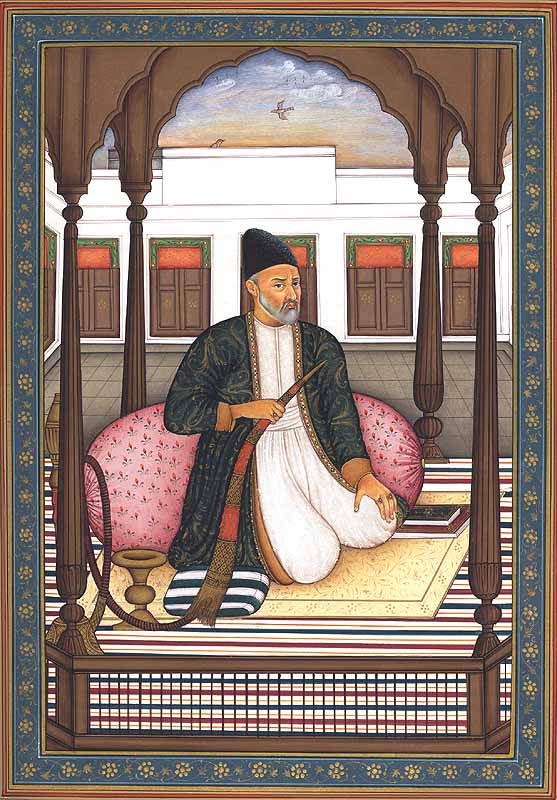
There is a curious paradox unfolding across the Indian subcontinent. Even as Urdu struggles for institutional space in schools, universities and public life, the popularity of its greatest poet continues to soar. Mirza Asadullah Khan Ghalib is today quoted on social media, recited at literary festivals, translated into dozens of languages and celebrated by readers, many of whom cannot even read the Urdu script. Digital platforms, translations and cultural initiatives have ensured that while the language faces challenges, its most celebrated voice continues to find new audiences across generations.
That enduring appeal says as much about Ghalib as it does about great literature. Truly great poetry transcends language, geography and time. It speaks to the human condition in ways that remain relevant regardless of the era. If one were to compile a list of the world’s greatest poets, it would undoubtedly be incomplete without the mention of Mirza Asadullah Khan Ghalib. He stands shoulder to shoulder with the finest poets the world has produced, and, by some measures, perhaps even a notch above many of them.
As the eminent poet and critic Ali Sardar Jafri observed in his introduction to Deewan-e-Ghalib, Ghalib’s genius lay not merely in breaking the conventions of his age or reflecting its restlessness, but in creating poetry that continues to resonate centuries later. His verse captures questions that remain as compelling today as they were in the nineteenth century.
The Deewan opens with the thought-provoking couplet:
Naqsh fariyadi hai kiski shokhi-e-tahreer ka
Kaaghazi hai pairahan har paikar-e-tasveer ka.
From the very first page, Ghalib invites readers to question reality itself. As one turns the pages of the Deewan, one encounters verse after verse that probes existence, destiny and the mysteries of life. His poetry refuses to offer simplistic answers. Instead, it compels readers to think, reflect and return to his words repeatedly, discovering new meanings with every reading.
That perhaps explains why Ghalib remains remarkably contemporary. Readers who know little about nineteenth-century Delhi still find themselves moved by his reflections on love, loss, longing and mortality. His poetry survives not because it belongs to a particular language, but because it speaks to universal emotions.
Ghalib embraced every shade of life rather than painting it in stark black and white. His poetry surges with a sea of human emotions, each couplet unfolding into a philosophy of its own. Idealism, mysticism, realism, rationalism and scepticism coexist naturally within his poetic universe. Few poets have managed to reconcile such diverse intellectual traditions with such effortless elegance.
He transformed the traditional ghazal into something far richer than an expression of romantic longing. In Ghalib’s hands, it became a compact yet profound medium through which life’s contradictions, doubts, desires and discoveries could coexist without conflict. His Deewan reflects the astonishing range of his genius. At one moment, he draws the reader into profound philosophical contemplation; at another, he delights in flights of imagination with the curiosity and playfulness of a child.
His ghazals contain joy, irony, surprise, grief and hope in equal measure. They are perhaps also a reflection of his own troubled life, marked by personal loss, financial hardship and emotional anguish. That sadness quietly permeates many of his finest verses:
Gham-e-hasti ka Asad kis se ho juz marg-e-ilaaj
Shama har rang mein jalti hai seher hone tak.
It is this poignant understanding of suffering that continues to touch readers across generations. Ghalib never romanticised pain, yet he recognised it as an inseparable part of human existence. His poetry consoles without preaching and questions without despair.
As he himself wrote:
Kehta hai kaun naala-e-bulbul ko be-asar
Parde mein gul ke jigar chaak ho gaye.
Beyond life, love, beauty and mysticism, another profound theme runs through Ghalib’s poetry—death. Yet he approaches mortality not with fear but with philosophical acceptance. Death becomes another dimension of existence, another mystery to contemplate rather than merely mourn.
His celebrated couplet captures this outlook with remarkable simplicity:
Ishrat-e-qatra hai dariya mein fanaa ho jaana
Dard ka had se guzarna hai dawa ho jaana.
There is extraordinary wisdom in these lines. Individual existence finds fulfilment in becoming part of something larger, just as unbearable suffering can ultimately transform into healing. Such reflections reveal why Ghalib is regarded not merely as a poet of romance but also as one of the greatest philosophical voices in world literature.
Yet it would be a mistake to imagine Ghalib solely as a sombre thinker. Alongside the philosopher stood a man of wit, warmth and exuberance. His personality sparkles through many of his ghazals, reminding us that he was equally capable of celebrating love with unmatched intensity. Few poets have captured the ecstasy, vulnerability and contradictions of love with such emotional honesty.
Perhaps that is why his romantic poetry has travelled so effortlessly across languages and cultures. Lovers continue to borrow his words because they express feelings that ordinary language often cannot. As he wrote:
Ishq se tabiyat ne zeest ka maza paaya
Dard ki dawa payi, dard la-dawa paaya.
Today, many of those who quote these immortal verses encounter them not in the elegant Nastaliq script but in Devanagari, Roman transliteration or English translation. That, too, is part of Ghalib’s remarkable journey. While Urdu may be facing difficult questions about its place in contemporary public life, Ghalib has escaped the boundaries of script and language. His poetry now belongs as much to the world as it does to Urdu.
That is the enduring paradox of our times. Languages may lose institutional ground, curricula may change, and scripts may become unfamiliar to younger generations. Yet true literary genius refuses to fade. Every age discovers its own Ghalib because every age grapples with the same questions of love, loss, mortality, hope and meaning.
Urdu may be shrinking in some spaces, but Ghalib continues to grow. And perhaps that is the ultimate triumph of great literature: while languages evolve and societies transform, the greatest poets remain timeless.