


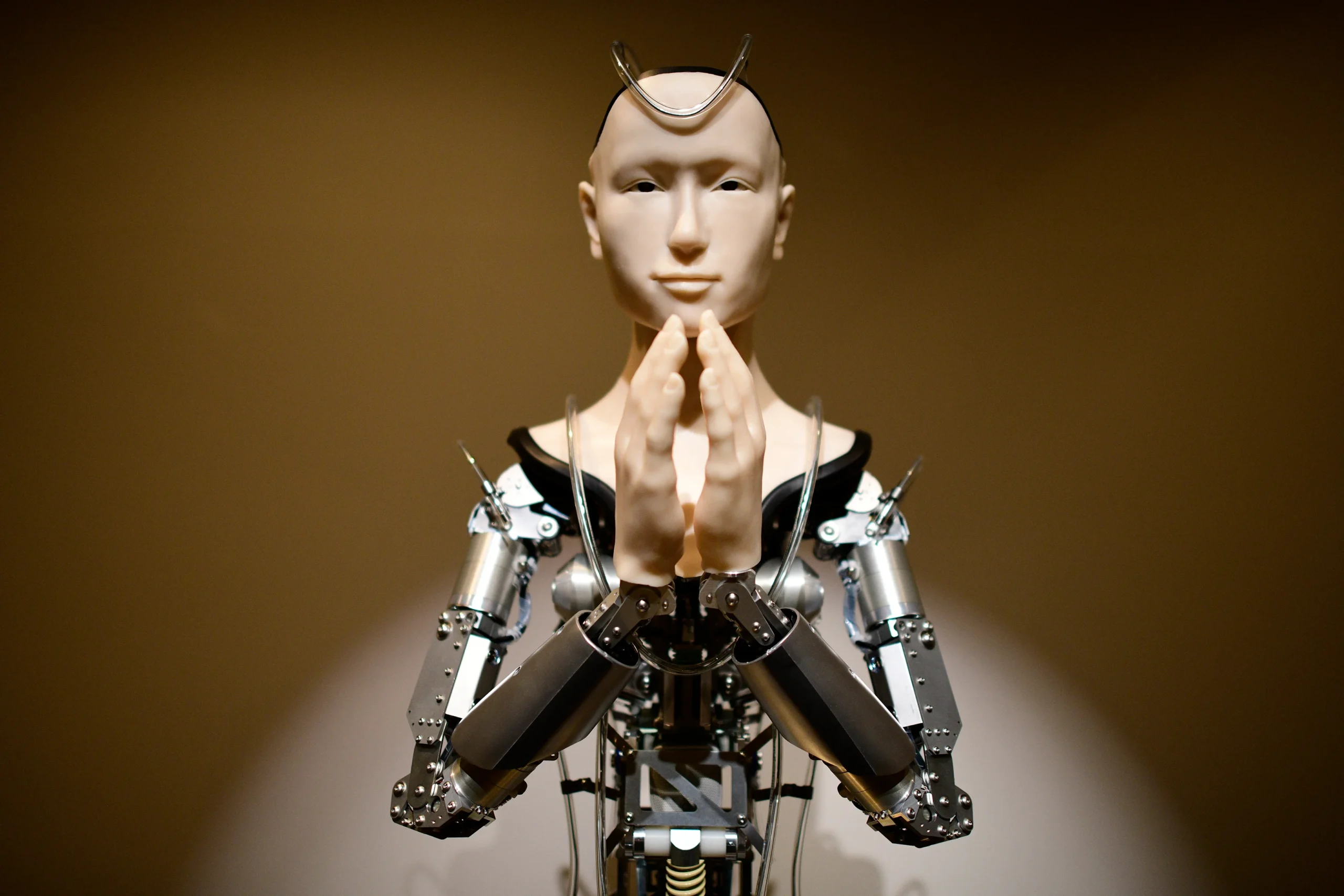
Robots are entering temples, raising a question: can machines perform faith?
Imagine attending a religious ceremony where a robot performs the puja. It lights the lamps, recites the aarti perfectly and distributes the prasad. There is no faltering or hesitation. The robot priest neither asks for money nor a donation, and performs the ceremony efficiently and quickly.
Is this fantasy? Certainly not. It is already becoming a reality in parts of India. As early as 2017, a technology expert developed a robotic arm to perform aarti, in which an oil lamp is offered to the deity to symbolise the removal of darkness. The robot performed during Pune’s Lord Ganesh festival, which attracts millions of devotees. Since then, several prototypes have been developed to perform religious rituals, signalling AI’s entry into the realm of religion.
On October 23, 2023, The Hindu reported that a robot performed Ayudha Puja, or worship of hardware, at the Vellore Institute of Technology. Students and faculty used a six-axis robot for the celebrations, with one robot performing the aarti and another distributing prasad. Robots were subsequently used for teaching students as well.
YouTube has also reported a robot priest performing Ganesh Puja in Shivapuravadi, Belagavi district in Karnataka. Designed by young innovator Saurabh Khote, the robot was built from scrap materials and modern technology. Villagers gathered for nearly six hours to watch it conduct the rituals. These examples suggest that the combination of technology and tradition is moving beyond isolated experiments.
The phenomenon is global. At Kyoto’s 400-year-old Kodaiji Temple in Japan, worshippers have encountered Mindar, a life-size robot monk that delivers sermons on the Heart Sutra. With a metallic body and synthetic skin, Mindar presents an ancient Buddhist teaching through technology rather than a monk of flesh and blood, according to AI Godmen and Robotic Rituals. Religious institutions elsewhere are also experimenting with machines for prayers, blessings and other religious functions. In 2017, Protestant churches in Germany used a robot to bless congregations.
Japan, facing a shortage of religious personnel, has increasingly turned to automation and robotics. “Robots don’t tire, they don’t err, they don’t demand salaries or scandalise congregations,” says Dr Thomas Arnold, a theologian at Heidelberg University. Their ability to repeat rituals precisely, he argues, can matter in traditions that emphasise accuracy.
In some ways, automation is not entirely new to religion. Faiths have long embraced technology and mechanical aids, from Tibetan prayer wheels to smartphone apps reminding Muslims to pray. Robot priests are simply a more dramatic extension of this relationship between technology and worship.
The larger question is whether devotees will accept machines performing religious ceremonies. India is deeply religious, and worshippers often expect rituals to be conducted according to established traditions. At the same time, the priestly class faces a growing problem: younger generations are less inclined to enter the profession than in the past. Automation and robotics may therefore have to fill part of the gap.
At the Shirdi Sai Baba temple, one of India’s busiest pilgrimage sites, automation has already been introduced to manage crowds and aspects of temple operations. Priests acknowledge that human mediation remains essential, even as technology moves closer to the heart of worship.
The debate is unlikely to end soon. Some devotees argue that divinity transcends the medium. So, whether the lamp is rotated by a priest or a machine, the offering remains an offering to the deity. Others fear that mechanisation strips rituals of their emotional and spiritual core, turning worship into spectacle. Whatever the outcome, AI-driven changes may be here to stay, and devotees may gradually adapt to new ways of worship.

