

Why a world obsessed with immediate results is forgetting the power of pure thought
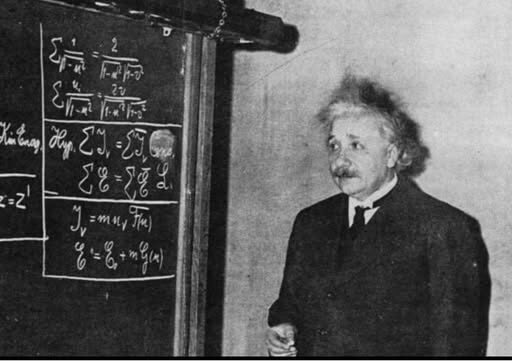
Beats us – the idea of making America great again, but this time without the ingredients that made America great in the first place: the immigration of ideas and the return on investment in those ideas. Even the American representative of kung fu (strangely, a panda who speaks in an American accent) knows there is no secret ingredient to awesomeness. The American nuclear might, for example, was a consequence of pure thought: E = mc2 originated in the mind of an immigrant from Germany. In the aggregate, the USA could eventually put a man on the moon because the scientific enterprise openly embraced ideas that travelled from everywhere.
The proportion of foreign students enrolled in the top universities in the USA provided a testament to this greatness. America became awesome because it invited (and nurtured) ideas and not forms of perfidy – the latter has unfortunately become a commonly held sentiment of the average American today who has mostly steered clear of tertiary education. Today, education is driven by immediate objectives to the extent that even the scientific enterprise is trammelled, and we are blindly mimicking this objective-driven model of education to make way for the miasma of intellectual deficiency when in fact, this is an open window of opportunity to achieve scientific dominance – something China has already realised: Trumps us … when it clearly shouldn’t!
He who promotes the market logic to rank disciplines by employability will likely wonder for instance: what’s the point of a globe? Images from space probes looking back at our planet reveal no political boundaries. Any globe is therefore, at best, a coloured representation of an otherwise pale blue object. That the Earth could fit well in a child’s embrace is an abstraction of a fairly high magnitude; if a globe conveniently abstracts away from the basic reality that our planet has a diameter of over twelve thousand kilometres, how are we to trust any prescience that the globe offers? Perhaps, our knowledge that the Earth isn’t that small is enough to dispel the very idea that a globe could be useful at all – one cannot even use a globe to find the nearest stationery shop.
Sadly, almost all criticism of theory essentially retains the flavour of these lines above. One with even the most basic sense of direction and the ability to read maps will immediately see through the series of non-sequiturs in the previous paragraph and consequently feel qualified to dismiss the criticisms as cretinous. It is true that the globe misses capturing important realities of the planet but remains useful in informing, say, the German child planning his first visit to Italy that he should travel south. That alone holds value for the prescience of a child who hasn’t yet travelled to Italy. The globe has helped us navigate beyond the infancy of our species, and we are still learning.
Our world’s obsession with immediate impact demonstrates a skewed preference for application and, in consequence, has transformed our thinking to the point where any form of theory is anathema. They ask: What good is thought without action? It is time we responded with a counterquestion: What good is action without thought? This counterquestion naturally arises in response to the ever-dwindling resources dedicated to the pure sciences, including pure mathematics, fields driven by pure thought that consequently allow for endless possibilities in several directions if and when not restricted by predefined objectives.
This is not a call against laziness; the most elegant mathematical short-cuts are often known to have come from those who wished to avoid lengthy chains of thought. But while a lazy mind has been recognised (even among scientists) to be effective at inventing ideas, it isn’t necessarily as good at understanding them. It is the laziness of the latter kind that explains dwindling resources in theoretical physics and pure mathematics. Far from being a remonstrance by the scientific enterprise, this is just a friendly reminder to emphasise pure thought in education. Theory is exactly that, a roadmap for thought, a blueprint for ideas. The ineluctable reality (that cutting funds for pure sciences is equivalent to killing new ideas) will likely obtrude in the immediate future, in the form of a stultified global posterity.
Perhaps the word “theory” has lost its lustre – even religious apologists dismiss evolution as “just a theory”. What is misunderstood here is that Darwin’s idea of natural selection is a theory that explains an observable fact – that fact is evolution. This misunderstanding isn’t significantly different from a display of scientific prowess by flat-earthers who show intransigence to new ideas, and flat-earthers may just be a consequence of the cuts in scientific funding. The attack on theory is somewhat ironically religious. After all, it is plain as day that one who is uncomfortable with theory has no right to be religious!