

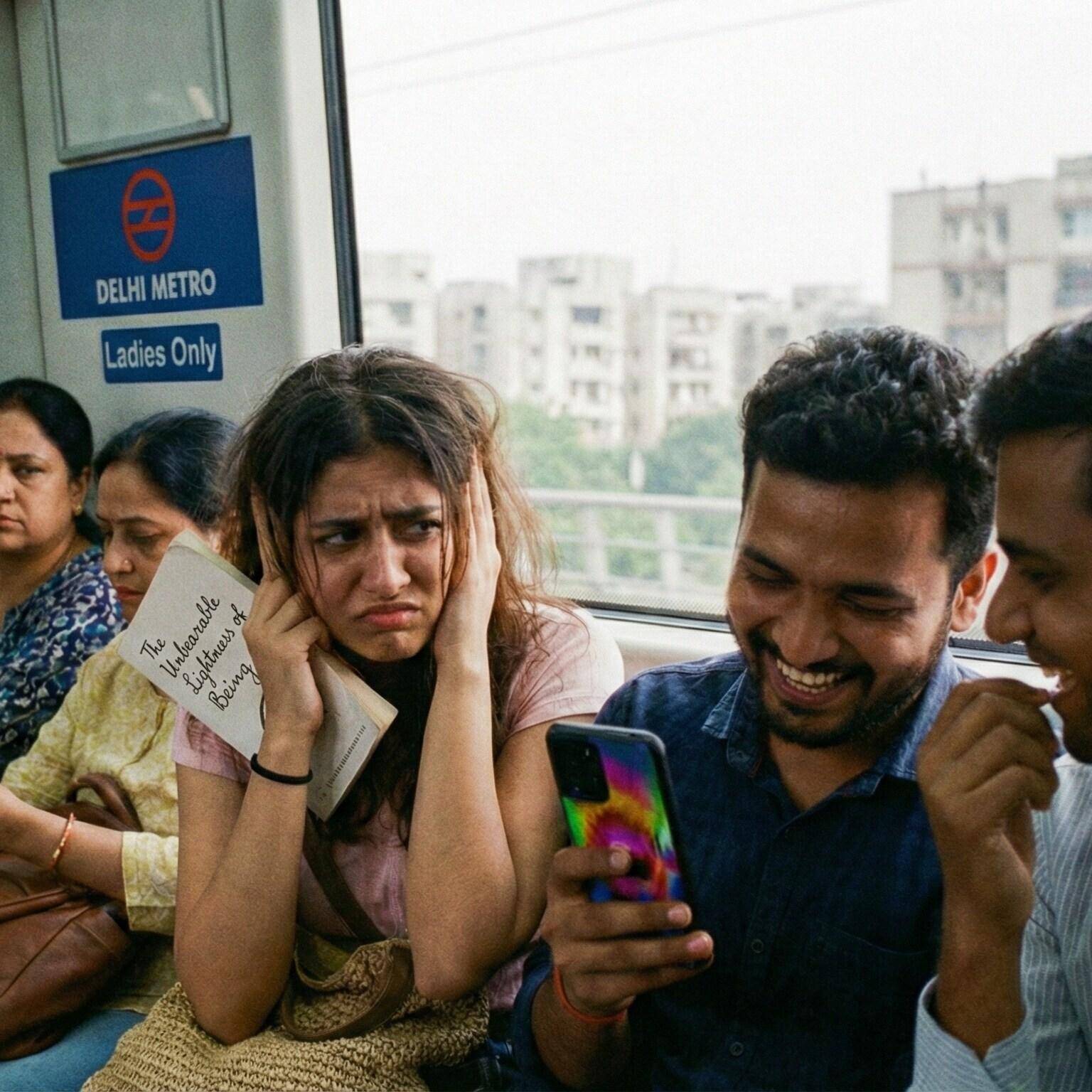
In an age of constant connectivity, the greatest courtesy may simply be giving the people around us our full attention
A hospital waiting room is rarely a cheerful place. People sit quietly, waiting for test results, worrying about loved ones, or simply gathering their thoughts. In one corner, an elderly woman closes her eyes, hoping for a few moments of calm before her name is called.
The silence is suddenly broken. A young man answers a video call on loudspeaker and launches into a spirited discussion about a delayed weekend delivery. For the next several minutes, everyone in the room is forced to listen. When the elderly woman politely asks him to lower the volume, he looks genuinely puzzled. “I’m just taking a call,” he replies.
That response perfectly captures one of the defining social shifts of the smartphone age. Many of us no longer realise when our digital lives spill into other people’s physical space. From hospital waiting rooms and libraries to buses, restaurants and airports, public spaces are becoming progressively noisier—not because people are talking more, but because smartphones have quietly changed our understanding of what is acceptable behaviour.
The irony is striking. The device designed to connect us is often making us less aware of the people standing right beside us. Good phone etiquette is therefore not about resisting technology. It is about restoring consideration.
Public spaces are shared spaces
The simplest rule is also the one most frequently ignored: your phone should not become everyone else’s phone. Whether you are commuting, waiting in a queue or sitting in a cafe, remember that every public space is shared with strangers who have not volunteered to become part of your conversation. A few simple habits make a significant difference:
- Avoid speakerphone in public. Unless you are alone in a private room, keep conversations to your ear or use headphones.
- Mute entertainment. Reels, games, videos and music should never become background noise for everyone else. Earbuds exist for a reason.
- Keep your voice down. Modern smartphones have highly sensitive microphones. There is no need to shout.
- Silence unnecessary alerts. Loud ringtones, notification pings and message tones quickly become noise pollution in hospitals, restaurants, classrooms and public transport.
- Step away for important calls. If the conversation cannot wait, excuse yourself and move a short distance away.
- Lower screen brightness. In theatres, auditoriums, flights or late-night public transport, an overly bright screen distracts everyone nearby.
These are not rigid rules. They are small acts of respect that make public spaces more pleasant for everyone.
When people deserve your full attention
Poor phone manners are not confined to public places. Many of us have become accustomed to dividing our attention between the person sitting across the table and the screen resting beside our plate. That habit sends a clear message: someone else, or something else, may be more important than the conversation taking place right now. A few changes can dramatically improve face-to-face interactions.
- Keep the phone out of sight. Simply placing it face down on the table still signals that the next notification could interrupt the conversation. A pocket or bag is better.
- Stop “phone snubbing”. Reading messages while someone is speaking is discourteous, whether at work or at home.
- Remove your earbuds when speaking to people. Leaving one earbud in while ordering coffee or talking to a colleague suggests you are only half-listening.
- Warn people if you expect an urgent call. A simple explanation—”I’m expecting a call from the doctor”—prevents misunderstandings if you need to step away.
- Ask before taking photographs or videos. Not everyone wants to appear online. Consent matters offline as much as it does online.
- Know when phones should disappear completely. Religious ceremonies, formal presentations, examinations and memorial services deserve undivided attention.
Good manners matter online too
Digital etiquette extends far beyond voice calls. How we communicate electronically can either strengthen relationships or quietly damage them. Some simple habits can prevent unnecessary friction.
- Text before calling unless the matter is genuinely urgent. People may be working, travelling or with family.
- Don’t keep calling repeatedly. One missed call is enough. If it is an emergency, call again immediately or send a brief message explaining the urgency.
- Never spring a video call on someone. A quick text asking if they are available is far more considerate.
- Use voice notes wisely. They work well for personal stories and emotion, but addresses, meeting times and instructions belong in text, where they can be searched later.
- Never forward private voice notes or personal messages without permission.
- If someone is on speakerphone, tell them immediately. Everyone deserves to know who can hear the conversation.
- Respect personal time. Avoid routine work calls or messages late at night, early in the morning or during family meal times unless the matter cannot wait.
- Introduce yourself when contacting a new number. Never assume people recognise your phone number.
- Don’t hijack group chats. Endless memes, forwards and private conversations belong elsewhere.
Technology needs etiquette
Smartphones have become our cameras, maps, wallets, offices and entertainment centres. They are among the most useful inventions of modern times. But every technological revolution requires a matching evolution in social behaviour.
Seat belts became normal. Queueing became normal. Keeping music to ourselves through headphones became normal. Phone etiquette deserves the same status. The issue is not merely of technology. It is awareness.
Every time we lower the volume, silence a notification, step away to take a call or put the phone aside during a conversation, we remind ourselves that courtesy remains one of civilisation’s simplest and most valuable qualities. In a world overflowing with signals, notifications and endless digital noise, perhaps the greatest mark of respect is also the rarest: being fully present for the people around us.