

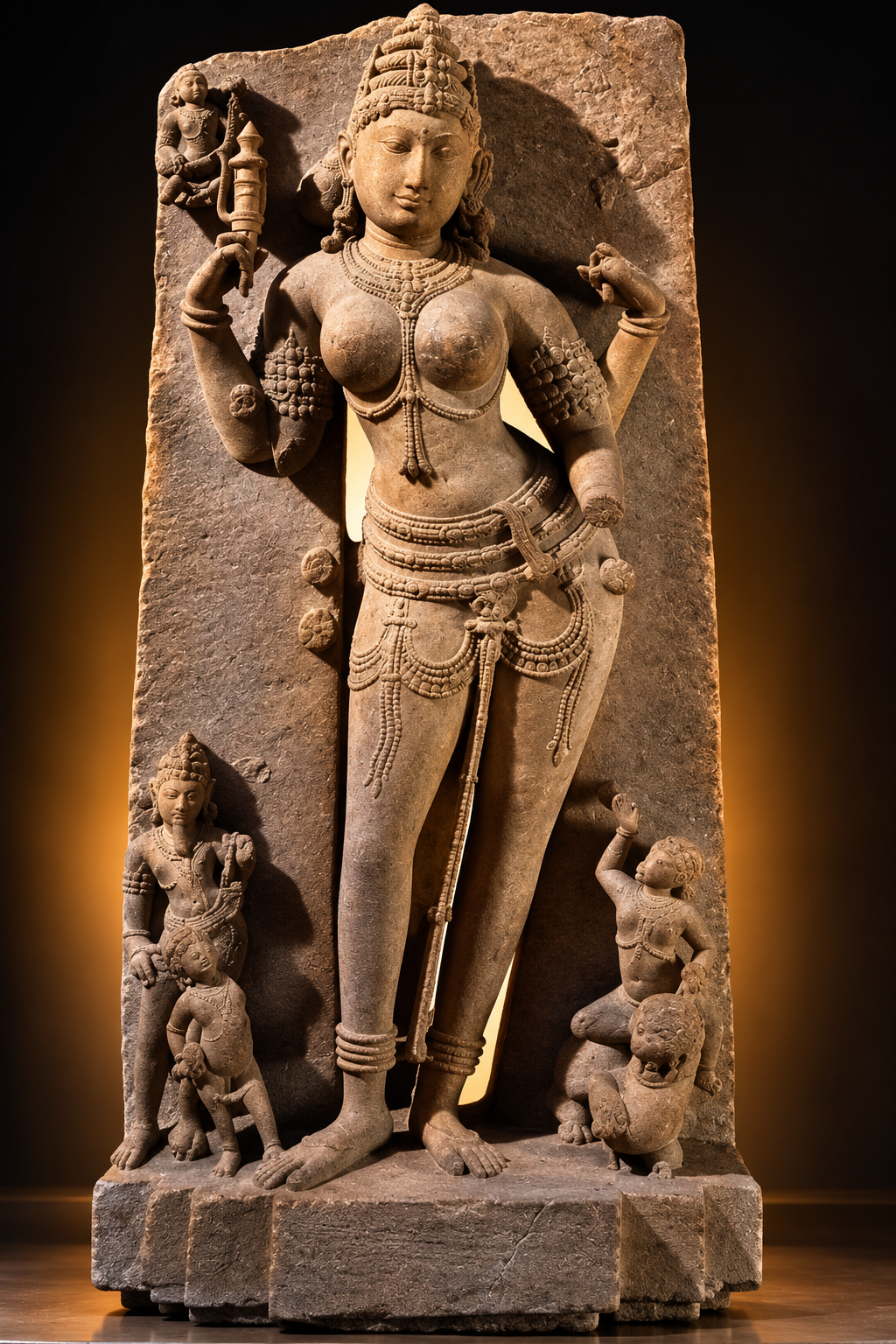
In August this year, the historic city of Bhopal, once the seat of the legendary King Bhoja, became the stage for a significant moment in contemporary international relations. As delegates gathered for the 11th BRICS Culture Ministers’ Meeting, the conversation shifted from generic cooperation to the tangible weight of a 250 kg marble sculpture currently housed in London. On August 8, 2026, the adoption of the Bhopal Declaration formally identified “provenance research” and the restitution of cultural property as central pillars of institutional cooperation among member nations. This diplomatic initiative has brought the Vagdevi idol, an 11th-century masterpiece of the Paramara period, into the evolving diplomacy between India and the United Kingdom.
The central question raised by this development is not merely why India wants the idol back, but what its journey reveals about the growing role of cultural heritage in international diplomacy. The Vagdevi case demonstrates that historical objects can become contested ground on which states negotiate questions of legal ownership, colonial responsibility, and national identity.
A Masterpiece in Marble
The sculpture is a four-armed female figure carved from coarse white marble, standing approximately 1.28 metres tall. The four-line inscription on its pedestal provides a specific production date: Samvat 1091, which corresponds to 1034–35 AD. The text identifies the creator as the artist Manathala, son of Sahira, and the scribe as Sivadeva, working under the patronage of Vararuci, a high-ranking religious superintendent.
While the sculpture is popularly known across India as Vagdevi (Goddess Saraswati), the patron deity of learning, its identity is a subject of intense scholarly investigation. Since 1981, art historians have argued that the figure’s physical features align more closely with the Jain goddess Ambika, the guardian deity of the 22nd Tirthankara, Neminatha. The sculpture features a lion mount, and the goddess holds an ankusha (elephant goad), which corresponds to characteristics of Ambika rather than the Saraswati imagery, which typically features a goose. Furthermore, she is flanked by two small children, identified in Jain lore as Subhamkara and Priyamkara.
Despite these academic distinctions, the idol possesses what scholars call a “romantic aura”. For the local population in Dhar, she represents the “living deity” of the Bhojshala, an ancient centre of learning built by King Bhoja, the most celebrated ruler of the Paramara dynasty of Malwa. The absence of the Vagdevi idol is experienced not just as a property loss, but as a profound “spiritual injury” to the community’s collective identity. This human connection is so strong that devotees in Dhar (Madhya Pradesh) have recently installed a replica of the idol at the Bhojshala site to conduct daily rituals while they wait for the original’s return.
Journey to Britain
The path from the ruins of Malwa to the galleries of the British Museum is rooted in the colonial history of the period. In 1875, as the old city palace in Dhar was being rebuilt, the sculpture was discovered in the debris. It was recovered under the supervision of Major General William Kincaid, a British officer stationed in the region who was deeply interested in local history and folklore.
The idol was removed from Dhar and shipped to England in 1886. It was formally acquired by the British Museum in 1909. For decades, it was cataloged as a mere archaeological specimen. It was not until 1924 that scholars O C Gangoly and K.N. Dikshit published the first major research identifying the sculpture as “Bhoja’s Saraswati,” thereby connecting its status as an object of immense national and cultural importance for India.
Impetus for Repatriation
The demand for the idol’s return has gained significant momentum following a landmark judicial decision. On May 15, 2026, the Indore Bench of the Madhya Pradesh High Court declared the Bhojshala Kamal Maula complex to be a temple of Goddess Saraswati, noting that the religious character of the site had never been extinguished. Crucially, the court directed the Union government to evaluate representations for the idol’s return from London.
This legal mandate aligns with a broader shift in Indian policy. Union Culture Secretary Vivek Aggarwal confirmed that the government has been actively pursuing the idol’s repatriation since approximately August 2025. This effort is part of a larger campaign that has seen more than 650 artefacts returned to India during the last decade. High-profile repatriations, such as the Chola-era Leiden Copper Plates returned by the Netherlands on May 16, 2026, have provided a successful model for this approach to heritage diplomacy.
Diplomatic Significance
The Vagdevi idol illustrates why repatriation is no longer merely a museum issue but a matter of statecraft.
First, it highlights the clash of legal regimes. The British Museum Act legally prohibits the permanent “deaccessioning” of items from the national collection, leading the museum to offer only short-term loans of up to three years. On the other hand, India increasingly views such heritage as inalienable sovereign property that belongs at its original site, particularly when judicial rulings affirm its religious character.
Second, the case addresses historical responsibility. India’s approach, as articulated by Minister of Culture Gajendra Singh Shekhawat, frames the return of these objects as the restoration of a “broken religious and cultural relationship” and a correction of colonial-era extraction. By raising the issue through the BRICS platform, India is moving the conversation beyond a bilateral dispute with the UK. It is positioning itself as a leader of the Global South in a collective effort to reclaim heritage lost to the “Imperial Project.” The Bhopal Declaration’s emphasis on “provenance research” signals that former colonies are no longer content to let Western museums be the sole arbiters of historical truth.
Finally, the idol reveals how cultural ownership impacts bilateral relations. While the UK and India signed a Programme of Cultural Cooperation (2025–2030) on May 2, 2025, to explore “shared access,” the Vagdevi case remains a friction point. For Britain, the museum acts as a universal guardian. For India, the idol’s presence in London is a lingering symbol of colonial dispossession.
Objects as Diplomats
The journey of the Vagdevi idol, from the debris of an 11th-century palace to a 21st-century diplomatic summit, highlights how historical objects can continue to influence relationships between states long after the political circumstances of their removal have changed.
The Vagdevi idol reveals that cultural heritage has become a “global public good” that requires active negotiation between the rights of communities and the laws of institutions. As India continues to rise as a global power, its demand for the return of its heritage is no longer an administrative request but a test of diplomatic resilience. Whether the idol returns to Dhar or remains in London, its most significant role in 2026 has already been performed: it has forced the modern world to confront the unfinished business of its colonial past.