


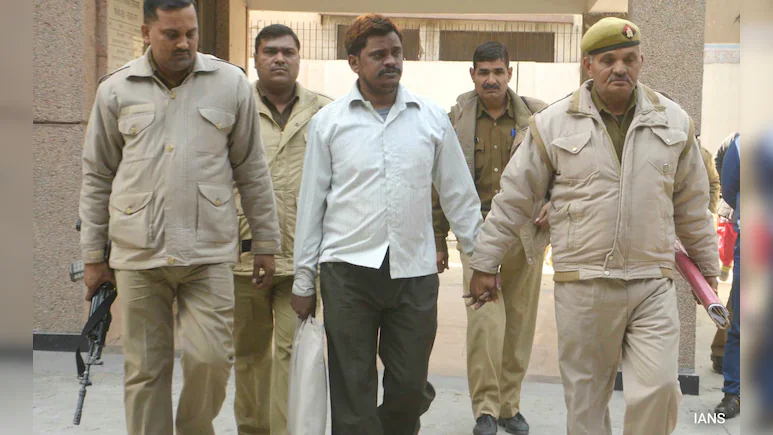
Nearly two decades later, the death of Surendra Koli, the most talked-about name in the infamous Nithari case, in Haridwar on Friday has reopened several old pages of the story. On one side is the conclusion of the courts: the prosecution failed to prove its case against Koli and Moninder Singh Pandher, the owner of the premises where the gruesome incidents took place, beyond reasonable doubt. On the other hand is the question that continues to haunt the families of the victims: if the two were not the killers, then where exactly did those children and girls go? Perhaps that remains the biggest unanswered question of the Nithari case.
The Disappearance That No One Seemed to Notice
It was 2005-06. At the time, I was with Rajasthan Patrika and regularly visited Noida’s Sector 20 police station and the SSP’s office, particularly for my reporting. Children and girls were disappearing one by one from the slums behind Kothi D-5 in Nithari.
During a court appearance in Ghaziabad in connection with my reporting, I met Surendra Koli. I wanted to investigate the Nithari case with Koli: who had killed more than 22 girls in Nithari, and why? Amid this series of questions and answers, I asked Koli: “You will be hanged, so tell the truth. Who committed these murders and why?” Koli replied: “My master did not kill them. He has been falsely implicated. I do not consider him guilty.” He then said to me: “I will not be hanged, I will not die by hanging.” At the time, I did not know that years later these utterances would become the strangest part of this story before me.
‘I Will Not Die By Hanging’
Surendra Koli was a devotee of Hanuman. He believed that Hanuman would save him. To my knowledge, on the date fixed for his hanging, he would observe a fast in jail and smear his entire body with ash. Preparations for the hanging would be made and then, suddenly, a court order would arrive.
In September 2014, his hanging had been scheduled and he had been taken to Meerut jail, but a few hours before the hanging, the Supreme Court stayed the execution. Later, his death sentence was commuted to life imprisonment. The man who had told me, “I will not be hanged,” indeed he did not die by the government noose.
Organ Trade Theory
During this period, I met a team of lawyers representing Moninder Singh Pandher at a society in Delhi’s Daryaganj. They said that Pandher and Koli were both innocent and that the disappearance and killing of the children could be linked to the trafficking of human organs.
I asked them for evidence. I asked: was there any scientific evidence? Was there any post-mortem report showing that kidneys, liver or other organs were missing from the recovered skeletons? Pandher’s lawyers could not provide me with any conclusive evidence. Their argument was: why would anyone kill someone and throw the body behind his own house? But for me, an argument alone was not enough to establish a story. So I dropped the story at the time.
The Pages of My Diary
I now open the opening pages of the Nithari case recorded in my diary. These pages make clear how the Noida Police allowed the killing of more than two dozen girls to continue through negligence and how, until the case suddenly came to light, the Noida Police had not registered any FIR over the disappearance of these girls.
I remember that on one occasion, parents from the Nithari slums went to Sector 20 police station to lodge reports, but many families said they were sent back with the explanation that girls run away. At the time, Kamal Yadav was the SHO of Sector-20 police station.
In the same sequence of events, several victim families from the Nithari slums once reached the residence of SSP Piyush Mordia. Before they could meet the SSP, the SSP’s PRO informed Kamal Yadav that a crowd had come from Nithari with a complaint against him. Kamal Yadav immediately reached the SSP’s residence and took the families standing outside to the police station in a vehicle, telling them: “Come to the police station, we will register your FIR.”
But, according to my recollection, even after that, an FIR was not registered in the manner those families expected, and the disappearance of children continued.
The Girl Named Payal
Meanwhile, social worker Usha Thakur, who lived near Nithari, reached the SSP’s residence. She had come with a complaint about the disappearance of a 14-15-year-old girl. She was unable to meet the SSP.
I sent a message to Piyush Mordia saying that I needed to meet him urgently. Mordia agreed. Usha Thakur gave him information about the girl’s disappearance. Mordia said that he would speak to the police station and take action.
After she left, Mordia told me: “Ashish, these girls run away; there do not appear to be facts suggesting any other serious crime in this matter.” I said: “Sir, if the girl is below 18, at least a missing-person report should be registered and, depending on the circumstances, the matter should be investigated under the sections relating to kidnapping.”
He understood my point and, according to my recollection, the disappearance of that minor girl, named Payal, was registered.
The Second Payal and the D-5 Connection
Meanwhile, another Payal disappeared. This Payal was an adult, and her FIR was registered at Sector-20 police station. The police examined her call details and found that her last location was linked to D-5 in Nithari.
It later emerged that some people had invited her to Pandher’s house for a party. This was her last known location. The search for Payal began. A sandal was found in the drain behind the kothi, but it was not certain that it belonged to Payal. The drain was therefore excavated. A JCB was called.
As the soil was removed, small bones and human skeletons began to emerge. What was found there turned the case from an investigation into a missing person into a crime far larger than that. There was panic from Noida to the Uttar Pradesh Police establishment. The media arrived and, before long, the Nithari case became a headline across the world.
From Missing Children to a National Crime Story
Kothi owner Moninder Singh Pandher and his domestic servant Surendra Koli were made accused. Later, the investigation was handed over to the CBI. Koli faced serious charges including murder, rape and disposal of bodies. The media even described him as a “cannibal”. There was extensive reporting on Pandher as well. But in this story, I came face-to-face with Surendra Koli.
The Allahabad High Court judgment of 16 October 2023 reopened that old page of my diary. The high court acquitted Surendra Koli in 12 cases and Moninder Singh Pandher in the two cases pending against him. The court found serious shortcomings in the confession, recovery, forensic evidence and the investigation process, and held that the prosecution had failed to prove the crime beyond reasonable doubt based on circumstantial evidence.
In the same judgment, the court also questioned why the possible organ trade angle had not been adequately investigated. The court did not say that the Nithari killings had taken place for the trafficking of human organs; rather, it questioned why this possibility had not been adequately investigated.
But this judgment was not final. The prosecution’s appeals against it reached the Supreme Court. In 2025, the Supreme Court dismissed the prosecution’s appeals in the cases in which the High Court had acquitted them. Thereafter, the final remaining case against Koli also reached the Supreme Court.
On 11 November 2025, the Supreme Court cancelled his conviction and sentence in that case as well. Thus, all his convictions in cases related to Nithari came to an end and, after spending nearly 19 years in jail, he was released.
The ‘Prophecy’ that Came Back
After coming out of jail, Koli went to his village, Mangrukhāl. His mother had died, his wife had remarried, and life was not easy for him in the village either. He left the village and came to Haridwar. There, he started a small tea shop and tried to live a normal life. Then, on September 18, 2026, Friday, he died at the same shop in Haridwar.
According to the details that have come before me, the noose attached to the fan had broken, Koli’s body was lying on the floor, and there was a hanging noose around his neck. The police sent the body for post-mortem and initially treated it as suicide.
There is no information so far that any suicide note was found at the spot. The conclusion will emerge only after the investigation and post-mortem.
And this is where my nearly two-decade-old diary opens again. The Koli to whom I had said in court, “You will be hanged, tell the truth,” had said: “I will not be hanged, I will not die by hanging.”
He did not die from a government hanging noose. The courts stopped his hanging, his sentence was changed, and ultimately the highest court cancelled his final conviction as well.
But some time after coming out of jail, the same man was found dead from a noose in Haridwar. Now the question is: why did the man who had refused to die by hanging ultimately hang himself?
The Question that Nithari Never Answered. And the bigger question is—if Koli and Pandher were not responsible for those killings, then who exactly killed those children and girls of Nithari?
I had seen those poor families going from one police station to another with my own eyes. I had seen the questions raised over the police’s initial role. I had seen human remains emerge after the drain behind D-5 was excavated. I spoke to Koli in court. I asked the lawyers representing Pandher for proof of the organ-trade claim and, when no proof was provided, stopped the story.
Now the final judgments of the courts have acquitted Koli and Pandher in those cases, but no other person has been declared the real killer of the Nithari victims. Therefore, Koli’s death is not merely the death of an old accused. It brings back the question from two decades ago that was considered buried in the soil of Nithari: did the initial police negligence result in the opportunity to reach the real killers being lost?
Was the organ trade angle merely an argument, or was it a path of investigation that was left unexplored?
And the biggest question—if it was not Koli, if it was not Pandher, then who exactly killed those children? Nearly twenty years ago, the question in Nithari was: where did the children go? Then the question became: who killed them?
Today Surendra Koli is also no more, and all convictions against him have come to an end, but Nithari’s biggest question still stands: who exactly killed those children?

