


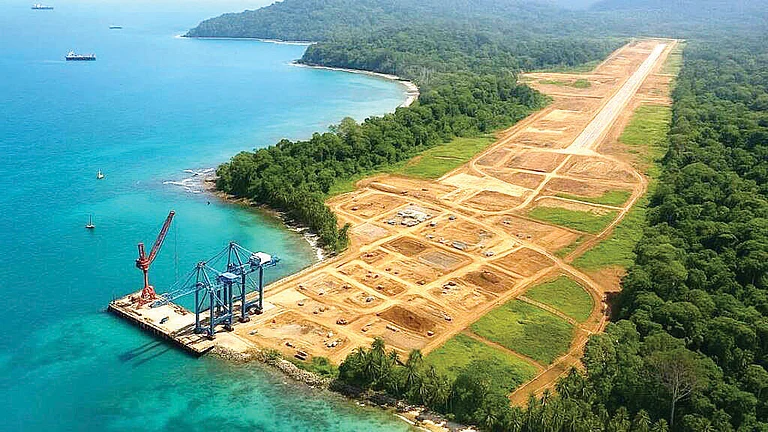
The bold Great Nicobar infrastructure project in India is more than just a development initiative in a far-flung island territory. It is, indeed, the very definition of an ambitious geopolitical enterprise. It is fast emerging as one of the most important Indo-Pacific strategic projects, reflecting New Delhi’s evolving maritime doctrine amid rising regional competition. The project is situated at the southern tip of the Andaman and Nicobar Islands, near the geopolitically crucial Strait of Malacca, with a view to converting the island of Great Nicobar from an isolated outpost into a strong maritime, logistical, economic and military hub. The project reflects India’s bid to become a decisive strategic player in the Indian Ocean and challenge China’s growing dominance in the region.
Great Nicobar will be built at an estimated cost of Rs 4,902 crore (approx. USD 9-11 billion) and has four major components: an international container transhipment terminal (14 million TEUs), a greenfield international airport, a new township, and a hybrid power plant (450 MVA) using gas and solar energy. These are intended to create a sustainable maritime ecosystem that will help transform India’s economic and security footprint in the Indo-Pacific region. The first phase is likely to be completed by 2028, aligning with India’s long-term strategic ambitions in the region.
The most important aspect of the project is its location. Great Nicobar is situated close to the Strait of Malacca, one of the world’s busiest maritime chokepoints. This narrow sea passage is vital for the Indian Ocean energy trade, and approximately 25-30 per cent of the world’s maritime trade passes through it between the Indian and Pacific Oceans. China values the Strait of Malacca even more: 70-80 per cent of its imported energy supplies and a substantial share of its trade flows traverse the route. During periods of geopolitical confrontation, this dependence is referred to as the “Malacca Dilemma” by Chinese strategists, who fear that their country’s sea lanes could be blocked or monitored.
Thus, Great Nicobar carries immense strategic significance for India. The development of infrastructure and India’s growing maritime presence near the Strait of Malacca will enable New Delhi to monitor this critical shipping corridor, enhance maritime domain awareness, and improve naval logistics capabilities. The project effectively places India at the crossroads of one of the world’s most important trade routes. Geopolitically, it strengthens India’s position in the broader Indo-Pacific strategic equation.
This also comes against the backdrop of China’s expanding presence in the Indian Ocean region, often referred to as the “String of Pearls” strategy. Over the last two decades, China has invested massive sums in ports and infrastructure projects across the Indian Ocean region, including Gwadar in Pakistan, Hambantota in Sri Lanka, Kyaukpyu in Myanmar, and Djibouti in the Horn of Africa. Beijing describes these as “economic” and “connectivity” projects under its Belt and Road Initiative (BRI), but many Indian strategists view them as “dual-use” installations capable of supporting naval operations.
It can therefore be argued that the Great Nicobar project is India’s strategic response to China’s expanding footprint. India’s plans to build a major transhipment and military-support base near the Strait of Malacca represent a significant step towards safeguarding its maritime interests and asserting itself as a major regional naval power. Owing to its potential to host surveillance systems, support naval operations, and even facilitate fighter aircraft deployment, military experts have already compared Great Nicobar to an “unsinkable aircraft carrier”. Such capabilities would significantly enhance India’s ability to project power in the eastern Indian Ocean and deepen Indo-Pacific cooperation with the United States, Japan, and Australia through the Quad framework.
However, the Great Nicobar project is not merely a military undertaking. It is equally a reflection of India’s economic aspirations. At present, a large share of cargo moving to and from India is routed through foreign ports such as Singapore, Colombo, and Port Klang. This dependency increases shipping costs and contributes to foreign-exchange losses. The proposed Great Nicobar international transhipment terminal is expected to allow India to handle large container vessels directly. If successful, the project could help India emerge as a major player in global maritime trade.
Further, the project aligns with India’s Vision 2047, which aims to position the country as a key force in the Indo-Pacific Economic Belt. In an increasingly geopolitically divided world, countries are becoming more conscious of the strategic importance of logistics infrastructure. Great Nicobar is also located close to Southeast Asian nations such as Indonesia and Thailand, offering significant opportunities for maritime trade connectivity and regional integration. It may also support the Indian government’s strategic outreach through initiatives such as “Act East” and “Security and Growth for All in the Region” (SAGAR), while advancing the broader vision of MAHASAGAR (Mutual and Holistic Advancement for Security and Growth Across Regions).
Yet the project has also triggered intense debate over its strategic and economic implications. One of the central concerns relates to its environmental impact. Great Nicobar is an ecologically fragile region rich in tropical rainforests, endemic flora and fauna, coral reefs, and indigenous communities such as the Nicobarese and Shompen tribes. Critics argue that large-scale infrastructure projects could irreversibly damage the fragile ecosystem and adversely affect the livelihoods of indigenous peoples.
There is also political opposition within India. Opposition leader Rahul Gandhi and others have expressed scepticism about the environmental clearances granted to the project and alleged procedural irregularities, describing it as a “scam” and a “grave crime” against natural and tribal heritage. Environmentalists warn that the multi-billion-dollar project could accelerate deforestation, damage marine habitats, and intensify ecological degradation in one of India’s most vulnerable regions. Concerns have also been raised about the sustainability of large-scale infrastructure development in an earthquake- and tsunami-prone zone increasingly threatened by climate change.
The Indian government, however, maintains that all environmental reviews and regulatory procedures have been duly followed. According to officials, only around 1.82 per cent of the total forest cover in the Andaman and Nicobar Islands will be diverted for the project. The government has also stressed that the initiative is both strategically and economically vital while incorporating ecological mitigation measures. New Delhi is increasingly attempting to balance environmental sustainability with national security imperatives and economic modernisation.
In many ways, the Great Nicobar project reflects the broader transformation of global geopolitics, where infrastructure, trade, technology, and military strategy have become deeply intertwined. The Indo-Pacific is no longer merely a geographical construct; it has become the epicentre of twenty-first-century strategic competition. Sea lanes, islands, and logistics hubs are now instruments of geopolitical influence. In this context, Great Nicobar symbolises India’s strategic autonomy and the gradual rebalancing of the regional power equation.
Overall, Great Nicobar is more than just a location; it is a powerful statement of India’s determination to safeguard its maritime interests while advancing economic growth and strategic influence. The project underlines the growing importance of the Indian Ocean as a major theatre of twenty-first-century geopolitical rivalry involving India, China, the United States, and other regional powers. It also highlights the rising significance of infrastructure geopolitics in shaping the evolving Indo-Pacific order, where ports, logistics hubs, and maritime chokepoints are increasingly linked to strategic influence and naval dominance. Meanwhile, emerging connectivity corridors along the Arctic-Indian Ocean axis are expanding the strategic scope of India-Russia relations and reshaping the geopolitical landscape of Eurasia. However, India will ultimately need to strike a careful balance between development, environmental conservation, local concerns, and national security if Great Nicobar is to realise its full potential. With the potential to become either a gateway of maritime prosperity or a flashpoint of ecological and political contestation, Great Nicobar now stands as a pivotal node in the Indo-Pacific century.
(Dr Sujit Kumar Datta is a professor, Department of International Relations, University of Chittagong, Bangladesh)
