


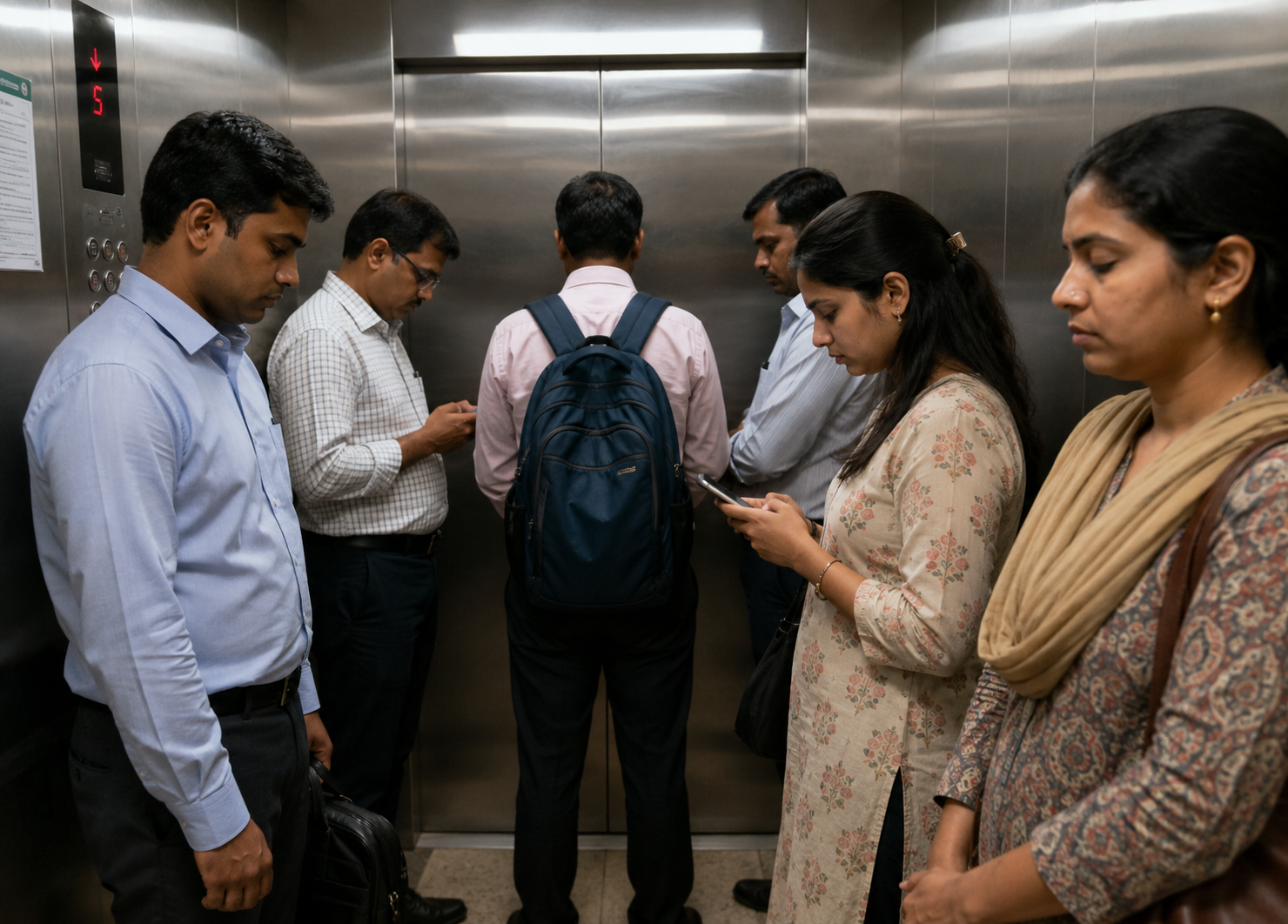
Next time you step into a lift, try something. Instead of walking in and freezing, watch what everyone else does. Watch yourself too. There is a good chance you will notice a strange little performance unfolding—one nobody rehearsed, yet everybody seems to know the steps.
You walk in. You turn around. You face the door. If there is another person, you quietly move to a corner. If a third person walks in, everyone subtly reshuffles, like pieces on a chessboard that nobody is deliberately moving. Nobody talks. Nobody makes eye contact. Someone suddenly finds their phone fascinating. This is not shyness. It is not rudeness either. It is something scientists call “proxemics”, the study of the invisible bubble of space we carry around us, and how we react when someone steps into it.
The Bubble Nobody Can See
Every person carries an invisible zone of personal space. That is usually somewhere between an arm’s length and about two feet, depending on culture and the relationship involved. Step into that zone uninvited, and something ancient switches on in the brain. It does not matter whether the other person is an office colleague or a stranger travelling to the fifth floor. The body reacts anyway, with a flicker of alertness, a tightening of the muscles and a discomfort that most of us have felt but never named.
A lift is one of the few places in daily life where this invisible bubble is constantly and unavoidably breached. You cannot step back. You cannot leave. You are sealed inside a metal box with strangers, standing closer than you would ever willingly choose to stand anywhere else, often closer than you would stand even with members of your own family.
We Build Walls Out of Nothing
Since we cannot create real physical distance in that tiny space, we improvise. We make the space feel larger by making ourselves smaller and looking away.
- We angle our bodies instead of facing one another directly.
- We stare at the floor indicator, watching the numbers tick upwards as though they are the most interesting thing in the world.
- We fold our arms, hold our bags a little tighter and occupy less space.
- We fall silent because speaking would mean acknowledging just how close we actually are.
None of this is planned. Nobody teaches it in school. Yet place ten strangers in ten different lifts, in ten different cities, and you will witness almost the same choreography every time. It is one of the most universal, unspoken agreements human beings have, a way of saying, “I know we are uncomfortably close, and I shall do nothing to make it worse.”
Why This Tiny Behaviour Matters
It is easy to dismiss all this as trivial—just an awkward ride to the office. But it reveals something far more significant about us. Even in the smallest, most ordinary moments of daily life, human beings are constantly negotiating comfort, respect and boundaries, usually without uttering a single word. In a sense, we are being remarkably considerate towards one another inside that confined space. We are managing an uncomfortable situation collectively and silently, ensuring that nobody feels crowded or threatened.
It is also a reminder of how much of our social behaviour operates beneath conscious thought. We often assume that manners are expressed through words—”please”, “thank you”, or holding the door open for someone. Yet some of our deepest forms of courtesy are physical: how we angle our shoulders, where we allow our eyes to rest and how much room we leave for someone we have never met.
The lift is a tiny theatre where a profoundly human instinct plays out every single day: the need for personal space and the quiet ingenuity with which we protect it when we cannot have it. So, the next time you find yourself studying the floor numbers instead of the person standing a foot away, do not think of it as odd. You are not being unfriendly. You are participating in something deeply human. You are taking part in a silent agreement that has helped keep shared spaces peaceful long before anyone gave the behaviour a scientific name.
Perhaps the real lesson is this: respect does not always require words. Sometimes, it requires only a little thoughtful silence, and the wisdom to look at the floor numbers instead of the stranger standing beside you.
