


The Middle East has suffered from volatility and security concerns for decades. There have been deep-seated rivalries that have manifested repeatedly, but the root causes remain unresolved, despite the Saudi-Iran and other Sunni countries’ rapprochement. Similarly, the Abraham Accords were intended to expand Israel’s diplomatic outreach in the region and bolster its security. This, in turn, was meant to free the United States, its sole security guarantor, to concentrate on more pressing priorities in the Indo-Pacific and the Eurasian war; however, the accords have failed to address the underlying issues. But the Middle East has an uncanny ability to draw the US back into the regional game, continuing to suffer from the MAD (Mutually Assured Destruction) syndrome. Iran-Israel and Israel-Palestine issues remain perennially on the burner.
The over two-year-old Israel-Hamas Gaza war is the quirkiest of all, given how Hamas carried out the October 7, 2023, terror attacks, inflicting severe physical and psychological damage on the ultra-rightist government led by Netanyahu. This triggered an unprecedented military response by Israel, which frittered away much of the international sympathy, leaving only the USA, disenchanted yet fully backing it. This was evident during the recent UNGA, when many countries walked out as Bibi stepped in, and more European countries not only recognised the State of Palestine but also threatened to pursue the execution and arrest of Netanyahu, as mandated by the ICC. He had to take a circuitous route to reach New York, where Trump has been trying to find a solution, as America’s non-NATO and regional security allies felt threatened after Netanyahu chose to attack Qatar to eliminate the leadership and negotiating team of Hamas.
The attacks on Qatar—first by Iran against the US base there and more recently by Israel killing Hamas junior leaders—sent a clear message to all countries in the region: they could be the next target of sovereignty violations. Moreover, the way the US behaved, or appeared helpless to restrain Netanyahu, led regional players to believe they are on their own and would have to find their own shield against an unbridled Israel. Since China is not ready to directly provide security cover to replace the USA, and Russia remains preoccupied and distracted in the Ukraine war, their choice fell back upon the ever-ready Pakistan, which flagged its nuclear bomb as an “Islamic Bomb” to secure legitimacy and financial support. In the past as well, Islamabad has come to their rescue, and thousands of Pakistani army personnel are already well-embedded in the region as advisers, trainers, and loaned fighters. It has also occasionally threatened Israel with nuclear attack if the holy mosques in Saudi Arabia are endangered.
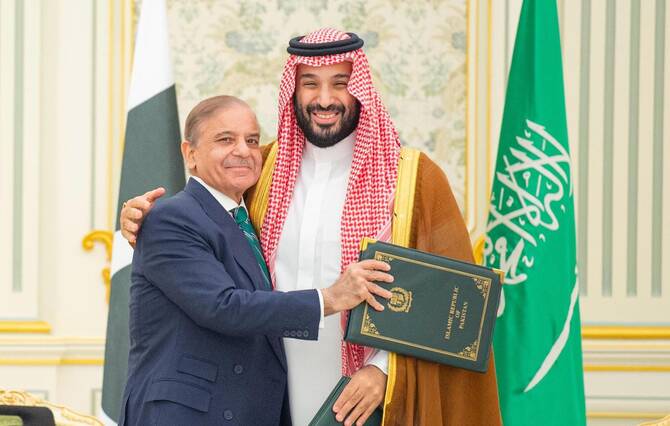
The strategic mistake of attacking Qatar by Netanyahu and his subsequent bravado provided an exceptional opportunity for Pakistan to sign the Strategic Mutual Defence Agreement (SMDA) with Saudi Arabia. For a cash-strapped Pakistan, with a struggling economy and near-pariah status due to its love for terrorists, this was an exceptional opportunity for a turnaround. It was further emboldened by its newfound proximity to the Trump Administration.
A private lunch for General Asim Munir, followed by a second meeting in less than three months along with Pakistani PM Shehbaz Sharif, came amidst fast-paced developments in the region. The optics of these meetings conveyed that the deal had US blessings. This was especially so as Trump himself, despite public posturing, was clearly frustrated with Netanyahu, whom he hosted for the fourth time at the White House to persuade him to be less adventurous and agree to some deal on Gaza.
A 20-point plan has been proposed by Trump, in which a Two-State Solution is still absent despite overwhelming support by the international community. This, even if accepted and executed by all sides, will leave scope for the next conflagration intact, as the root cause remains unaddressed.
There has been an obvious concern in India regarding the Pakistani security deal and Saudi Arabia’s position, as Riyadh has long been a comprehensive strategic partner and in many ways a lynchpin of India’s Act West Policy. Likewise, in Saudi Arabia’s Act East Policy, India figures prominently, and institutional frameworks have been established for more profound engagement.
The Saudi-Pakistan mutual defence agreement, based on available details, outlines that if one partner is attacked, it will be considered an attack on the other. Although Riyadh has assured New Delhi that the pact had nothing to do with India, an agreement carries its own binding sanctity, and its potential repercussions must be duly analysed with remedial action taken in good time. Surely, during his meeting with the Saudi foreign minister in New York, Dr S. Jaishankar would have secured the requisite clarifications.
Meanwhile, Netanyahu’s apology to his Qatari counterpart for the aggression against the country, made at the behest of President Trump, has eased tensions somewhat, and Doha is once again on board.
The Joint Statement issued by the foreign ministers of Saudi Arabia, Qatar, Jordan, Egypt, Indonesia, the UAE, Turkiye, and Pakistan warmly welcomed President Trump’s 20-Point Plan for ending the Gaza war, preventing the displacement of Palestinians, and advancing comprehensive peace, while also promising the non-annexation of the West Bank by Israel. PM Narendra Modi, in his tweet, also welcomed Trump’s announcement of a comprehensive plan to end the Gaza war, as it provides a viable pathway to long-term and sustainable peace, security and development for the Palestinian and Israeli people, hoping that all concerned will rally behind Trump’s initiative.
Pakistan may feel emboldened by its renewed relevance with the USA and the Gulf countries and might try to perpetrate yet another Pahalgam-type terror attack, to which India will have to respond as it did through Operation Sindoor. The actions and positions taken by its new and old partners will only be judged in real-world scenarios rather than hypothetical assumptions. But for sure, there is a question mark. For the Saudis, it is the security cover, which has been fully supported by China, for whom both Saudi Arabia and Pakistan are important allies. New Delhi will have to be vigilant with the new dynamic involving Pakistan in the West Asian matrix, where US support to Islamabad could pose a challenge.
(The author is a former Indian ambassador to Jordan, Libya, and high commissioner to Malta. He also worked as deputy chief of mission (in the rank of ambassador) to Moscow)
