


The Cost of Hasty Execution
The huge expansion in Indian infrastructure stock, lauded globally, belies the tensions of hasty execution. The continuous occurrence of structural shortcomings and casualties, especially during the early days of a project’s delivery, is a matter that merits introspection. The incidents of surface slippage, cracks, subsidence and potholes in the mega-budget, newly commissioned Lucknow-Kanpur, Ganga, Delhi-Dehradun and, earlier, the Delhi-Mumbai Expressways – all inaugurated with spectacular fanfare – should ring alarm bells. The monetary loss may be in crores, but the trust deficit and reputational loss are profound and lasting.
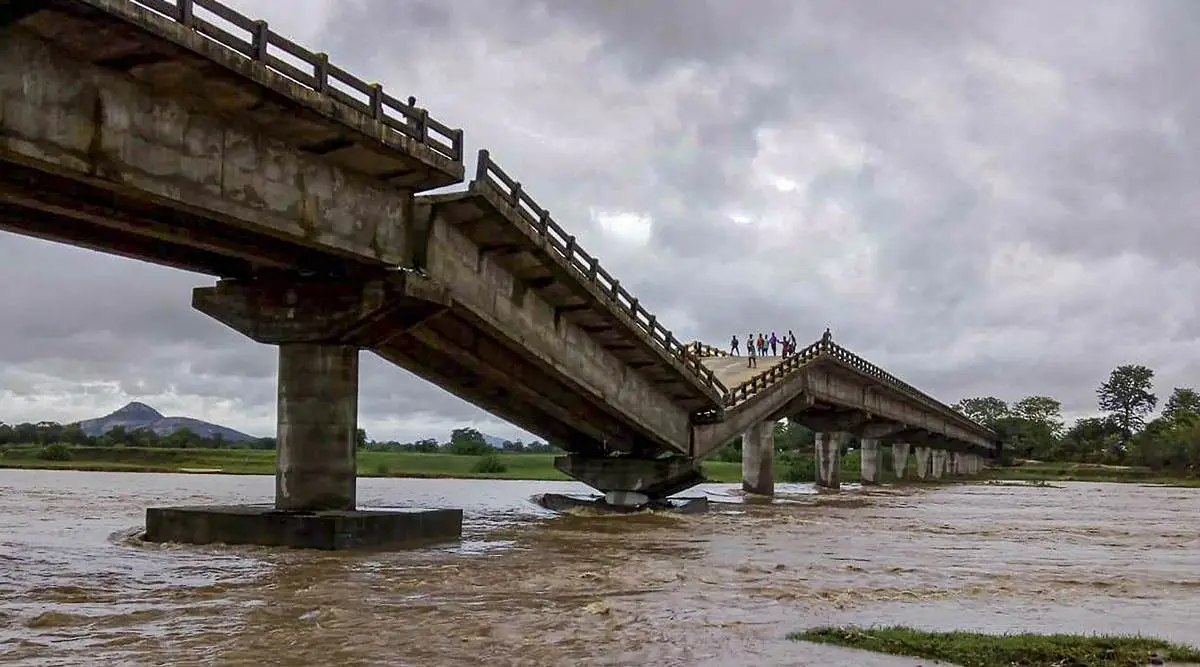
On the night of May 3, 2026, a 33-metre slab of the Vikramshila Setu near Bhagalpur gave way in two stages, splitting a 4.7-kilometre structure into two and cutting off the shortest link between south and north Bihar. Commuters were forced onto a 161-kilometre detour, then onto boats, until the Army and the Border Roads Organisation could throw together a Bailey bridge. Fortunately, no one died – one reason this collapse did not dominate the national conversation. A key part of the Aguwani to Sultanganj bridge collapsed, not once, but three times – in three consecutive years, between 2022 and 2024.
In May 2025, an RE wall failed on the Ramanattukara–Valanchery stretch of NH-66 in Kerala as the project neared completion. In August 2025, a hundred-metre protection wall on the Chakki bridge corridor between Himachal Pradesh and Punjab – built barely fifteen months earlier – came apart. Two months later, a 9.4-metre RE wall approach to a vehicular underpass collapsed at Mylakkadu on NH-66. In April 2026, the carriageway settled near an RE wall underpass approach on NH-32 in Tamil Nadu.
When Infrastructure Fails
The Railways are somewhat better because their systems are more robust. However, the recent collapse between Thakurwadi and Monkey Hill on Central Railway’s (CR) Bhor Ghat section caused unprecedented damage. Nearly 50–60 m of landmass supporting the railway line between the two locations was washed away, leading to the cancellation of around 30 trains.
These are not cases of scattered bad luck. By October 2025, NHAI itself had been forced to acknowledge that reinforced-soil wall panels have been failing, sometimes suddenly, even within two to three years of completion. The causes for such breakages can be identified as: inadequate geotechnical investigation, ground improvement measures skipped or under-specified, drainage provisions that cannot cope with monsoon saturation, reinforced-soil wall technology deployed in terrain that it was never suited to, and a supervisory architecture so diffused between designers, concessionaires, independent engineers and NHAI’s own field staff that, when something goes wrong, no one is quite sure whose failure it was.
It is tempting to treat each collapse as a local story, a bridge here, a wall there, and move on once the debris is cleared. Every rupee spent rebuilding a wall, a carriageway or a bridge span that should never have failed in the first place is a rupee not spent creating new infrastructure, maintaining what already exists, or improving safety elsewhere. It is also a rupee spent twice – once to build and then once to rebuild. Add to this the indirect costs, like diverted freight, lost productivity from hours-long detours, the fishing boats now doing the work bridges were meant to replace, and the slow erosion of the government’s own brand, and the adverse impact is enormous.
The Problem with Lowest-Bid Contracting
Industry voices are prone to point to that lazy incentive problem sitting underneath the technical one: government tenders are awarded to the lowest bidder. It is a norm nobody is willing to spurn for fear of scrutiny from auditors and investigative agencies. Contractors who win consequently with unsustainably low bids have only one place to recover their margin – by cutting corners on materials, ground investigation and workmanship – the very inputs that determine whether a wall or a bridge approach survives its first monsoon. Sometimes, sub-contracts are made to other parties that are technically competent but also have the acumen to drum up huge legal claims to compensate for the shortfall.
Detailed Project Reports are the technical backbone of every project. Often, they are rehashed from earlier projects with little adaptation to the specific geology, water table or flood history of a new site, or are mere desktop reports. Independent engineers, whose function is to catch these gaps before concrete is poured, often lack either the experience, authority or incentive to hold up a project over what appears to be trivial, an incorrect soil report or an imperfect alignment. They are prone to be inefficient and poorly staffed when selected on low bids. Once a structure is built, ownership frequently passes to agencies or concessionaires with far less institutional memory and concern than the engineers who originally designed it.
What Needs to Change
The remedies are neither exotic nor expensive relative to the losses at stake. Independent, mandatory design vetting is a must for RE/RS walls and bridge structures, informed by confirmatory soil investigation and at least a decade of monsoon and flood data rather than routine DPR-stage assumptions. Field and laboratory testing – settlement, drainage – at defined milestones are needed, not left to visual inspection or a construction timetable. Deterrent accountability for design consultants is required when their geotechnical assumptions turn out to be wrong. Empanelled, technically qualified specialist agencies for RE wall execution should be deployed if the original contractors lack that expertise. A structural-health monitoring and maintenance regime is necessary for the thousands of bridges and walls already standing – a well-built structure left unmaintained for two decades will fail just as surely as a poorly built one does after its opening.
Government will also have to ensure that it gets the best out of its contractors. It is important to keep the eligibility and qualification bar sufficiently high rather than to succumb to the populist temptation to relax the criteria merely to encourage small players to participate in bids. Weak contractors, if selected, have to be watched and provided a helping hand within the parameters of legality – rather than be allowed to flounder and fail; the loss is ultimately the government’s. Agencies adept in testing and retesting structural designs should be enlisted to undertake scrupulous scrutiny of projects, even at government expense.
Quality Over Quantity
Most critically, India should stop taking pride in merely the speed of building infrastructure. Beyond optics, in deference to our Viksit Bharat goal, we should, instead, find satisfaction in quality over quantity, durability over appearance and effectiveness over expediency.
