


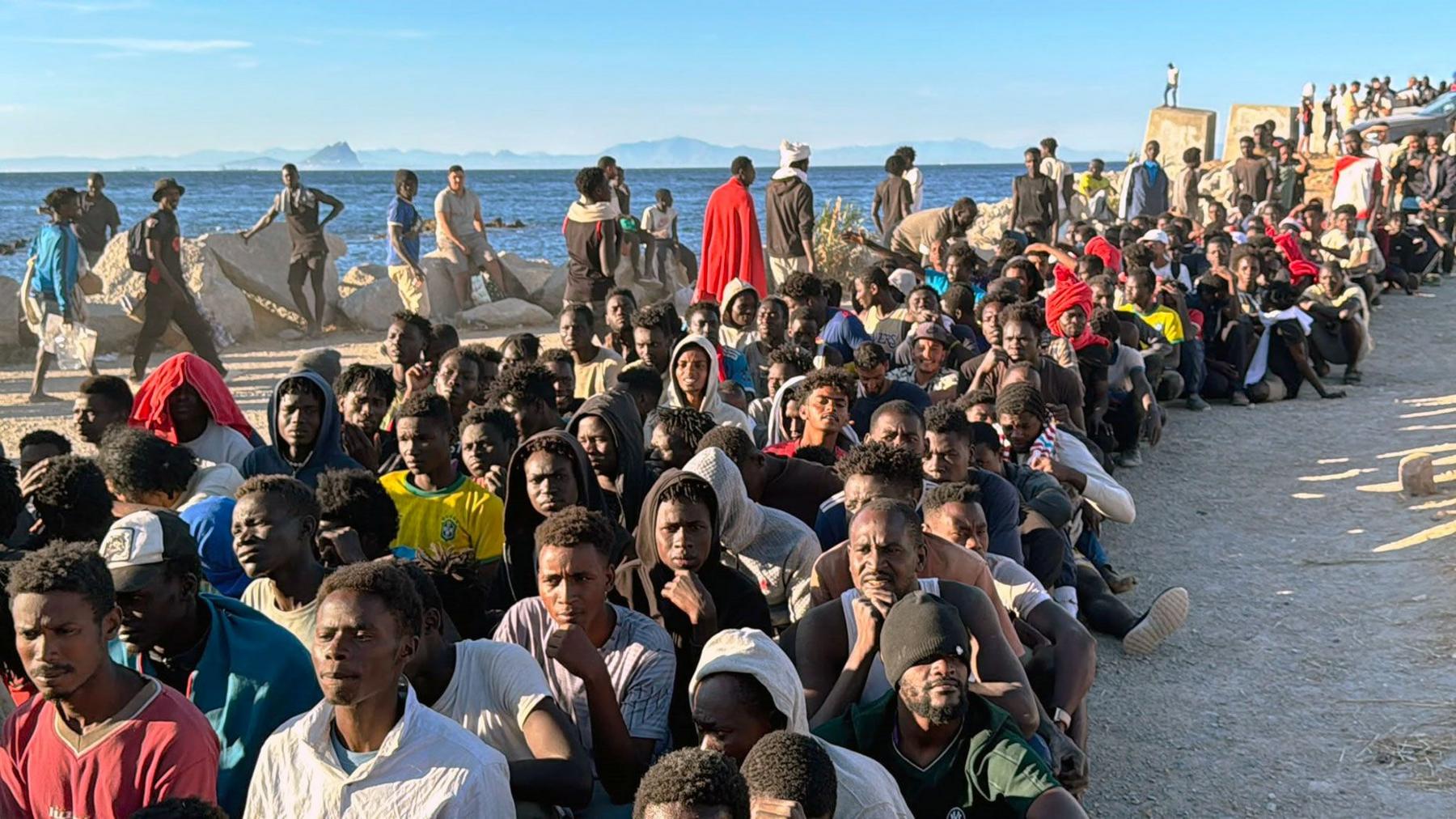
When the illusion of sealed borders collides with the global reality of migratory flows
On the North African coast, just a few miles from the Spanish mainland, stand two strips of land that encapsulate five centuries of European history: Ceuta and Melilla. Spanish autonomous cities geographically immersed within the territory of Morocco, they represent a unique case in the global geopolitical landscape, the European Union’s only land border with the African continent. For Madrid, they are enclaves, national territory in every sense under the 1668 Treaty of Lisbon for Ceuta and since the 15th century for Melilla; for Rabat, they are enclaves to be returned, the lingering legacy of a colonialism never fully laid to rest.
The two cities, separated by hundreds of kilometres of Moroccan coastline, share a special status achieved in 1995 when they gained administrative autonomy while remaining an integral part of Spanish national territory. Ceuta, overlooking the Strait of Gibraltar, has a population of about 84,000 spread across just 18 square kilometres; Melilla, more expansive at 200 square kilometres, hosts a population of around 87,000, split almost equally between Christians and Muslims in a daily intertwining of cultures and languages that crosses the border every day for work and commerce. Both are encircled by fortified fences — barbed wire, cameras, surveillance towers — that together form a tangible symbol of Europe’s external frontier.
Yet behind the physical barriers lies a diplomatic dispute that has never truly been settled. When Morocco gained independence from France in 1956, the two enclaves were not included in the decolonisation process: according to the United Nations, they do not feature among non-self-governing territories awaiting decolonisation, unlike Western Sahara. This is an interpretation Rabat has never fully accepted, repeatedly demanding the return of Ceuta and Melilla, alongside the neighbouring minor Spanish presidios.
The Crisis and Humanitarian Emergency
For weeks, this fragile balance has been thrust back into the spotlight. The migration crisis sweeping through Ceuta, the most severe since 2021, has brought back to the heart of the debate not only the humanitarian emergency, but also the unresolved question of sovereignty over these territories, which have always been a source of diplomatic friction between Spain and Morocco.
The numbers illustrate the sheer scale of the emergency: approximately 49,000 migrants crossed the Ceuta border in less than 24 hours between July 30 and 31, 2026, composed overwhelmingly of young people and teenagers, including over 7,000 unaccompanied minors, according to estimates from the Spanish Ministry of the Interior, forcing Madrid to deploy the army and initiate the first repatriations. The Spanish government also responded by closing the Melilla border crossing, while just weeks earlier, the Supreme Court had ruled that migrants intercepted at sea while attempting to reach the two cities cannot be immediately repatriated, leaving them under the care of Spanish authorities. According to some Moroccan observers, this surge may not be entirely spontaneous: border control management by Rabat has historically been used as a political lever of pressure against Madrid, and the current crisis risks falling into the same pattern.
The border crossing, undertaken by swimming, on foot, or by scaling the barriers, resulted in at least 72 fatalities, mostly due to drowning or being crushed in the crowd. Although the vast majority of migrants returned to Morocco in the days that followed, several thousand remained in Spanish territory, severely straining the Spanish reception system.
The speed and severity of the event prompted the European Union to convene an informal meeting of interior ministers, instigated by a letter signed by 22 member states led by Italy and Denmark. European Commission President Ursula von der Leyen proposed increased support for Madrid and closer cooperation with Rabat, reviving the outsourcing model previously tested with Tunisia and Libya along the central Mediterranean route.
Mapping Routes and Statistical Paradox
Ceuta represents merely the latest chapter in a much broader international migration landscape. Providing a measure of this phenomenon on a European scale are the data from Frontex, the European Border and Coast Guard Agency tasked with managing the security and control of the external borders of the Schengen area.
These figures were recently invoked by Spanish Prime Minister Sánchez in a contentious social media post directed at Italy, after Rome threatened to suspend Schengen in the wake of the Ceuta crisis. Sánchez published the total number of irregular entries recorded between 2021 and 2026 along the primary routes into the European Union:
• Italy: 478,600 entries (confirming it as the main arrival point over the five years)
• Western Balkans: 340,600 entries
• Greece: 259,800 entries
• Spain: 234,760 entries
• Eastern Border: 48,000 entries (approximately)
A comparison that, according to the Spanish premier, downplays the accusations levelled against Spain, showing that Italy recorded more than double the number of irregular entries recorded in Spain over the same timeframe.
Looking at more recent trends, Frontex reports for the early months of 2026 paint a dynamic picture: irregular crossings at EU borders are down by 37 per cent overall compared with the previous year, yet with a sharp spike precisely on the routes affecting Spain. Land entries into Ceuta and Melilla surged by 246.3 per cent, rising from 654 to 2,265 cases between early January and mid-May (with Ceuta alone accounting for 2,187 crossings). This trend runs parallel to a sharp contraction of the Atlantic route towards the Canary Islands, which dropped by 78 per cent thanks to agreements between Spain, Mauritania, Senegal, and Gambia. In the background remains the most tragic figure: according to the International Organization for Migration, since the beginning of 2026, over 1,200 people have lost their lives attempting to reach Europe by sea.
Nevertheless, crises like the one in Ceuta expose the structural limits of official statistics: large numbers gathered in periodic reports fail to capture or predict the real, dynamic nature of migratory flows, which can concentrate in a matter of hours and shatter monthly averages. Behind these movements lie agile, decentralised criminal networks, ready to reroute flows towards new corridors as soon as an old route is sealed off.
Lessons from Europe’s Migratory Dilemma
The dramatic events in Ceuta are not an isolated episode; rather, they expose the structural contradictions of European migration policy, perpetually torn between the illusion of building fortresses and the necessity of far-sighted political vision.
Western migration policies continue to chase emergencies, treating a structural phenomenon as though it were a sequence of unpredictable humanitarian crises or simple matters of public order. On the contrary, human mobility is not an anomaly to be eradicated, but a permanent, interconnected component driven by deep economic disparities, regional instability, and shifting geopolitical balances.
Economic Engine and Demographic Gap
The economic engine of migration is fuelled by widening global inequalities. The gap between advanced European economies and those of countries of origin (particularly in North Africa, sub-Saharan Africa, and the Middle East) creates an insurmountable differential in prospects for younger generations. In countries of origin, there is a surplus of young populations, often highly educated yet crushed by chronic unemployment and underemployment. Simultaneously, the European Union is experiencing a demographic winter, characterised by rapid population ageing and a structural labour shortage in key sectors, from agriculture and eldercare to construction and advanced manufacturing. In this sense, mobility responds to a basic economic law of supply and demand that administrative borders struggle to halt.
Limits of Containment and Half-Sovereignty
The European Union’s standard strategy relies heavily on external containment: delegating border control to third countries, erecting physical barriers, and tightening regulatory constraints.
However, this model frequently results in half-sovereignty: Europe pays substantial financial resources to block flows at a distance, yet ends up exposed to political blackmail and instrumental pressure from transit countries, which use migration as a geopolitical bargaining chip. When socio-economic conditions in countries of origin plummet — driven by chronic youth unemployment in North Africa, persistent conflicts, or climate shocks in the Sahel, the Middle East, and Asia — barriers merely displace the problem rather than solve it.
Systemic Crises and the Geopolitics of Borders
Contemporary migration does not stem from a single root cause, but is the result of overlapping multifactorial crises. Civil wars, oppressive authoritarian regimes, and the fragmentation of state power across various areas of the Sahel and the Middle East eradicate any prospect of human security, forcing entire communities to flee. Furthermore, the climate crisis is no longer a future scenario, but a reality actively reshaping human geography: desertification, prolonged drought, rising sea levels, and the loss of arable land severely hit subsistence economies, pushing millions of people to relocate first within their own countries and subsequently along international corridors.
Against this backdrop, mobility is profoundly influenced by digital modernity. Unlike in the past, today’s migrants are immersed in an interconnected world: smartphones, social networks, and diaspora networks provide real-time information on routes and opportunities, neutralising psychological distances and turning the journey into a collective project. And while criminal smuggling networks deftly exploit every restriction, migratory flows are co-opted by transit countries as geopolitical arenas where human vulnerability is heavily bartered.
Beyond the Illusion of ‘Zero Migration’
Treating mobility as an anomaly to be eradicated inevitably generates short-sighted policies. Pretending to wipe out human movement by erecting physical barriers is akin to trying to hold back a tide with sandbags: the water will always find a new breach, empowering transnational criminal networks in the process. Accepting mobility as a permanent component means pivoting from punitive surveillance to strategic regulation.
On the political front, the European impasse remains profound: on the one hand, the hardline approach of fortification at all costs is invoked; on the other, observers point out that demographic decline and chronic labour shortages make the orderly management of flows an unavoidable economic necessity. The fundamental flaw lies precisely in chasing the myth of “zero migration”. For major regional powers and emerging economies, Europe’s misstep offers a clear warning: physical barriers and administrative deterrents are insufficient to shield a society from the tensions of a deeply unequal global economy. A genuinely sustainable strategy requires long-term economic agreements, legal entry channels tailored to actual labour-market needs, and the clear-eyed recognition that human mobility, driven on the front lines by millions of young people searching for a future, is an inescapable feature of an interconnected planet. Ultimately, the greatest risk is not the evolution of migratory flows, but the political illusion of confusing mere border surveillance with a genuine strategic vision, forgetting that no wall can ever halt the aspirations of those simply seeking a future.
(Giorgia Pietropaoli is an Italy-based writer, investigative reporter and teacher of classical literature. She specialises in Middle Eastern dynamics, with a particular focus on Iran and Afghanistan, and maintains a strong commitment to human rights.)
