


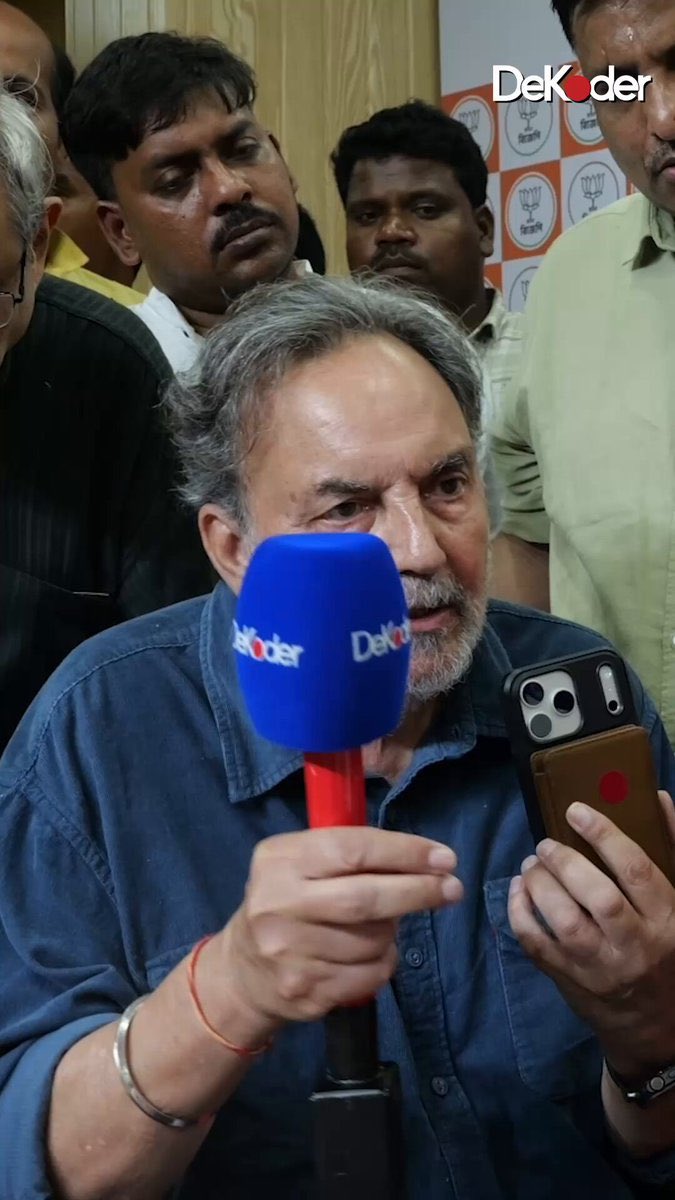
There is a certain discomfort in that now-viral image of Prannoy Roy—76, slightly stooped, camera slung with the ease of a field reporter rather than a studio patriarch. The photograph does not simply evoke nostalgia; it points to a rupture. It is less about a man returning to the field and more about a profession that has gradually abandoned it.
For those of us who came of age inside NDTV, this is not sentimentality. It is memory anchored in practice. Editorial meetings where numbers were interrogated like evidence; where a misplaced decimal point could halt a broadcast; where silence in the studio signalled discipline, not absence. We were taught that nothing outranks facts, and that TRP is not a journalist’s concern, it belongs to management. Journalism, in that ecosystem, was neither performance nor personality. It was a method. And over time, that method has thinned out.
To understand how Indian journalism drifted, one must begin with its altered political economy. Data compiled by the Telecom Regulatory Authority of India shows that television news continues to depend heavily on advertising revenue. In a market with over 390 news channels, the competition is not for truth but for attention. Credibility has steadily given way to “time spent”.
The consequences are visible on screen. A 2023 study by the Centre for Media Studies tracking prime-time debates across major Hindi and English channels found that more than 65 per cent of airtime went to studio discussions rather than ground reporting. Most of these debates centred on polarising political narratives rather than policy or governance. The shift is not cosmetic. The newsroom, in effect, has moved from the field to the theatre.
The contrast with the Roy era of election coverage is instructive. Data was not ornamental; it was foundational. The introduction of psephology into mainstream broadcasting—constituency-level modelling, swing analysis, vote-share projections—turned elections into something to be studied, not merely consumed. Viewers were not only told who was winning; they were also shown how and why.
Today, election coverage is often reduced to binary contests. Graphics have grown louder, but analysis has thinned. The screen is crowded, yet understanding is limited. The decline is not just visual; it runs deeper, shaping how knowledge itself is produced and presented.
Verification has weakened along the way. In 2022, Alt News documented over 200 instances of misleading or false information amplified by mainstream television channels, many of which were neither corrected prominently nor acknowledged. This is not an occasional lapse. It reflects a system where speed has overtaken scrutiny.
In Dr Roy’s newsroom, as we used to call him, the rule was clear: if a fact could not be verified, it did not go on air. Being second to break a story was acceptable; being wrong was not. This was not caution for its own sake. It was credibility, carefully built and fiercely protected. In a high-stakes information environment, the cost of error is public, not just professional.
Then there is the question of proximity to power. Over the past decade, several independent studies, including those by the Reuters Institute for the Study of Journalism, have pointed to declining trust in Indian news media. Audiences increasingly perceive outlets as aligned with political interests. Trust levels remain higher than in some Western markets, but the downward trend, particularly among younger viewers, is unmistakable. This reflects a deeper weakening of editorial independence.
Dr Roy’s approach was anchored in distance—not hostility. The ability to question without fear or favour depended on it. That distance today is often blurred, sometimes by pressure, often by incentives.
The transformation is most visible in the rise of the “anchor-as-protagonist” model. In many newsrooms, the anchor no longer moderates but directs and dominates the narrative. Debate formats are structured for confrontation rather than clarity. Guests are selected to generate conflict rather than insight. In such a system, journalism risks sliding into advocacy, or at times, into spectacle presented as scrutiny.
This is why the image of Dr Roy carries weight beyond nostalgia. It brings back into focus a set of professional values that have become less visible but remain essential.
First, rigour. Dr Roy’s training in economics informed his insistence on methodological clarity. Whether analysing election data or the Union Budget, the principle held is that evidence precedes assertion. In the current context, this calls for renewed investment in data journalism, verification systems and subject expertise.
Second, restraint. In an attention-driven media environment, restraint appears counterintuitive. Yet it is precisely this quality that distinguishes journalism from noise. Credibility is shaped as much by what is withheld as by what is broadcast.
Third, institutional culture. At its peak, NDTV functioned as a newsroom where editorial debate was encouraged, not discouraged. Recreating such environments requires structural commitment: clear editorial firewalls, transparency in ownership and protection for journalistic dissent.
Fourth, respect for the audience. One of the central ideas of the Roy school of journalism is that viewers are capable of engaging with complexity. This demands resisting simplification, sensationalism and manipulation. It requires trusting that clarity, not dilution, builds connection.
The standard objection is that the media landscape has changed irreversibly. Digital platforms fragment attention, algorithms reward virality, and economic pressures constrain quality journalism. All of this is true, but it is not the full picture.
Alongside this decline, independent, reader-funded journalism has grown in India. Despite constraints, several platforms have demonstrated that audiences are willing to support depth and credibility. Long-form reporting, data-driven investigations and explanatory journalism are not relics; they are finding space again. The conclusion is difficult to ignore: the demand for serious journalism has not disappeared, it has been neglected.
What would then a revival look like? Dr Roy’s presence in the field at 76 offers part of the answer. The image is not symbolic; it is diagnostic. It reveals a gap between available tools and actual practice.
For those who have worked within that earlier framework, the task is not to romanticise the past but to apply its principles to current realities. The Roy school is not a fixed template; it is a set of standards. Rigour, independence and restraint are not tied to a medium. They apply equally to digital, television and print.
The image, ultimately, prompts a difficult question: when the tools of journalism have become more powerful—real-time data, satellite feeds, digital archives—why has its practice grown more superficial?
There are no simple answers. There is, however, a clear starting point. Journalism must return to first principles. At its core, the profession is not about visibility but about veracity. Not about volume, but about accuracy. Not about performance, but about reporting. It demands ethical clarity. Journalism cannot alternate between roles—watchdog one day, megaphone the next. Its function remains constant: to inform, to scrutinise, and to hold power accountable.
As Prannoy Roy walks back into the field, camera in hand, he is not merely covering an election. He is demonstrating a way of working. The question is whether Indian journalism is still willing to learn from it.
(Bikash C Paul is a Delhi-based senior journalist and executive editor of ‘New Delhi Post’)
