

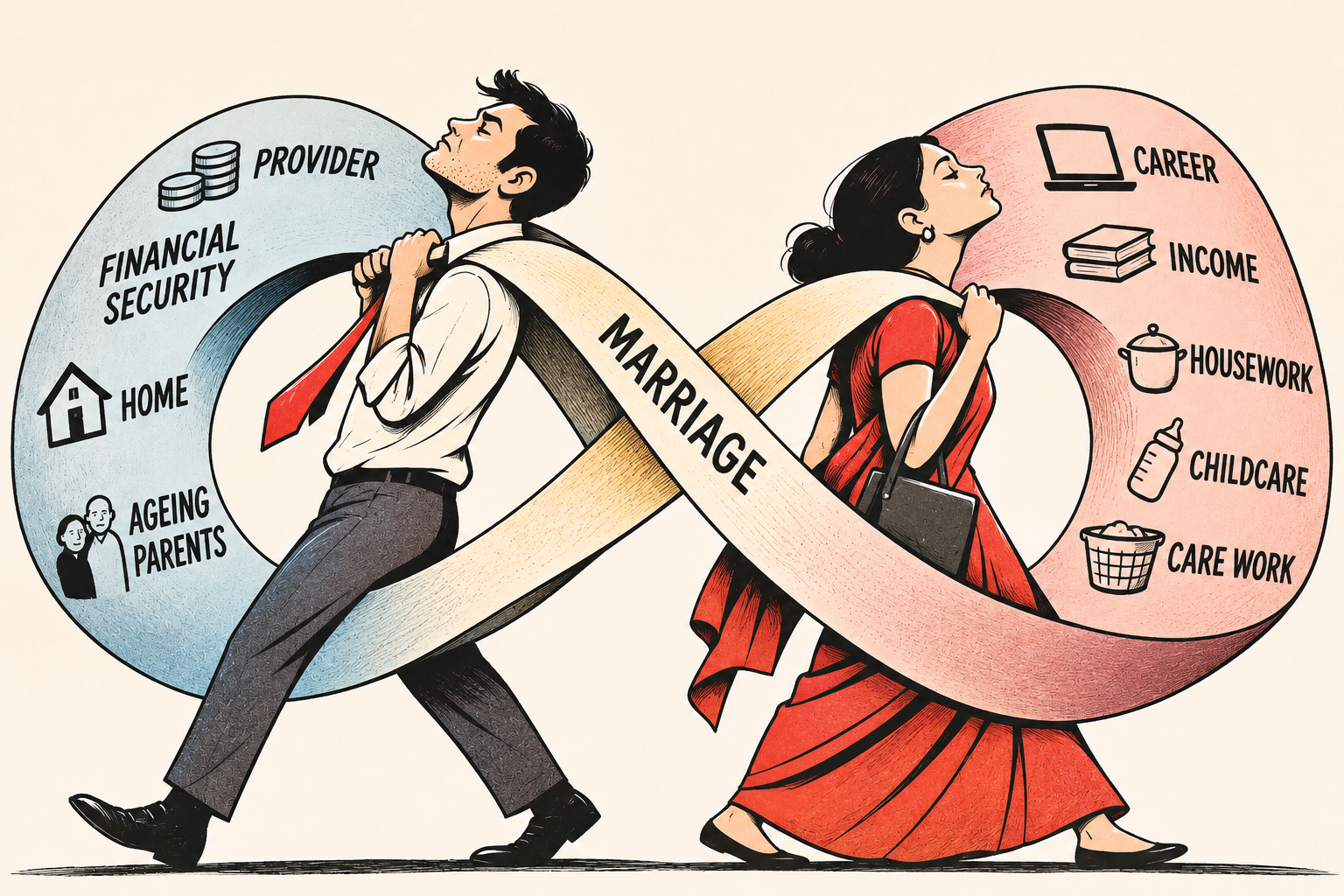
For generations, an Indian man’s social standing has been tied to his ability to provide a steady job, a home, financial security for his family and support for ageing parents. Marriage has reinforced this expectation: men provide, while women are often expected to adjust their careers to family responsibilities.
But this arrangement is under strain. The economy increasingly requires two incomes, and women seek greater financial independence. Yet men are still expected to remain the principal earners. The resulting tension concerns not just money but power, identity and the changing terms of marriage.
A March 2022 Pew Research Center study, based on interviews across India in 2019–20, found that 54 per cent of Indians believed both men and women should earn money. Yet 43 per cent believed men should remain the primary earners. Shared responsibility is gaining acceptance, but traditional expectations persist.
Resistance is particularly evident when women seek employment. A November 2025 research paper by Andrea Smurra, discussed in a World Bank research blog, examined 1,100 young married couples in Lucknow. Although 92 per cent of women wanted to work, only 26 per cent were employed. In 75 per cent of couples, husbands had the final say on whether their wives could accept a job.
Some men feared that their wives’ employment would shift household decision-making power, giving them greater control over spending and family resources. In experimental scenarios, some husbands preferred the existing arrangement even when their wives’ employment would increase household income.
This exposes a weakness in the breadwinner model: earning is not simply about money. Being the principal provider can also mean being the principal decision-maker. A second income improves financial security but can challenge an established hierarchy.
The marriage market reflects a similar contradiction. A 2025 study by economists Farzana Afridi, Abhishek Arora, Diva Dhar and Kanika Mahajan, published in Economic Development and Cultural Change, examined an Indian online matrimonial platform. It found that employed women were 12.8 per cent less likely to attract interest from male suitors than unemployed women. Those in traditionally male-dominated occupations faced an additional disadvantage. Though limited to the platform studied, the findings highlight the influence of traditional expectations on partner selection.
Men, meanwhile, face mounting pressure to fulfil a role that is becoming harder to sustain. An August 2026 Harvard Kennedy School study of 1,254 Indian men aged 18–30 found that three-quarters believed achieving financial security was harder for their generation than for their parents’ generation. Though not nationally representative, the finding captures the anxieties of young men confronting inherited expectations.
Women face a related burden. The National Statistical Office’s Time Use Survey 2024 found that women aged 15–59 spent an average of 305 minutes daily on unpaid domestic services, against 86 minutes for men who participated in such activities. Paid employment has not brought women an equal share of household responsibilities.
The result is an unequal arrangement: women are expected to contribute financially without gaining equivalent control or shedding domestic work. Men remain under pressure to provide, even when the responsibility could be shared.
The answer is not to replace male dependence with female dependence or dismiss the pressures men face. Partnership must be redefined. Earnings, household decisions, childcare and care of ageing parents must become shared responsibilities, negotiated according to individual circumstances rather than gender.
The problem is not that men are expected to provide. It is that society continues to measure their worth by their earning capacity while resisting changes that could make family life more financially secure and equitable.