

Why the government’s record-breaking Instagram campaign failed to control the narrative among India’s Gen Z
In one week, the government broke a world record, lost a Cabinet minister and kept posting. In that order. Let’s begin with the sequence of events, because the sequence itself is the argument. On July 23, the Prime Minister posted a selfie video on Instagram about the examination paper leak controversy, calling the scandal painful for students and their parents. It crossed 300 million views within a day. His profile gained 1.1 million followers overnight, taking the total past 104 million. The press described it as a global record.
The following night, he posted again, thanking young people for their suggestions. Another ten lakh followers arrived. On July 25, Dharmendra Pradhan resigned as Union education minister. At roughly the same time, police were firing tear gas at protesters at Jantar Mantar.
The next day, the prime minister posted a third video announcing a task force on examination reform under Nandan Nilekani. Nirmala Sitharaman followed with a video on fast-track courts, while other ministers joined a coordinated social media campaign. The most successful piece of political content produced in the country bought the government barely forty-eight hours, yet the response was simply to produce more of it.
When Views Become Ammunition
We argued in an earlier piece that Instagram is not a broadcast platform but a remix engine. Every Reel a minister uploads becomes permanent raw material for anyone determined to turn it against him.
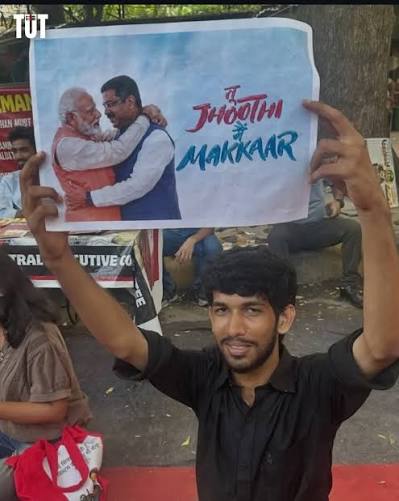
The first video opened by addressing the protesters as “Friends”. A parody retained that opening before cutting to three young women looking into the camera and replying, “No, we are not.” Others overlaid voiceovers, juxtaposed the footage with old promises, and re-edited the Prime Minister’s pauses, gestures and delivery. Within hours, the original message had become source material for countless reinterpretations. One enterprising youngster even uploaded a tutorial explaining how the video should have been shot.
Consider what this means. Those 300 million views measured not only the government’s reach; they also became the distribution network for the parody. Every view was a potential download.
In digital communication, volume is not protection; it is exposure. The headline figure also deserves context. India has about 553 million Instagram users. Against that, the Prime Minister’s 104 million followers represent only a fraction of the platform, many of whom are outside India. More than four out of five Indian Instagram users do not follow him directly. They see his content only when the algorithm chooses to deliver it. Besides, a view is simply a playback count. It measures how often a video was served, not how many minds it persuaded.
Still Calling Them ‘Friends’
The detail that should concern political strategists most has nothing to do with follower counts. The Sunday video, posted after a Cabinet minister had resigned and after the parody had spread nationwide, opened with the same word: “Friends”.
Just two days after young users had built a viral joke around rejecting that greeting, the government used it again, unchanged. There is hardly clearer evidence that those producing the content were not paying attention to the conversation unfolding around it. There was one concession. The Prime Minister abandoned the polished, cinematic production that had defined his communication for more than a decade and recorded the videos himself on a mobile phone. The format changed. The vocabulary did not. You cannot borrow the grammar of a platform while ignoring what its users have already said back to you.
Why This Is Bigger Than Social Media
At this point, the story stops being about Instagram. Gen Z, generally defined as those born between 1997 and 2012, numbers about 407 million people in India according to United Nations estimates, or 391 million by census projections. Either figure makes it the world’s largest Gen Z population, comfortably ahead of China’s 264 million. It also represents 29.2 per cent of India’s eligible electorate, the highest share among the world’s major economies.
In ten states, Gen Z accounts for more than 30 per cent of eligible voters. Bihar leads with 36.7 per cent, while Uttar Pradesh and Jharkhand are just under 34 per cent. Together, those states elect 234 members to the Lok Sabha.
Another nine states have Gen Z populations between 25 and 30 per cent, accounting for a further 212 seats. Together, that is 446 of the Lok Sabha’s 543 seats. Only four major states fall below the 25 per cent mark.
The 2027 Uttar Pradesh Assembly election, in a state with roughly 72 million Gen Z citizens and 80 Lok Sabha seats, will offer an important political test. The regional picture is equally instructive. Gen Z constitutes 33.6 per cent of the electorate in Nepal, 32.3 per cent in Bangladesh and 23.7 per cent in Sri Lanka. Governments fell in all three countries. India, at 29.2 per cent, sits within the same demographic band. So far, the political cost here has been the resignation of a Cabinet minister rather than the fall of a government.
A Movement Born From a Remark
On May 15, the Chief Justice of India remarked in open court that some unemployed young people were like cockroaches. The following day, Abhijeet Dipke, a 30-year-old journalism student and former social media volunteer for the Aam Aadmi Party, posted a line asking what would happen if all the cockroaches came together.
It began as a joke. Within days, he had built a website, social media handles and the foundations of what became the Cockroach Janta Party (CJP). Within days, the Cockroach Janta Party (CJP) had crossed 20 million followers on Instagram, overtaking both the BJP and the Congress on the platform. It is not registered with the Election Commission. It has no candidates, no symbol, no cadre and no office. Its mascot was chosen because cockroaches are notoriously difficult to kill.
One remark in a courtroom produced, within a fortnight, a movement larger on India’s dominant youth platform than either national party had built through years of professional campaigning and substantial resources. The gap was never about supply. The audience already existed; it was waiting for someone to articulate what it felt.
On May 21, the government had CJP’s account on X taken down, citing national security concerns. Dipke simply opened another account and remarked that cockroaches do not die. Meanwhile, the movement consolidated on Instagram, a younger, larger platform far better suited to the form the protest had already assumed. Its following continued to grow. You cannot delete a grievance. You can only push it elsewhere, often to a place less favourable to you.
Attention Versus Participation
That is the distinction at the heart of this episode. The government competed for attention. The protesters generated participation. They are different activities, measured by different metrics, with no direct exchange rate between them.
Consider what the movement created: “Get Ready With Me” videos before heading to protest sites; fit checks featuring helmets, goggles and homemade protective gear; protesters joking about maintaining their Strava streaks while fleeing baton charges; barricade footage edited to resemble Subway Surfers; and placards declaring that “every joke is a small revolution.”
This was not merely content about a protest. The content became part of the protest itself. It reduced the barrier between watching and participating by making involvement look socially desirable. A government Reel asks viewers to agree. A fit-check video invites them to join. One 23-year-old student summed it up to a news agency. Her generation finds speeches boring. They consume information in short bursts and communicate in the same way.
Who Was Really Protesting?
This may be the most important observation of all. Sanjay Srivastava of SOAS has argued that many of those at the protests were probably government supporters themselves, making this fundamentally different from the major agitations of the past decade.
The reason lay in the narrowness of the demand. Calling for the resignation of one minister is not an ideological position. It is a demand for accountability that even a BJP supporter can make without ceasing to support the BJP. That is precisely what made the movement so broad. Opposition parties, including the Congress, arrived later and attached themselves to a campaign they had not created.
Any political strategy built around the assumption of “our people” versus “their people” risks misunderstanding what actually happened. Much of the anger appears to have emerged from within the government’s own support base. A supporter does not stop being angry simply because they have been shown another Reel.
What Was Really Lost
Cabinet ministers can be replaced. Governments reshuffle portfolios, and the news cycle eventually moves on. The more significant loss may be one that cannot be easily measured. For more than a decade, openly mocking the Prime Minister remained relatively uncommon in mainstream political culture. That inhibition now appears to have weakened, not because of an opposition campaign or a newspaper investigation, but because thousands of young people with editing apps began responding to him on the very platform that had helped build his political image.
One 21-year-old told reporters they were simply replying to the Prime Minister in the language he had taught them. This is the first Indian generation whose politics, humour and social interactions have evolved alongside the global internet. Humour is often dismissed by the political class as trivial.
It is anything but trivial. It is now one of the principal vehicles through which political messages travel. None of this suggests that politicians should retreat from Instagram. It suggests they should understand the platform better.
Send three ministers who speak its language rather than forty who do not. Measure shares and saves beyond the existing follower base. Count how many hostile comments identify a specific grievance, because those comments reveal the political problem in plain sight. Respond to concerns instead of merely making announcements. And before posting the next video, understand what became of the last one.
Follower counts recover. Political taboos rarely do. The government received an unmistakable lesson about the difference between distribution and communication. It treated social media as a channel for broadcasting messages. The response it received was not another speech, but a four-word reply. It is still opening its videos with the very word that provoked it.