

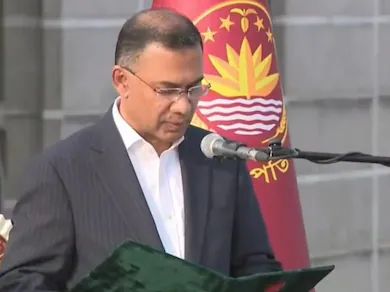
For Tarique Rahman, sworn in as Bangladesh’s new prime minister, and for his party, the Bangladesh Nationalist Party (BNP), the central question is not whether they like India, but whether they can afford strategic distance from their largest neighbour.
Geography answers that question before ideology even gets a word in. Politics in South Asia has always been hostage to geography. Mountains, rivers, corridors, and coastlines dictate strategy more stubbornly than campaign slogans ever could. Bangladesh shares a 4,097-kilometre border with India, one of the longest land frontiers in the world. It is ringed on three sides by Indian territory, and its economy is interlaced with Indian markets, transit routes, and energy grids. Whatever political tensions may flare, the map remains stubbornly unchanged. Statesmanship begins by accepting that permanence.
Interdependence Without Subordination
Trade between the two countries has crossed $13 billion in recent years, with India exporting energy, cotton, machinery, and food products, while Bangladesh sends garments, jute goods, and pharmaceuticals across the border. India is Bangladesh’s largest trading partner in South Asia. That is not a sentimental statistic; it is a structural fact.
BNP’s “Bangladesh First” manifesto promises ambitious infrastructure development, expansion of port capacity, and a target of generating 35,000 megawatts of electricity by 2030. Such ambitions cannot be realised in isolation. They require capital, connectivity, and stable supply chains. India matters here.
Indian investments in power plants, cross-border electricity transmission, and railway modernisation have already created an integrated energy and logistics network. A government serious about growth does not rip out functioning circuits to prove a point. It recalibrates terms, renegotiates where necessary, insists on transparency, but keeps the system running.
A Comprehensive Economic Partnership Agreement (CEPA), long discussed but never finalised, offers BNP a platform to reset trade on a more equal footing. Lower tariffs, harmonised standards, and smoother customs procedures would benefit Bangladeshi exporters as much as Indian suppliers. Pragmatism, properly understood, is not capitulation; it is actually administrative competence.
There is also the matter of connectivity to India’s Northeast. Bangladesh’s ports, Chattogram and Mongla, can serve as gateways for landlocked Indian states. In return, Dhaka can secure transit fees, infrastructure upgrades, and deeper integration into regional supply chains. Managed transparently, such arrangements consolidate sovereignty rather than dilute it.
Economic nationalism, if it is to be taken seriously, must produce growth. Growth requires stability. Stability requires cooperative neighbours.
Security Shadows: Lessons from 2001-2006
New Delhi’s anxieties are not imaginary. During BNP’s previous tenure from 2001 to 2006, India accused Dhaka of allowing northeastern insurgent groups, including elements of ULFA, to operate from Bangladeshi soil. The infamous Chattogram arms haul remains etched in Indian strategic memory.
Whether one accepts every Indian allegation or not, perceptions shape policy. The Siliguri Corridor, the narrow “Chicken’s Neck” connecting mainland India to its Northeast, is strategically vulnerable. Any hint of militant activity across the Bangladeshi border heightens Indian alarm.
BNP now has the opportunity to close that chapter decisively. A public commitment to zero tolerance for anti-India insurgents, reinforced by intelligence-sharing frameworks and visible counter-terrorism operations, would reassure New Delhi and stabilise the frontier.
Security cooperation does not negate sovereignty. It strengthens it. A state that exercises full territorial control projects authority; a state that tolerates ambiguity invites suspicion.
There is also the issue of minority protection. Reports of attacks on Hindu communities, whether exaggerated or real, travel quickly across borders and inflame domestic politics in Indian states. BNP must recognise that internal communal harmony is no longer a purely domestic concern. In a hyper-connected age, local disturbances acquire geopolitical weight. A mature administration anticipates this dynamic and acts pre-emptively.
The Hasina Dilemma: Law Over Theatre
One immediate flashpoint is India’s decision to shelter former prime minister Sheikh Hasina. BNP leaders have demanded her extradition, reflecting strong domestic pressure and expectations among party cadres. But diplomacy is not street theatre.
An overly aggressive public campaign risks cornering India into defensive postures. A quieter, law-based approach framing extradition requests in judicial rather than rhetorical terms would better serve the BNP. Let the courts speak. Let documentation lead. Quiet negotiation often succeeds where megaphone diplomacy fails.
India has already signalled its willingness to engage the new government. Early congratulatory messages and diplomatic outreach suggest that New Delhi understands the political shift in Dhaka. That opening should be used strategically, not squandered rhetorically.
Water, Borders, and the Politics of Emotion
No India-Bangladesh relationship is complete without acknowledging perennial disputes: river water sharing, border killings, and undocumented migration.
The Teesta water-sharing agreement has languished for years, entangled in Indian federal politics. BNP can revive negotiations, but it must do so with patience. Indian state governments, especially West Bengal, play decisive roles. Diplomatic pressure without political arithmetic will yield little.
Border shootings by India’s Border Security Force remain emotionally charged within Bangladesh. Addressing these requires institutional mechanisms such as joint patrols, non-lethal enforcement protocols, and regular flag meetings. Institutionalised engagement delivers more than episodic outrage.
Migration, meanwhile, has become politically explosive in several Indian states. BNP must recognise that inflammatory rhetoric in Assam or West Bengal can derail otherwise constructive bilateral agendas. Calm engagement and credible data-sharing offer a more durable path forward.
Between Beijing and Delhi: Geopolitical Balancing Act
South Asia is no longer insulated from global power competition. China’s expanding footprint through infrastructure financing and defence cooperation offers Bangladesh options. Pakistan retains symbolic resonance within certain political constituencies. But diversification must not morph into triangulation.
A visible drift towards Beijing or Islamabad as counterweights to India would alarm New Delhi and risk regional polarisation. Bangladesh’s comparative advantage lies in balanced diplomacy, engaging China economically, maintaining channels with Pakistan, but anchoring neighbourhood policy in stability with India.
History offers cautionary lessons. Smaller states that overplayed great-power rivalries often found themselves squeezed rather than strengthened. Sovereignty endures through equilibrium, not brinkmanship.
From Slogan to Strategy: The Domestic Test
BNP has previously flirted with “India-Out” rhetoric. Such slogans may mobilise crowds, but governance demands strategic discipline.
The 2026 electoral mandate grants BNP legitimacy. It also imposes responsibility. Tarique Rahman’s invocation of “equality and mutual respect” strikes the appropriate tone. Equality does not imply symmetry of size or power; it implies clarity of interests and firmness in negotiation.
Bangladesh needs not to be subordinate to India. Nor does it benefit from reflexive antagonism. Effective diplomacy operates in the disciplined space between deference and defiance.
The Strategic Imperative
The post-Hasina moment presents BNP with a rare opportunity. By recalibrating relations with India, the party can secure economic momentum, reassure investors, and stabilise borders during a period of regional uncertainty.
South Asia has endured too many cycles of suspicion and recrimination. The alternative is not naïve harmony but structured cooperation: institutional dialogues, routine high-level engagement, defence exchanges, and sustained cultural diplomacy.
People-to-people ties matter. Millions of Bangladeshis travel to India annually for healthcare, education, and tourism. Simplifying visa procedures, expanding academic partnerships, and encouraging cross-border cultural initiatives can soften entrenched perceptions.
Statesmanship demands long horizons. The grievances of yesterday must not dictate the opportunities of tomorrow. BNP now governs a nation of more than 170 million people. It cannot outsource its geography. It cannot ignore its largest neighbour. And it cannot afford a policy shaped by nostalgia or resentment.
The choice before BNP is not between pride and pragmatism. It is between strategic performance and strategic paralysis. If it chooses performance, grounded in economic realism, security cooperation, diplomatic tact, and geopolitical balance, Bangladesh can emerge as a confident regional actor. If it chooses paralysis, South Asia will relapse into its habitual mistrust.
Geography, history and shared civilisational linkages ensure that India and Bangladesh cannot wish one another away. The wiser course is disciplined and forward-looking engagement.
(M A Hossain is a political and defence analyst based in Bangladesh.)