


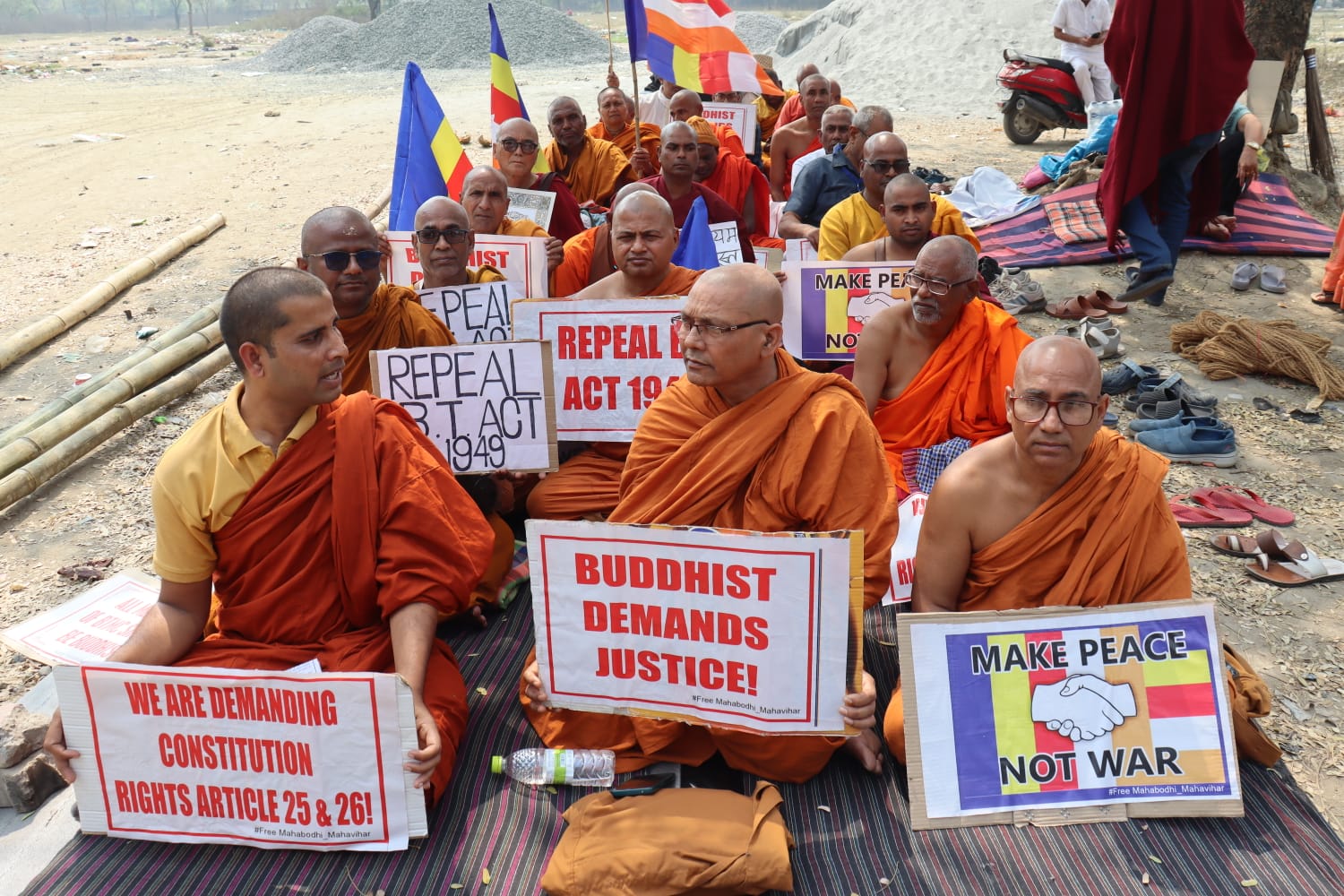
India, the birthplace of Buddhism, is witnessing a historic movement—the Mahabodhi Vihar Liberation Movement. This movement, led by Buddhist monks, demands full control of the Mahabodhi Temple in Bodh Gaya, a sacred site where Lord Buddha attained enlightenment. The demand for temple control stems from the Bodh Gaya Temple Act of 1949, which gives Hindus a majority role in its management. Now, Buddhist leaders and activists argue that this act violates their religious rights and must be repealed.
Historical Background: Why is This Movement Happening?
1. The Significance of the Mahabodhi Temple
The Mahabodhi Temple in Bihar’s Bodh Gaya is one of the holiest sites for Buddhists worldwide. It is believed that Gautama Buddha attained enlightenment under the Bodhi tree here over 2,500 years ago. Emperor Ashoka (268–232 BCE) played a crucial role in preserving the site and spreading Buddhism across Asia.
However, centuries later, Buddhism declined in India, and Hindu Mahants took control of the Mahabodhi Temple. By the 19th century, British authorities allowed Hindu caretakers to continue managing the temple, leading to Buddhist protests.
2. The 1891 Movement by Anagarika Dharmapala
In 1891, Sri Lankan Buddhist leader Anagarika Dharmapala launched a movement demanding Buddhist control over Mahabodhi Temple. He founded the Mahabodhi Society to restore the site to Buddhists, but his efforts were only partially successful. The temple remained under Hindu control until 1949.
3. The Bodh Gaya Temple Act of 1949 (BT Act)
After India’s independence, the government introduced the Bodh Gaya Temple Act, 1949 (BT Act). This law created a nine-member management committee with a mandatory Hindu majority:
- 5 Hindus (including the District Magistrate as chairman)
- 4 Buddhists
This meant that Buddhists could not hold the chairperson’s position in their holiest shrine, unlike in Buddhist-majority countries such as Sri Lanka, Myanmar, Thailand, and Japan, where Buddhist sites are managed exclusively by Buddhists.
For decades, Buddhist monks have demanded the repeal of the BT Act, but their voices were ignored. Now, a renewed movement—the Mahabodhi Vihar Liberation Movement—has reignited the struggle.
Demands of the Mahabodhi Vihar Liberation Movement
- Repeal the Bodh Gaya Temple Act, 1949
- The BT Act must be abolished as it prevents Buddhists from having full control over their sacred temple.
- Hand Over Mahabodhi Temple to Buddhists
- The Mahabodhi Temple should be managed exclusively by Buddhist monks and institutions, like other Buddhist religious sites around the world.
- End Hindu Majority in the Management Committee
- The current Hindu-majority committee should be replaced with an all-Buddhist committee to protect Buddhist religious rights.
- Recognize the Temple’s Global Buddhist Importance
- The temple is a UNESCO World Heritage Site, visited by millions of Buddhists from Sri Lanka, Myanmar, Thailand, Japan, South Korea, and other countries. The Indian government should ensure that its administration reflects Buddhist heritage.
Impact of the Movement
1. International Reactions
The movement has attracted global attention. Buddhist-majority countries like Sri Lanka, Myanmar, Thailand, Japan, and South Korea are closely watching the situation. If India fails to act, it could damage diplomatic relations with these nations.
2. India’s Secularism Under Question
India is a secular nation, yet its laws allow non-Buddhists to control a major Buddhist shrine. This has sparked debates on religious freedom and the fairness of India’s temple administration policies.
3. Impact on Buddhist Tourism
Bodh Gaya is one of the most visited Buddhist pilgrimage sites. If Buddhists feel alienated, international tourism to India’s Buddhist heritage sites may decline, impacting the economy.
4. Nationwide Protests and Political Pressure
The movement is spreading across India, especially in Uttar Pradesh, Maharashtra, and Bihar, where large Buddhist communities are rallying in support. If the government does not act, massive protests in Delhi and Bodh Gaya may escalate.
Current Situation: What’s Next?
Since February 12, 2025, thousands of Buddhist monks have been protesting in Bodh Gaya, demanding action. The leader of the movement, Bhante Vinacharya, has issued an ultimatum to the Indian government:
- If their demands are not met by April 20, 2025, the monks will march from Delhi to Bodh Gaya in a nationwide protest.
The government has yet to respond officially, but Buddhist activists are determined to continue the struggle until justice is served.
The Mahabodhi Vihar Liberation Movement is not just about temple management—it is about religious rights, historical justice, and India’s commitment to secularism. As the movement gains momentum, the Indian government faces a critical decision: Will it respect Buddhist heritage and reform the BT Act, or will it allow tensions to escalate?
The world is watching. The question remains: Will Buddhists finally regain full control of their most sacred temple in India?
