


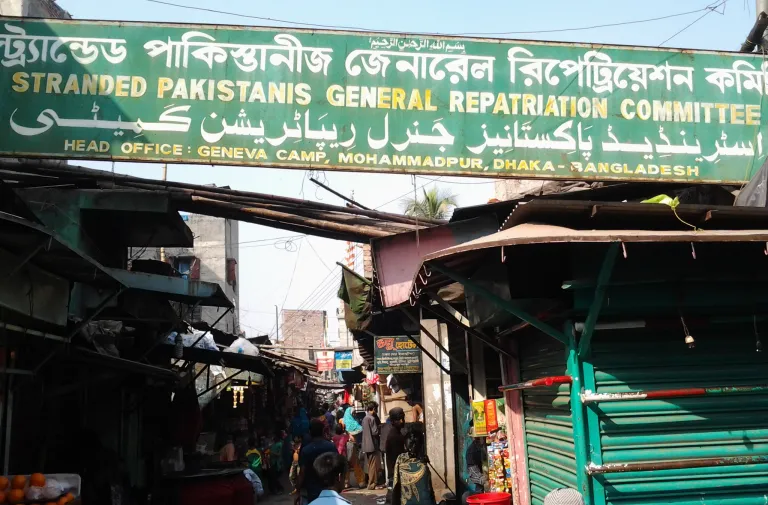
The interim administration in Bangladesh under Nobel laureate Muhammad Yunus has created a power vacuum that foreign actors are exploiting at an alarming rate. Among them, Pakistan’s notorious Inter-Services Intelligence (ISI) is expanding its footprint in Bangladesh, using one of South Asia’s most marginalised communities as its newest proxy.
The Urdu-speaking Bihari community, commonly known as “Stranded Pakistanis”, has lived for decades in limbo inside Bangladesh. Descendants of migrants who sided with Pakistan during the 1971 Liberation War, they were rejected by both Islamabad and Dhaka. Today, hundreds of thousands still inhabit cramped camps, facing unemployment, discrimination and statelessness.
According to multiple local intelligence reports and investigative accounts, ISI operatives have begun exploiting this community’s frustration and poverty to recruit foot soldiers under a project allegedly codenamed “Take Back East Pakistan”. Young men and women from Bihari settlements are reportedly being flown to Pakistan-occupied Kashmir (PoK) for training in weapons handling, explosives and guerrilla tactics. Upon return, they are redeployed across Bangladesh with explicit orders to destabilise the country and, ultimately, to target India.
These operations, according to sources in Bangladesh’s intelligence community, have evolved into what ISI now calls the “Mohajir Regiment”. This clandestine force, they claim, already numbers in the tens of thousands. Over the past year, trained members have allegedly participated in attacks on police stations, jailbreaks and seizures of armouries during Bangladesh’s post-Hasina chaos.
Since early 2025, ISI activity in Dhaka has reportedly intensified. Covert offices have been established to coordinate recruitment, financing and infiltration operations. More disturbingly, the network is said to have begun inserting small groups of trained fighters into Indian territory to establish sleeper cells and conduct reconnaissance for future terrorist operations.
While some of these details await independent corroboration, they fit a familiar ISI pattern: weaponising marginalised communities and exploiting regional instability for strategic gain.
Intelligence sources further suggest that ISI is using Bangladesh as a corridor for drug and arms trafficking, generating vast illicit profits to finance the “Mohajir Regiment” and other Islamist groups. The collapse of law and order since Sheikh Hasina’s ouster has only strengthened these networks.
ISI’s creation of a “Mohajir Regiment” marks a dangerous escalation in Pakistan’s regional proxy strategy, a fusion of terrorism, narcotics and hybrid warfare. Bangladesh’s turmoil has offered Islamabad a new staging ground; India could be its next target.
If this nexus of narco-terrorism takes root, it would not only threaten Bangladesh’s sovereignty but also open a new front in ISI’s long campaign of asymmetric warfare against India. Smuggling routes from Cox’s Bazar through West Bengal and Assam could become arteries of infiltration, feeding trained militants and weapons into Indian territory.
For India, this development is a clear and present danger. A radicalised, ISI-influenced Bangladesh on its eastern flank would severely complicate regional security. The possibility of ISI-backed sleeper cells infiltrating Indian territory under the cover of migration or trade must be treated as an urgent counterterrorism priority.
India’s border with Bangladesh, stretching more than 4,000 kilometres, remains porous despite fencing and surveillance. Any large-scale mobilisation of trained operatives disguised as refugees could overwhelm local policing and destabilise sensitive regions of Assam, West Bengal and Tripura.
Moreover, a militarised “Mohajir Regiment” could spark sectarian violence within Bangladesh itself, creating a new wave of refugees and humanitarian crises that would inevitably spill over into India.
(Salah Uddin Shoaib Choudhury is an award-winning journalist, writer and editor of the newspaper Blitz, Bangladesh. He specialises in counterterrorism and regional geopolitics)
