

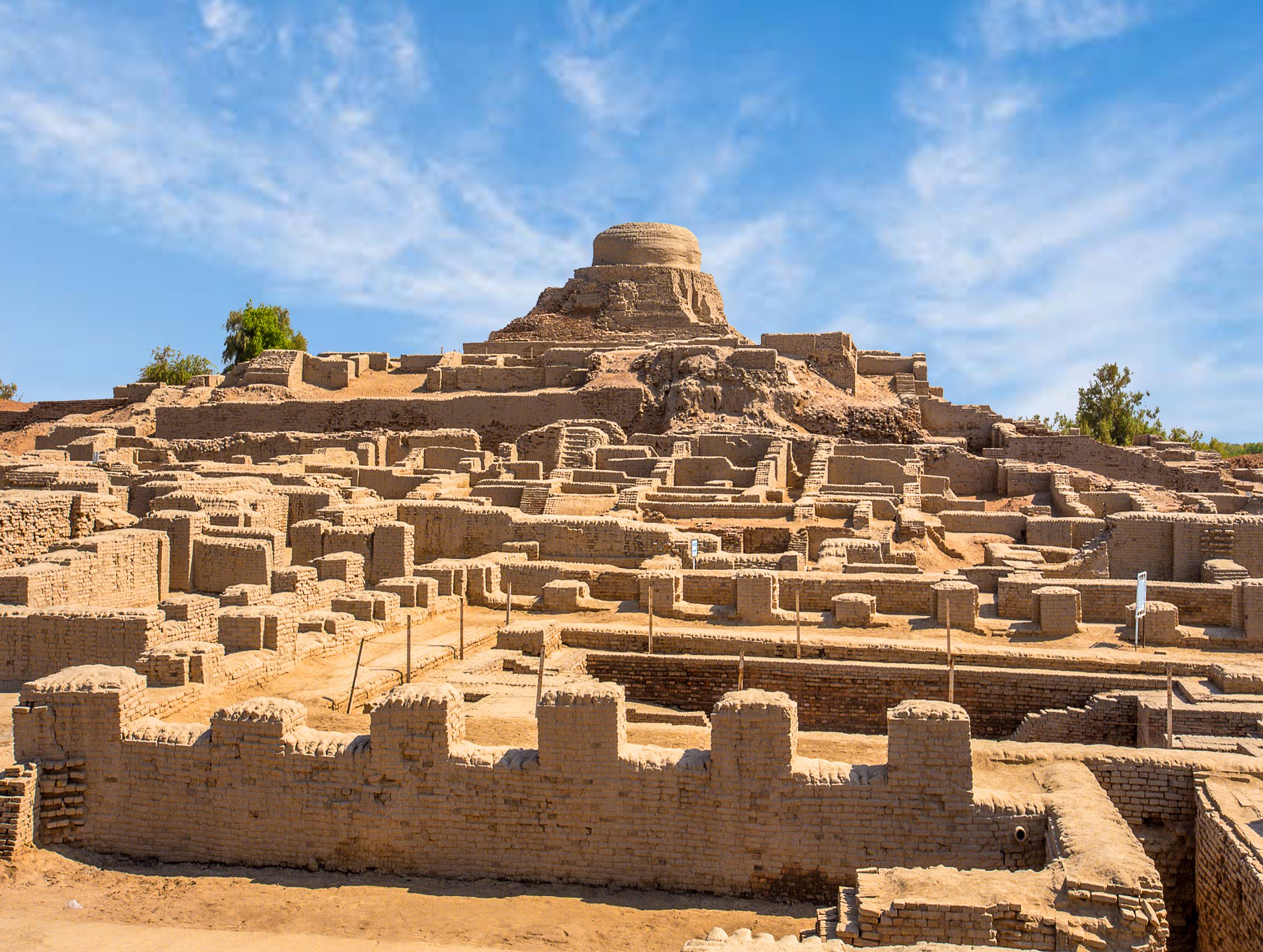
Pakistan’s renewed embrace of the Indus Civilisation comes after decades of defining itself almost exclusively through an Islamic identity. While archaeology continues to reshape the understanding of the ancient Indian subcontinent, history should not become an instrument of contemporary politics.
Historical narratives evolve with discoveries, better research and fresh perspectives. That is precisely what has happened over the past two decades with our understanding of the ancient Indian subcontinent. Ironically, the scholarly reassessment now coincides with Pakistan’s sudden attempt to identify itself with the Indus Civilisation after decades of distancing itself from that very heritage.
The question is not whether modern Pakistan forms part of the geography of the ancient civilisation. It undeniably does. The real question is why this shared inheritance has become politically useful only now.
Long before Europe and northern Asia emerged from their frozen landscapes, the inhabited world flourished around the Indian Ocean. The earliest long-distance trading networks radiated from the Indian subcontinent, whose two extensive coastlines became the hub of maritime exchange stretching from East Africa to Southeast Asia and beyond.
As the Ice Age ended, three massive episodes of sea-level rise reshaped the world’s coastlines. At the same time, the melting Himalayan glaciers created or expanded seven great rivers across northern India, enabling an estimated 10 per cent of the world’s population to flourish. We now know that the Sarasvati was the greatest of these rivers, which is why increasing numbers of scholars prefer the term Indus-Sarasvati or Sarasvati-Sindhu Civilisation rather than the older “Indus Valley Civilisation”.
Its archaeological footprint certainly extends into present-day Pakistan. That is why the phrase “the Indian subcontinent” is used deliberately rather than simply “India” in my own work. Earlier Eurocentric historians tended to divide ancient history into neatly separated civilisations such as Pharaonic Egypt, Greece and Rome. That framework left little room for recognising the central role of the subcontinent in shaping the wider ancient world.
Fortunately, several distinguished historians encouraged this broader interpretation. They also highlighted evidence supporting it, including the remarkable number of maritime terms in Thai and Khmer that derive from Sanskrit. Reviews following publication were similarly encouraging, reflecting a growing willingness among scholars to reassess long-held assumptions.
One principal argument is that north-western India played a vital role in sustaining Mesopotamia. Apart from the narrow fertile belts along the Tigris and Euphrates, Mesopotamia had become largely desert by around 3000 BC. Although it has traditionally been described as the “cradle of civilisation”, it could not sustain itself without imports.
Those imports came from the agricultural surpluses of the Indus-Sarasvati region. Food and timber were indispensable. As with other successful maritime civilisations throughout history, commercial prosperity generated intellectual advancement. Knowledge flourished across mathematics, geometry, algebra, biology, medicine, astronomy, metallurgy, philosophy, governance and history.
The influence of this intellectual tradition survives even today. Mathematics based on units of four remains embedded in the number of seconds in a minute, minutes in an hour, hours in a day, degrees in a circle and even imperial weights. The so-called Arabic numerals, including the indispensable concept of zero, ultimately reached Europe through the Arabs after the collapse of the Roman Empire plunged much of Europe into the Dark Ages.
The subcontinent’s influence extended far beyond commerce. I argue that the Indo-European languages spread from the northern subcontinent in three distinct waves, giving rise to the Germanic-Slavic, Romance-Celtic and Greek language groups. In Japan, the gates of Shinto shrines continue to be guarded by Indian wind and thunder deities, while Kyoto’s Sanjusangen-do temple houses 28 Indian gods flanking the Buddha, including Ashura, who had earlier become Ahura Mazda in Persia.
Archaeology has continued to reinforce the case for the subcontinent’s extraordinary antiquity. Around 2000, underwater explorations in the Gulf of Cambay uncovered a drowned port on the banks of an ancient river, together with a second port farther south, suggesting two separate inundation events that could place the earliest settlement before 9500 BC. Dredging recovered evidence of human activity dating to around 29,000 BC, sun-dried clay pottery from approximately 24,000 BC, primitive fired pottery from about 18,000 BC and high-quality pottery dating to around 11,000 BC. Surely, this must be Dvarka of Mahabharata fame.
Subsequent discoveries have been equally remarkable. Bhirrana, on the banks of the Sarasvati, has been dated to between 7570 and 6200 BC. Off Poompuhar in southern India, archaeologists have identified an extensive submerged port complex they believe may be around 15,000 years old, although I have yet to see conclusive evidence supporting that precise date.
Taken together, these discoveries, alongside the abandonment of the Aryan Migration theory and a growing appreciation of maritime trade, are transforming our understanding of the ancient world. Increasingly, historians are reassessing the central place of the Indian subcontinent in global civilisation.
The question is whether Pakistan is undertaking a similar reassessment for historical reasons or political ones.
Since Partition in 1947, Pakistan has defined itself overwhelmingly through its Islamic identity. Among religious extremists, little of significance is acknowledged before the Prophet Mohammed. Aurangzeb attempted to destroy the Buddhas of Bamiyan, a task completed by the Taliban in 2001, while the Islamic State later demolished priceless Mesopotamian antiquities.
Having spent decades emphasising its Arab-Islamic identity and distancing itself from India’s civilisational inheritance, Pakistan now appears to be embracing that very past. Noted Pakistani sociologist Dr Shahid Rashid has argued that “the narrow-minded belief that Sanskrit isn’t our tongue… should be discarded”, while Information Minister Attaullah Tarar has declared that Pakistanis are “children of the Indus Valley”.
Indians have generally welcomed the rejection of the Aryan Invasion or Migration theory and the renewed recognition of the subcontinent’s importance in early world history. Pakistan, however, confronts a more complex dilemma. Its sudden rediscovery of the Indus heritage appears less like an organic historical reassessment than a politically convenient shift, perhaps linked to contemporary disputes over the waters of the Indus River.
Yet this shared civilisational legacy need not be a source of rivalry. It could instead become common ground.
As a non-Indian, what strikes me most about Indian history is not the continuity of political boundaries but the remarkable continuity of its civilisational traditions, cultural beliefs and religious practices, alongside their enduring global influence.
The Indus-Sarasvati civilisation belongs to the shared heritage of humanity. The question is whether Pakistan’s post-Partition narrative, built upon defining itself as wholly separate from India, will allow it to embrace that continuity honestly or whether present-day politics will continue to shape its reading of the past.