


On June 17, 2026, Rahul Gandhi, the Leader of the Opposition in the Lok Sabha, stood before thousands of students in Kota, Rajasthan, the nerve centre of India’s high-stakes coaching economy, and called the Indian education system an “extortion machine” and a “rejection system”. He did not use the language of electoral politics. He used the language of lived pain.
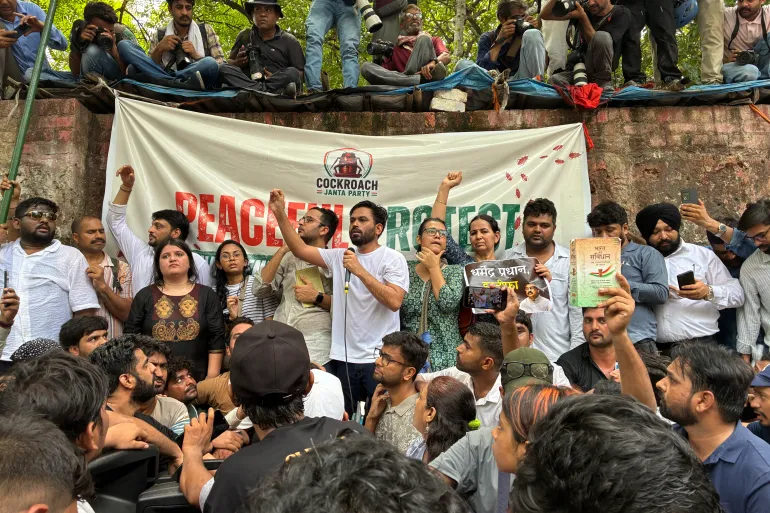
Barely a month earlier, on May 16, 2026, a 30-year-old Indian student in Boston named Abhijeet Dipke had launched the Cockroach Janata Party (CJP), a satirical political movement born from Chief Justice of India Surya Kant’s controversial comparison of unemployed youth to “cockroaches and parasites of society”. Within days, the CJP had amassed more than 20 million Instagram followers, surpassing the online reach of most mainstream political parties. By early June, young people wearing cockroach masks were marching at Jantar Mantar in New Delhi, chanting: “Cockroaches are coming, Dharmendra Pradhan is going!”
These are not unconnected events. Together, they mark a defining rupture in the relationship between the Indian state and its youth. The trigger in both cases was the same: the NEET-UG 2026 paper leak. The examination, held on May 3, 2026, for more than 2.27 million medical aspirants, was cancelled on May 12 following revelations of a vast paper-leak network linking coaching-centre insiders, chemistry professors in Pune and Rajasthan, and NTA personnel. A CBI investigation subsequently revealed that the same racket had also compromised NEET-UG 2025.
But the anger runs far deeper than a single examination. The Kota speech and the Cockroach movement are symptoms of a systemic collapse. Indian education does not merely need repair. It needs reimagining. Here are twenty analytical points that illuminate what is truly ailing the system.
I. THE ECONOMICS OF EDUCATIONAL EXPLOITATION
1. A Nation Underfunds Its Future: The Budgetary Betrayal
The National Education Policy (NEP) 2020 made a categorical promise: India would invest 6 per cent of its GDP in education. In 2026, that promise remains unmet. The combined public spending on education by the Centre and most state governments continues to hover below 3 per cent of GDP, a gap that widens with every passing year. The Union education budget in 2025-26 stands at approximately Rs 1.48 lakh crore, a large-sounding number until placed against the scale of the task.
Rahul Gandhi’s Kota address delivered a staggering comparison: families of the approximately 22 lakh NEET aspirants alone collectively spend amounts comparable to the government’s entire education budget, just for one examination’s coaching, hostel accommodation, travel and application costs. The exact arithmetic of individual state NEET application fees is debated, but the moral arithmetic is undeniable: the Indian state is significantly underinvesting while extracting massive sums from student families through an examination economy that has grown entirely without social safety nets.
“India’s education system is an extortion machine. We want a system that allows you to dream big,” Rahul Gandhi said in Kota on 17 June 2026.
2. The Rs 6 Lakh Crore Scandal: Exam Fees vs Social Welfare
Consider this: the total budgetary allocation by the Central Government for five critical ministries, Education, Health, Women and Child Development, Sports, and Youth Affairs, comes to less than Rs 6 lakh crore. As Gandhi pointed out in Kota, this is comparable to the total fees collected annually across all public examinations in India: NEET, JEE, UPSC, SSC, RRB, CUET, state PSC examinations, banking exams and dozens of others combined.
This is the paradox of the Indian developmental state in education: it collects from those who aspire but invests far less than it promises. The examination economy has become a parallel tax on ambition, paid mostly by the non-rich, with no certainty of return. When a government spends less on social welfare than it collects from desperate exam-takers, it is not running an education system. It is running a lottery.
3. Degrees Without Destinies: The Employability Collapse
Rahul Gandhi presented a set of figures in Kota that crystallise the employability crisis: of every 1,000 students who enter the primary education pipeline, only 12 eventually secure formal graduate-level employment. Another 693 are absorbed into informal, part-time or gig-economy work, precarious, unprotected and economically vulnerable. The remainder face structural unemployment.
These numbers may be political formulations rather than peer-reviewed data, but they reflect a documented reality. The All India Survey on Higher Education (AISHE), CMIE surveys, Periodic Labour Force Surveys and industry employability reports consistently confirm that the majority of Indian graduates, across disciplines, are not employment-ready by the standards of modern enterprises. Degrees signal completion of syllabi, not the acquisition of skills. The system manufactures educated unemployability on an industrial scale.
4. Rejection Machine: A System Designed for Failure
Of the more than 2.27 million students who appeared for NEET-UG 2026, fewer than one lakh would have secured seats in government medical colleges. For UPSC Civil Services, anywhere between 10 lakh and 13 lakh candidates typically compete for approximately 1,000 final selections annually. JEE Advanced, the gateway to the IITs, admits fewer than 17,000 students from more than 2.5 lakh qualified candidates. These are not selection systems. They are mathematically designed rejection machines.
The system treats the 98 per cent who do not make the cut as failures, not as individuals who simply did not clear one examination. There are no dignified alternative pathways for most students, no robust apprenticeship systems, no vocational routes with equivalent social recognition and no safety nets for the years of investment made. As Gandhi declared in Kota, the examination system is built around rejection, not selection.
II. INFRASTRUCTURE IN FREEFALL
5. 92,000 Schoolrooms Gone: The Silent Dismantling of Public Education
Across India, approximately 92,000 government schools have been closed or merged in recent years. The official justifications of low enrolment, rationalisation and infrastructural deficiencies cloak a graver reality: the systematic starving of the public school system has made closures self-fulfilling. When parents see crumbling buildings, absent teachers and a lack of laboratories, they withdraw their children. Enrolment falls. The school ‘fails’ by the government’s own metric. And then it closes.
The trend is sharpest in BJP-ruled states. Kerala, governed by the Left Democratic Front, stands in contrast. It has witnessed the fewest school closures and has consistently invested in upgrading public-school infrastructure through computer laboratories, midday meals, libraries and inclusive design. Tamil Nadu and Himachal Pradesh have also maintained relatively stronger public-school systems. The political variable is not incidental. School closures are a policy choice.
The consequences fall most heavily on girls, children with disabilities, first-generation learners, Dalit and Adivasi children, and rural communities. When a village school closes, the distance to the next school increases. Dropout risks rise. Education retreats from the margins precisely where it is needed most.
6. Science Without Laboratories: A Blackboard Republic
For the overwhelming majority of India’s students, particularly those in government schools, low-cost private schools and underfunded colleges, science remains a theoretical exercise. Chemistry is taught without beakers, biology without specimens and physics without instruments. Students memorise diagrams of the human digestive system without ever examining a model. They solve numerical problems on electrical circuits without ever constructing one.
This is not merely a pedagogical failure; it is also a failure of imagination about what education is meant to achieve. Scientific temper, enshrined in Article 51A(h) of the Constitution, cannot be cultivated through the rote reproduction of textbook diagrams. Laboratory practice, hypothesis testing, observation and experimentation are the foundations of scientific citizenship. Without them, India produces rote learners who can pass standardised examinations but cannot adapt to a world that increasingly demands creativity, innovation and problem-solving.
7. The Life Skills Gap: No Financial, Legal or Health Literacy
Indian school curricula remain largely disconnected from the realities of adult life. A student who completes Class XII with distinction may still not know how to read an insurance policy, identify a predatory loan, understand consent and bodily autonomy, access government welfare schemes, recognise the symptoms of common illnesses, file a consumer complaint or verify a piece of viral misinformation. Schools teach trigonometry but not tax literacy. They teach the speed of sound but not the sound of one’s rights.
Financial literacy, health education, legal awareness, civic rights, mental health, digital safety, climate science and media literacy remain largely absent or merely tokenistic in most curricula. This leaves young Indians, particularly those from lower-income and first-generation educated families, highly vulnerable to exploitation, misinformation, financial fraud, health emergencies and civic disenfranchisement.
8. EdTech: Disruption Without Transformation
The pandemic accelerated India’s edtech boom. Platforms offering recorded lectures, test-preparation kits, doubt-solving bots and AI tutors proliferated rapidly. Yet the deeper pedagogical structure remained unchanged. A video lecture is still a lecture. A digital multiple-choice examination remains a test of memory. The medium changed; the method did not.
More critically, edtech has deepened inequality rather than reducing it. Students with reliable internet access, personal devices, quiet study spaces and technologically literate parents can use digital tools effectively. Students without these advantages, a demographic that includes much of rural India, found themselves doubly disadvantaged during and after the pandemic. They lost years of learning while their urban peers moved ahead. The digital divide in Indian education is not a residual problem. It is a structural one.
III. PEDAGOGY FROZEN IN TIME
9. The Rote Empire: Memory Mistaken for Intelligence
The Indian classroom remains deeply hierarchical and teacher-centred. Students are discouraged from questioning, debating, disagreeing or arriving at answers through independent reasoning. The mark is the metric, and the mark is awarded for reproducing the correct answer rather than for the quality of the reasoning that produced it. Curiosity is not rewarded; conformity is.
Assessment design drives teaching. When examinations reward memorisation, schools teach memorisation. The result is a vast population of young people who spend twelve to sixteen years in education yet emerge without the capacities that the 21st-century economy and democracy actually require: critical thinking, collaborative problem-solving, evidence evaluation, creative risk-taking and adaptive learning. India’s education system continues to train students for a pre-digital world in a post-AI era.
10. NEP 2020 and the Skilling Mirage: Promised, Not Delivered
The National Education Policy 2020 represented an ambitious and, in many ways, overdue reimagining of Indian education. Its emphasis on vocational education, multidisciplinary learning, mother-tongue instruction in the early years and holistic assessment offered a genuine alternative to the rote-examination culture. On paper, it was among the most thoughtful education frameworks India has produced.
In practice, implementation has been uneven and slow. Vocational education remains stigmatised as a ‘lesser’ pathway for those unable to compete academically. The National Skill Development Corporation (NSDC) has repeatedly come under criticism from parliamentary committees, CAG reports and industry associations for missed targets, low placement rates, inadequate quality control and a failure to align training programmes with actual labour-market demand. Skilling without placement is a fraud by another name, and many young people have experienced precisely that.
11. Coaching Industrial Complex: Shadow Ministry of Education
In Kota, Hyderabad, Delhi, Chennai, Pune and dozens of smaller cities, the coaching industry has effectively replaced schooling as the ‘real’ education system for competitive examinations. Families mortgage homes, sell farmland and take bank loans to fund two, three or even four years of coaching. The Kota ecosystem alone is estimated to be worth thousands of crores and accommodates more than two lakh students at any given time.
The coaching industry thrives precisely because the public education system fails to prepare students adequately for competitive examinations, while those examinations have become hyper-scarce gateways to meaningful economic opportunities. It is a market born of public failure. Yet it remains largely unregulated, wildly uneven in quality and deeply extractive of middle-class and lower-middle-class family resources. When coaching success becomes the principal determinant of social mobility, merit itself becomes a function of purchasing power.
V. THE HUMAN COST: SUICIDES, DROPOUTS AND BRAIN DRAIN
15. Student Suicides: The Darkest Metric of Systemic Violence
Student suicides are the most devastating consequence of the education system’s failures. Kota alone has witnessed dozens of student suicides in recent years, prompting interventions ranging from modifications to ceiling fans in hostel rooms to inadequately resourced counselling services. In the immediate aftermath of the 2026 NEET paper leak, media reports confirmed that at least three students took their own lives following the trauma of a cancelled examination. Years of preparation and family sacrifice were destroyed in a moment of institutional failure.
High-school dropout rates, particularly among girls, Dalit students, children from migratory labour families and students from Muslim communities, also reflect a system that fails to support the most vulnerable. Each dropout is not merely a statistical entry. It is a life constrained by poverty, distance, examination anxiety, social discrimination, domestic pressure or the simple absence of a school worth attending. No examination reform will address this crisis without parallel investment in nutrition, mental health, social protection and an inclusive school culture.
“When the highest judicial authority calls the youth cockroaches, and three students die after a paper leak, the education system has crossed from failure into crisis.”
16. 2 Million and Counting: The Study-Abroad Exodus
By 2025, more than 2 million Indian students were enrolled in foreign universities in Canada, the United States, the United Kingdom, Australia, Germany, Ireland, the UAE, Singapore and elsewhere. This is not primarily a story of global ambition or the appeal of foreign credentials. It is, to a significant extent, a story of distrust.
When a family invests Rs 50 lakh to Rs 1 crore or more in sending a child abroad, it is effectively voting with its savings against the domestic higher-education system. India’s public universities, with the notable exception of a small group of IITs, IIMs, IISc, NLUs, AIIMS and a handful of central universities, offer limited research environments, weak pedagogical cultures, infrastructure gaps and uncertain employment pathways. Private universities vary enormously in quality, with many offering degrees that are neither academically rigorous nor widely recognised by employers. The study-abroad surge is the market’s own verdict on Indian higher education.
17. Paper-Leak Epidemic: Merit Destroyed by Organised Crime
The 2026 NEET paper leak was not an aberration. It formed part of a documented pattern. NEET-UG 2024 was similarly rocked by paper-leak allegations that reached the Supreme Court. The 2026 CBI investigation revealed that the same network responsible for the 2026 breach had also compromised NEET-UG 2025. CUET-UG 2026 experienced technical glitches affecting thousands of candidates, while CBSE’s online marking portal suffered a security breach exposed by a 19-year-old student. SSC examinations have also faced recurring allegations of fraud.
For students, particularly those from lower-income families who have no access to private-sector alternatives or overseas education, public examinations remain the only meritocratic ladder available. When paper leaks destroy that ladder, the social contract breaks down entirely. Young people are not merely angry. They are rationally outraged. The state has failed to protect the one mechanism it claimed was fair.
VI. STRUCTURAL AND GOVERNANCE FAILURES
18. Institutional Autonomy Eroded: Campuses Under Surveillance
India’s universities and colleges are constitutionally intended to be spaces of intellectual inquiry, democratic debate and academic freedom. In practice, many have witnessed a contraction of those freedoms. The appointment of politically aligned vice-chancellors over academically distinguished candidates, the shrinking of elected student-union spaces, the use of institutional authority to silence dissent and the filing of FIRs against protesting students and faculty are documented trends that have chilled the intellectual climate on campuses.
University campuses have historically produced the ideas, movements and leaders that drive societies forward. From the freedom movement to the post-Emergency revival of democracy, Indian campuses have served as incubators of civic change. When campuses become sites of surveillance and conformity rather than inquiry and debate, they cease to produce thinkers. They produce credentials without conviction, graduates who have learned to remain silent.
19. Teacher Crisis: Understaffed, Undervalued, Overburdened
No education system can outperform the quality of its teachers, and India’s teaching workforce is under severe strain. Across states, teacher vacancies in government schools run into the hundreds of thousands. The heavy dependence on para-teachers, contractual instructors and Shiksha Mitras, who are often paid a fraction of regular teachers’ salaries and lack pension benefits or job security, has created significant pedagogical discontinuities.
Regular teachers, meanwhile, are routinely assigned non-academic duties, including election work, census surveys, government-scheme data entry, midday-meal administration and compliance-related tasks. A teacher who spends substantial portions of the academic year on non-teaching responsibilities cannot function as a full-time educator. The teacher remains the single most important determinant of educational outcomes. Until India invests in dignified, well-trained, adequately compensated and academically focused teachers, no curriculum reform will close the learning gap.
20. Digital Divide: Two Indias, Two Educational Futures
The Covid-19 pandemic exposed with remarkable clarity what analysts had been documenting for years: India has two educational systems separated by a digital wall. Urban, upper-middle-class students adapted to online learning, accessed premium edtech platforms, maintained academic continuity and, in many cases, accelerated their preparation for competitive examinations. Rural, poor and first-generation students lost months or even years of learning because they lacked devices, internet connectivity, reliable electricity and quiet spaces in which to study.
This divide did not disappear after the pandemic. Digital infrastructure in government schools remains inconsistent. The PM e-VIDYA initiative and similar programmes have suffered implementation gaps. Many students in aspirational districts across Chhattisgarh, Jharkhand, Uttar Pradesh, Bihar, Rajasthan and the North East remain effectively excluded from digital learning. The digital divide is no longer simply an infrastructure challenge. It is an educational-equity crisis with intergenerational consequences.
21. Cockroach Generation: Satire as Political Language
The Cockroach Janata Party, founded on May 16, 2026, by Abhijeet Dipke in response to Chief Justice Surya Kant’s remarks, represents a new grammar of youth politics in India. The CJP’s examination manifesto demanded Rs 10,000 in compensation for each candidate affected by a paper leak, transparent testing processes, physical verification of answer sheets and an independent audit of government contracts awarded to private examination agencies. These are not frivolous demands. They are specific, practical and constitutionally grounded.
The CJP’s rapid growth to more than 20 million followers, drawing support from figures as diverse as Sonam Wangchuk, Prashant Bhushan and Anna Hazare, demonstrates that the movement touched a genuine nerve. The government’s response, including allegations that the CJP’s Instagram page was blocked on national-security grounds when it had fewer than one lakh followers, the filing of suo motu petitions, and a Union minister’s claim that 49 per cent of followers were Pakistani, a claim subsequently challenged by independent audience analytics showing more than 94 per cent Indian followers, only strengthened the movement’s credibility among young people.
When a satirical political party attracts more youth engagement than most parliamentary parties, it is not a novelty. It is a referendum on institutional legitimacy.
CONCLUSION
22. From Extortion Machine to Empowerment Engine: What India Must Do
India’s young people are not agitated because they are impatient, entitled or misinformed. They are agitated because they have studied, paid, waited, applied, suffered the consequences of paper leaks, endured delays, faced insults and repeatedly been told to try again. They have done everything the system asked of them. The system has not reciprocated.
The path forward requires political will, not merely policy documents. First, public investment in education must credibly move towards 6 per cent of GDP, not as a distant aspiration but as a budgeted commitment over the next five years. Second, the examination system must be overhauled. Paper security must be treated as critical national infrastructure, the NTA must be restructured with parliamentary accountability and examinations must evolve into multiple-attempt processes rather than single-point elimination contests.
Third, assessment must shift from memory to competence. Portfolios, projects, practicals, internships, oral examinations, community assignments and problem-solving exercises must carry weight alongside written examinations. Fourth, vocational education must be destigmatised, adequately resourced and linked directly to employment through mandatory apprenticeship requirements for MSMEs, the public sector, panchayats and social enterprises.
Fifth, school closures must stop. Every neighbourhood school, however small, is a democratic institution. Sixth, mental health must be treated as an essential component of educational infrastructure. Counsellors, peer-support systems, suicide-prevention protocols and pressure-reduction mechanisms should become mandatory, not optional, in schools, colleges and coaching centres.
Seventh, the federal structure of education must be respected. Language policy should be guided by constitutional choice rather than administrative coercion. Curriculum reform must be scholarly rather than ideological. India’s civilisational heritage is rich enough to be taught without distorting history or excluding minorities.
Finally, young people must be treated as stakeholders, not managed as a vote bank. Rahul Gandhi’s Kota convention and the Cockroach Janata Party have, in different ways, conveyed the same message: India’s youth are watching. They are counting. They are organising. And they will not be crushed quietly.
The demographic dividend that India so often celebrates is not a guarantee. It is a wager. That wager will be won or lost in classrooms, laboratories, counselling rooms, examination halls and employment offices. At present, India is losing it. The only question is whether those in power are listening carefully enough to change the outcome, or whether they would prefer the cockroaches to remain silent.
(Prof Ujjwal K Chowdhury is a senior educationist and author)