The US-Israeli military campaign against Iran that began in late February 2026 has been widely framed as an energy crisis. Brent crude touched $126 per barrel in March. Iranian drones struck Qatar’s Ras Laffan LNG complex. The International Energy Agency described the resulting disruption as the largest supply shock in the history of the global oil market.
All of that matters. Yet the more consequential story is unfolding further downstream. The Strait of Hormuz, a 24-mile-wide chokepoint at the mouth of the Persian Gulf, is rewriting the economics of food production for hundreds of millions of people, including India’s farmers and consumers. It is a story about urea, phosphate, sulphur and the crop calendar. In India, those four words carry a weight that no stock-market ticker can fully capture.
Before Iran’s retaliatory blockade brought maritime traffic through Hormuz down by 95 per cent, the waterway carried far more than oil. One-third of globally traded fertiliser moved through the strait. Forty-five per cent of the world’s sulphur supply, a critical phosphate fertiliser input, passed through Hormuz. Iran alone operated seven urea plants producing 4.5 million tonnes annually. Gulf producers collectively account for a significant share of the diammonium phosphate and potassium used by Indian farmers every kharif and rabi season.
When Kpler’s vessel-tracking data showed only 191 ship crossings in April 2026, compared with a pre-war monthly average of 3,000, it signalled more than an energy emergency. It marked the beginning of a fertiliser crisis.
The warning signs are already visible. Urea prices surged 46 per cent in a single month. Russia suspended ammonium nitrate exports. China blocked phosphate exports, removing roughly a quarter of global supply. US domestic fertiliser availability fell to 75 per cent of normal by mid-March.
The consequences are spreading rapidly. The FAO Food Price Index stood at 130.7 in April 2026, its highest level in three years. The World Food Programme estimates that an additional 45 million people could face acute hunger by mid-2026, on top of the 360 million already experiencing food insecurity worldwide.
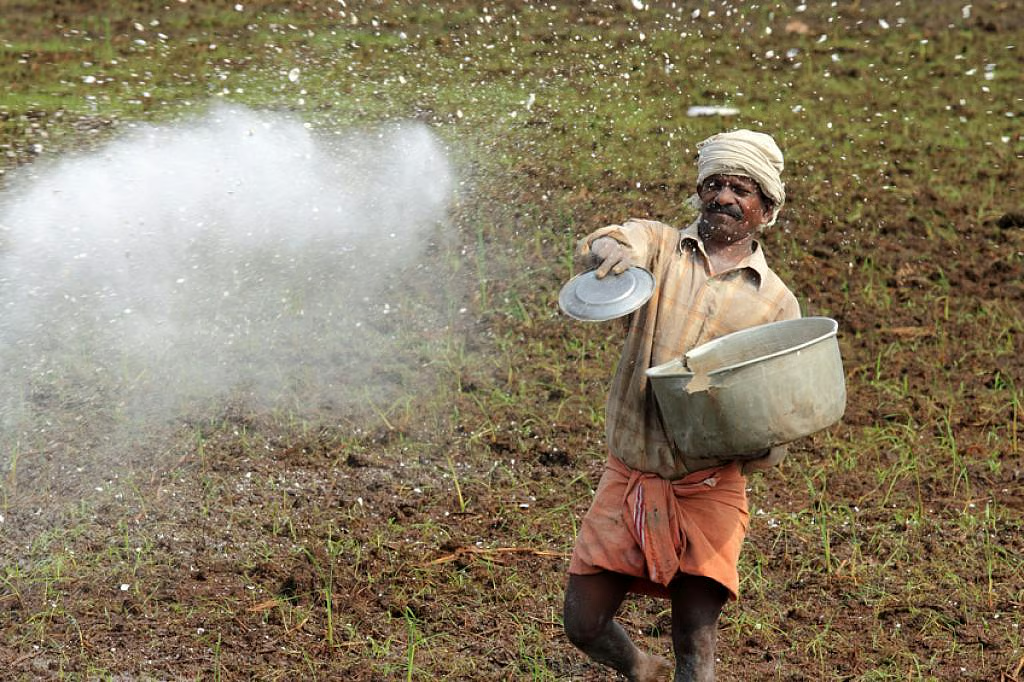
For India, the risks emerge along several fault lines. First is fertiliser dependency. India imports a substantial share of its urea and phosphatic fertiliser requirements, much of it historically sourced from Gulf producers. Delayed shipments do not simply mean higher costs; they threaten planting schedules.
As the FAO Director-General has warned, agriculture operates within a crop calendar that cannot be postponed. Fertilisers must be applied at specific moments. If they do not arrive on time, yields suffer regardless of what happens later. That warning applies directly to the kharif sowing season now approaching.
Second is the energy-agriculture nexus. With Hormuz disrupted and Gulf LNG supplies constrained, energy costs are feeding directly into cultivation costs. Diesel prices affect tractors, irrigation pumps and transport networks. Cold-storage facilities, food-processing plants and controlled-environment agriculture all become more expensive to operate. This is not abstract macroeconomics. It affects every stage of the food supply chain, from farm to consumer.
Third is the risk of a hoarding cascade. Every major food crisis of the past two decades has demonstrated how scarcity becomes amplified. Governments impose export restrictions. Traders hold inventory in anticipation of higher prices. Consumers buy more than they need when shortages appear likely.
The combination of fertiliser shortages, rising energy costs and food inflation creates precisely the conditions in which these behaviours reinforce one another. Consumers ultimately bear the burden of decisions taken throughout the supply chain while possessing the least information and the fewest options.
This is where much policy discussion misses the point. Governments often respond to food-price pressures with familiar instruments such as procurement, price support, export restrictions and subsidy announcements. Some of these measures are necessary. However, they are primarily designed for demand-side shocks or disruptions affecting individual commodities.
The Hormuz blockade is fundamentally different. It combines an input shock, an energy shock, a logistics shock and a financial shock, all operating simultaneously and reinforcing one another.
The implications for agricultural production are significant. Research published in Nature Communications suggests that a 25 per cent reduction in nitrogen fertiliser availability could reduce yields of major cereals by between 8 and 15 per cent.
For a country producing more than 300 million tonnes of foodgrains annually, such losses are not marginal. They represent a genuine food-security challenge.
Even under relatively optimistic assumptions, the arithmetic remains uncomfortable. Planting decisions that shape the next harvest are already being made under conditions of fertiliser scarcity. Diplomacy may eventually ease tensions, but biology follows its own timetable.
That reality has immediate implications for India. Port delays at Mundra are already running between 40 and 49 days. At the same time, rising US Treasury yields, a weakening rupee and higher dollar-denominated import costs are tightening financial conditions precisely when government support may be most needed.
India exemplifies what UNCTAD has described as a compounding trap. Higher food and energy import costs weaken the currency, increase subsidy burdens and raise the cost of servicing dollar-denominated obligations. None of these pressures is individually catastrophic. Together, they become far more serious.
There are practical steps India can take. The immediate priority is securing available fertiliser supplies through bilateral arrangements wherever possible, rather than relying exclusively on volatile spot markets. Equally important is transparent communication with state governments and farmers regarding availability, delivery schedules and substitute inputs.
On the energy front, accelerating LPG supplies through alternative channels is both an economic and political necessity. The larger lesson, however, extends beyond the current crisis. India requires strategic fertiliser reserves comparable to its petroleum reserves, sufficient to cover at least one planting season. Such a mechanism would provide a critical buffer against precisely the kind of disruption now unfolding.
This institutional gap has existed for years. The cost of ignoring it is increasingly evident. More broadly, agricultural policy in India remains over-politicised and under-institutionalised. Farm issues receive constant political attention, yet the country still lacks the kind of long-term, evidence-based architecture that treats food security as a strategic priority on par with defence, energy or cyber security.
The Hormuz crisis did not create India’s vulnerabilities. It exposed them. The strait will eventually reopen. Trade flows will recover. Yet even optimistic industry estimates suggest that normalisation could take months, while some shortages may persist well into 2027.
What cannot be recovered are planting windows missed, fertiliser applications delayed and harvest decisions already made under constrained conditions. The era of assuming that global supply chains will always function smoothly has ended. That assumption was first shaken by the war in Ukraine. Hormuz has reinforced the lesson.
The next disruption will not wait for India to strengthen its institutions, build strategic reserves or redesign its policy framework. It will simply arrive.
A failed monsoon has never been merely a farm problem. It becomes a family problem, a village problem and ultimately a national problem. The Hormuz blockade is the geopolitical equivalent of a failed monsoon, transmitted through fertiliser supply chains and energy markets. India would be wise to treat it with the same seriousness.
(Rakesh Chitkara is Country Director, UAE, World Agriculture Forum, Netherlands, and a former senior executive with global majors like Dow, GE and Abbott)