





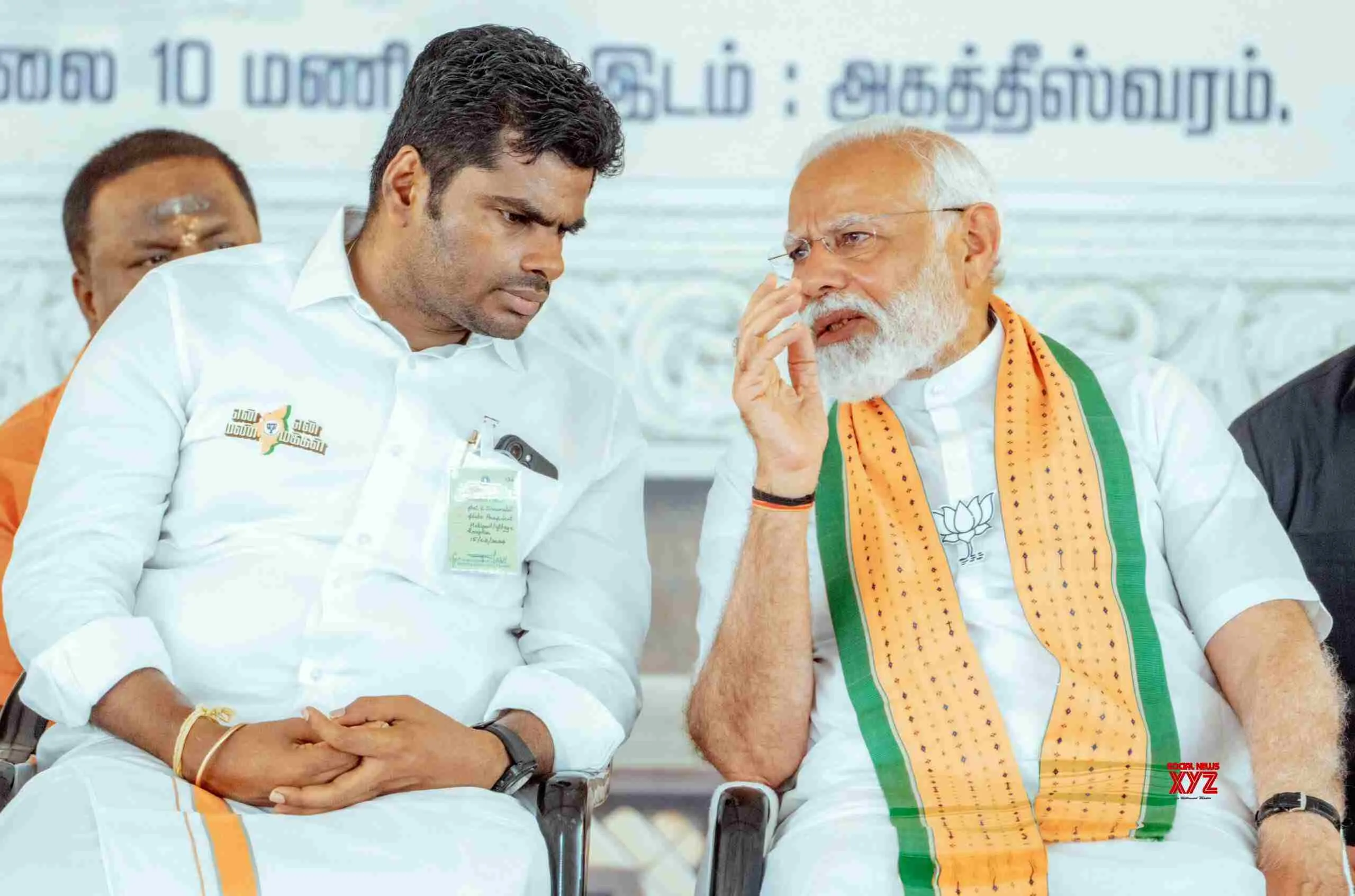
Nothing in politics is permanent. Alliances shift, loyalties change, and political equations are constantly rewritten. Tamil Nadu has recently witnessed one such development with potentially far-reaching consequences: the departure of K Annamalai from the BJP.
A former Indian Police Service officer, Annamalai entered politics inspired by Prime Minister Narendra Modi’s style of leadership. Long before the 2024 Lok Sabha election, he was not only inducted into the party but was also entrusted with the leadership of its Tamil Nadu unit.
Under Annamalai’s stewardship, the BJP improved its performance significantly in the state. While it failed to win a substantial number of seats, its vote share reportedly rose by around 11 percentage points compared to previous elections. Yet despite this improvement, he was removed from the post of state president and gradually sidelined from the party’s preparations for the 2026 Assembly election.
Barely weeks after the formation of the new state government, Annamalai severed his ties with the BJP. His exit is not merely the story of a leader leaving a party. It reflects a deeper disagreement over how the BJP should grow in Tamil Nadu.
Annamalai has always practised an aggressive and direct style of politics. He wanted the BJP to emerge as a distinct political force, separate from both the DMK and the AIADMK. Unlike many BJP leaders, he never believed the party should depend on regional allies such as the AIADMK for survival. He repeatedly argued that the BJP should build its own independent political base rather than function as a junior partner to established Dravidian parties. This was the central point of disagreement between him and the BJP leadership.
The BJP’s central leadership, however, appeared more interested in achieving immediate electoral gains. It chose to revive its alliance with the AIADMK despite Annamalai’s reservations. The electoral results failed to justify those expectations, but by then the damage within the party had already been done.
The significance of Annamalai’s departure lies in the fact that many BJP leaders privately acknowledge that whatever presence the party has acquired in Tamil Nadu over the past few years owes much to his efforts. Yet public messaging from the party seeks to project that his exit will not affect its prospects. The reality may prove different.
The core of Annamalai’s political thinking is an understanding that Tamil Nadu cannot be approached through the same ideological framework that works in parts of North India. He appears to have recognised early that a politics driven primarily by hardline Hindutva is unlikely to deliver major electoral dividends in a state shaped by a strong Dravidian cultural tradition.
His approach was different. He believed that any meaningful expansion of the BJP in Tamil Nadu would require a combination of Tamil identity, nationalism, clean governance and grassroots organisation-building. He did not want the BJP to become either a subsidiary of a regional party or merely another Dravidian formation competing for space within an already crowded political landscape.
Unable to pursue that vision within the BJP, he now appears ready to pursue it independently. Political observers familiar with Annamalai’s thinking believe that his proposed political platform will seek to challenge the entrenched Dravidian order while advancing a Tamil-first agenda rooted in nationalism, youth aspirations and governance reform. His extensive political tours across Tamil Nadu over the past several years have given him valuable organisational experience, local networks and direct engagement with voters. Those experiences are likely to form the foundation of any future political venture.
His personal image also remains one of his strongest assets. Over time, Annamalai evolved into one of the BJP’s most recognisable and combative faces in Tamil Nadu. In many respects, he became synonymous with the party itself. For a considerable section of the electorate, support for the BJP became inseparable from support for Annamalai.
This is precisely why his departure could hurt the party. The larger issue, however, goes beyond one individual. It concerns the BJP’s understanding of Tamil Nadu itself. Many political analysts argue that the BJP’s North Indian political model cannot simply be transplanted into Tamil Nadu. The social, cultural and political assumptions that shape voter behaviour in the two regions differ fundamentally.
One of the most important differences lies in the concept of nationalism. In much of North India, nationalism is often expressed through a framework of cultural and religious nationalism commonly associated with Hindutva. In Tamil Nadu, however, nationalism is deeply intertwined with Tamil identity, language, regional pride and the legacy of the Dravidian movement.
The state’s political culture has been profoundly influenced by the ideas of social justice, anti-caste mobilisation and Dravidian self-respect articulated by leaders such as E.V. Ramasamy Periyar. As a result, politics in Tamil Nadu is shaped more by regional autonomy, linguistic pride and resistance to cultural homogenisation than by the themes that dominate much of North Indian political discourse.
This is why issues such as opposition to Hindi imposition carry far greater emotional and political significance in Tamil Nadu than they do in many northern states. The BJP’s broader national narrative, centred on ideas such as “One Nation, One Language” and “One Culture”, faces inherent limitations in a state where political identity has historically been shaped by resistance to precisely such forms of centralisation.
Annamalai appeared to understand this contradiction. He recognised that if the BJP hoped to become a serious political force in Tamil Nadu, it would have to adapt itself to local realities rather than expect local realities to adapt themselves to the BJP.
His disagreements with the party were not limited to electoral alliances. He was also an outspoken critic of some of the icons of traditional Dravidian politics, including leaders associated with both the DMK and AIADMK traditions. For the BJP, which was attempting to build bridges with regional forces, such confrontational politics often created discomfort.
The resulting tensions eventually widened the distance between Annamalai and the party leadership. His removal as state president reportedly triggered significant internal unrest within the Tamil Nadu BJP. Several leaders resigned from organisational positions, exposing factional divisions that had previously remained concealed. Once that process began, his continued stay in the party appeared increasingly unlikely.
His future political project, if and when it emerges, is expected to occupy a unique ideological space. It may remain rooted in Hindu civilisational identity, but not necessarily through the North Indian interpretation of Hindutva. Rather, it could seek to blend religious identity with Tamil cultural pride, regional aspirations and a more inclusive conception of nationalism.
Whether such a political experiment succeeds remains uncertain. Yet it would undoubtedly create a new challenge for both the DMK-AIADMK establishment and the BJP. The broader lesson is that Tamil Nadu’s politics cannot be understood solely through electoral arithmetic. The state’s social history, linguistic identity, religious traditions and cultural institutions have all contributed to a political culture distinct from that of North India.
Even religious practices often reflect these differences. Tamil Nadu’s Vaishnavite traditions, temple architecture and devotional practices evolved through their own historical trajectory. Likewise, its politics developed around social justice, linguistic pride and regional self-respect. These cultural and historical realities continue to shape political behaviour in the state. Any party seeking long-term success in Tamil Nadu must engage with them seriously rather than view them through a purely North Indian lens.
Whether Annamalai ultimately succeeds or fails, his departure raises an important question for the BJP: can it build a genuinely Tamil Nadu-specific political model, or will it continue trying to fit the state into a framework designed elsewhere? The answer may determine not only the future of the BJP in Tamil Nadu but also the future trajectory of Annamalai’s own political journey.
(Gyanendra Pandey is a veteran journalist and also a political analyst)


