


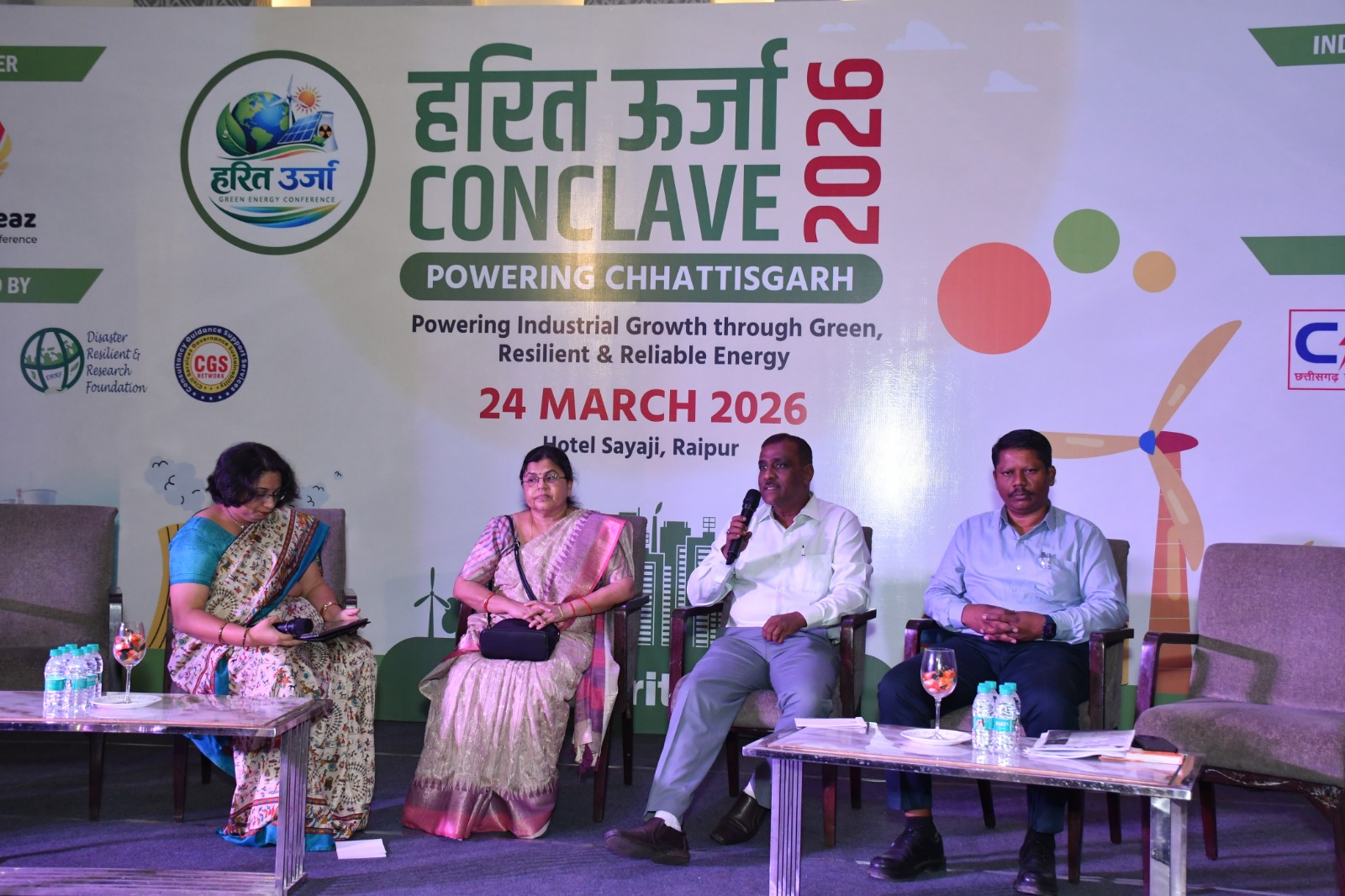
Even as Chhattisgarh positions itself at the centre of India’s industrial energy transition, policymakers and industry leaders on Monday flagged persistent regulatory bottlenecks, grid constraints and policy ambiguities slowing the state’s shift to renewable energy.
The “Harit Urja Conclave – Powering Chhattisgarh”, held in Raipur, brought together senior government officials, industry stakeholders, energy experts and academia to deliberate on accelerating industrial decarbonisation and clean energy adoption in one of India’s most energy-intensive states.
Organised by MAD IDEAZ in association with PHD Chamber of Commerce and Industry (PHDCCI), DRRF, CG-SIMA, CGS Network and the Chhattisgarh State Power Distribution Company Ltd (CSPDCL), the conclave focused on bridging the widening gap between policy intent and on-ground implementation.
Policy vs Practice: The Core Tension
At the heart of the discussions was a critical question: Can Chhattisgarh’s policy framework keep pace with industry’s renewable energy ambitions?
A key panel highlighted regulatory inconsistencies, cross-subsidy burdens and grid limitations as major deterrents. Industry participants argued that while policy direction appears progressive, execution remains uneven and often unpredictable.
Speakers at the event included Rajesh Singh Rana (IAS), CEO of the Chhattisgarh State Renewable Energy Development Agency (CREDA); S S Bajaj, Head of Corporate Affairs at Jindal Steel Ltd; O P Banjare, General Manager at CSIDC; Bimbisar Nagarjun, Superintendent Engineer at CSPDCL; and Sumit Sarkar, CEO of the Chhattisgarh Biofuel Development Authority, among others.
Shivani Lal, Founder and CEO of MAD IDEAZ, said the conclave aimed to move beyond rhetoric. “Harit Urja is a platform for actionable dialogue to shape Chhattisgarh’s energy future, enabling industry to align growth with sustainability,” she said.
Open Access Emerges as Flashpoint
Industry representatives identified the open access framework as the single biggest structural challenge in scaling renewable energy adoption.
While open access allows industries to procure power directly from renewable sources, participants flagged multiple friction points:
- High cross-subsidy and additional surcharges
- Delays in approvals
- Uncertainty in banking provisions
- Grid constraints
- Complex forecasting and scheduling requirements
- Frequent regulatory changes
These issues, stakeholders said, have created a climate of uncertainty for both industrial consumers and renewable developers.
At the same time, distribution companies raised concerns around revenue stability, grid management and demand forecasting—underscoring the need for calibrated, balanced reforms.
Industrial Reality: Transition Not So Simple
Chhattisgarh, a coal-dominated power-surplus state with strong steel, mining, cement and aluminium sectors, faces a structural challenge: transitioning energy-intensive industries to intermittent renewable sources without compromising operational reliability.
Beyond open access, industry flagged additional barriers:
- Limited land availability for renewable projects
- Inadequate transmission infrastructure
- Integration challenges between intermittent renewable power and continuous industrial loads
- Financing constraints for hybrid and storage solutions
Experts noted that despite favourable policy signals and falling renewable costs, the transition from intent to implementation remains complex and fragmented.
State Push, Uneven Outcomes
The Chhattisgarh government has rolled out several initiatives to promote renewable deployment, energy security and industrial decarbonisation. However, adoption across industries remains inconsistent.
Participants stressed that policy clarity, regulatory stability and execution efficiency will be decisive in determining whether the state can sustain its leadership in industrial energy transformation.
The Way Forward
Deliberations at the conclave converged on a few clear priorities:
- Strengthening regulatory certainty
- Streamlining open access mechanisms
- Improving grid readiness
- Enabling financing for storage and hybrid solutions
- Enhancing coordination between industry and utilities
The conclave also facilitated business linkages and knowledge exchange, positioning itself as a platform to accelerate partnerships in clean energy deployment.
A Strategic Crossroads
As India pushes towards aggressive decarbonisation targets, Chhattisgarh finds itself at a strategic crossroads, balancing its legacy as a coal powerhouse with emerging pressures of sustainability, ESG compliance and cost competitiveness.
The message from Raipur was unambiguous: without urgent policy fine-tuning and execution reforms, the state risks slowing its own green transition.
