


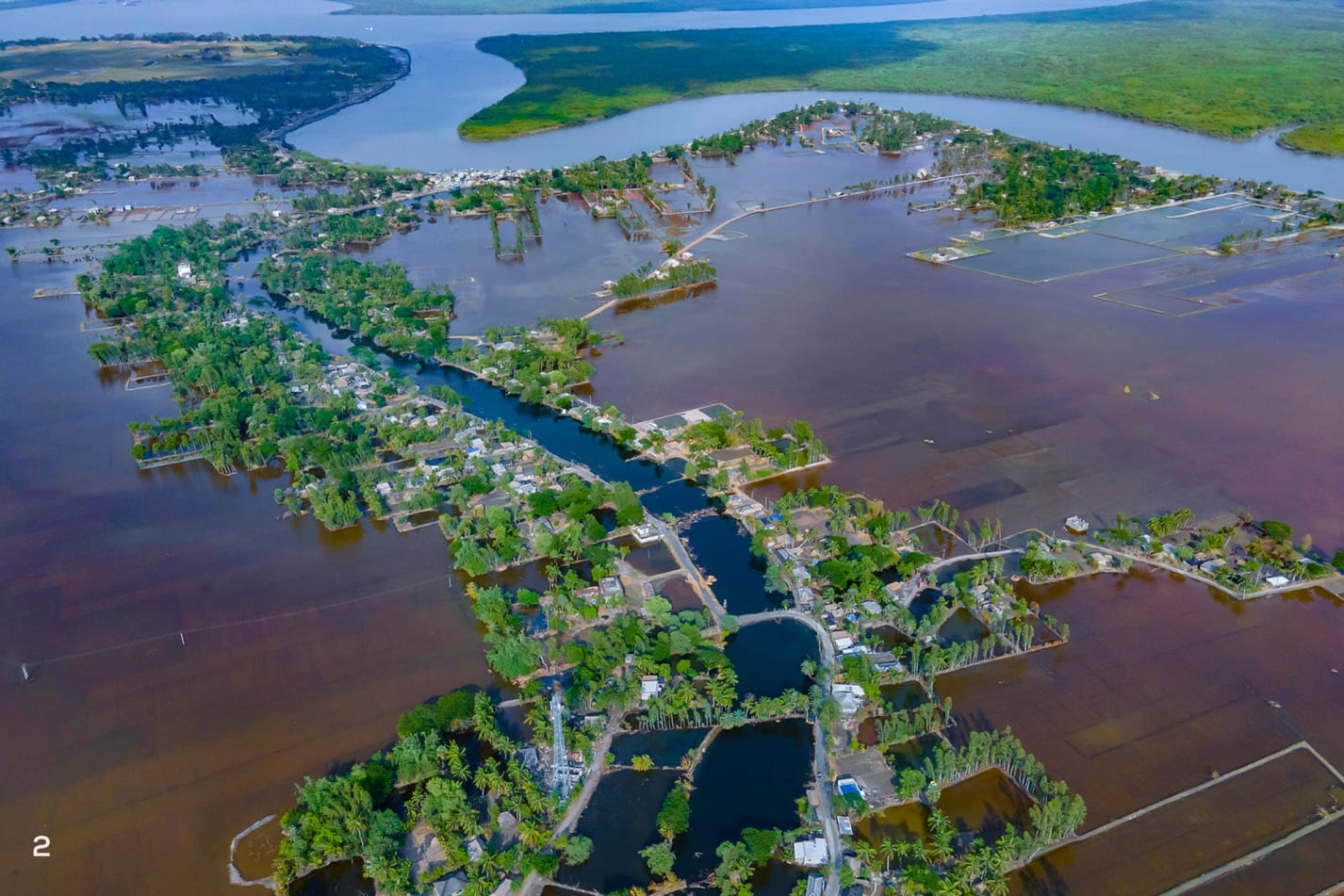
On a shrinking island in the Sundarbans, Abdul Rahman gestures toward a stretch of brown water. “That used to be our courtyard,” he says. There is no drama in the statement. No storm, no singular disaster. Just a quiet subtraction of land, year after year, until the house, then the fields, then the village itself, cease to exist.
This is how displacement happens in this part of India: incrementally, invisibly and almost always without record. Across India’s eastern delta, particularly in the Sundarbans, a form of migration is underway that resists classification. It is not triggered by a single calamity but by a cumulative environmental decline. It leaves behind no registry, no official counts, and it does not produce refugee camps. The scale is neither anecdotal nor marginal. It is systemic and accelerating.
A Delta in Structural Retreat
The Indian Sundarbans, part of the world’s largest mangrove ecosystem, is now among the fastest-eroding inhabited landscapes on the planet. Satellite analyses and government data converge on a stark assessment: over 200 square kilometres of land have been lost since the 1970s, with erosion rates intensifying in the past two decades. Sea levels here are rising at nearly twice the global average, driven not only by ocean expansion but also by land subsidence, a less visible but equally destructive process.
The consequences are already mapped:
- Islands like Ghoramara have lost most of their habitable land
- Mousuni Island continues to shrink under tidal pressure
- Thousands of hectares of farmland have turned saline and unproductive
- Cyclones such as Amphan (2020) and Yaas (2021) have accelerated embankment collapse
This is not episodic damage. It is a geomorphological decline where the land itself is withdrawing from habitation.
Scientific projections sharpen the urgency. By 2050, significant portions of the delta could become uninhabitable, with millions at risk of displacement across the India-Bangladesh Sundarbans system. Conservative estimates already suggest over one million people may have been displaced from the Indian Sundarbans over the past two decades. What remains absent is not evidence, but recognition.
‘Category’ That Does Not Exist
India does not officially recognise “climate migrants”. International law does not help either. The 1951 Refugee Convention defines refugees through persecution, not environmental collapse. Within India, there is no statutory framework that categorises people displaced by erosion, salinity or sea-level rise.
This creates a bureaucratic void with tangible consequences. Those leaving the Sundarbans are treated as economic migrants, not displaced persons. Their movement is interpreted as voluntary; hence, their losses are unquantified and their rights undefined.
The implications are immediate: in many cases, there is no compensation for land lost to erosion, no guaranteed rights to rehabilitation or relocation, no inclusion in disaster displacement databases, and no targeted welfare frameworks in receiving cities. In effect, the state acknowledges the environmental crisis, but not the human movement it produces.
Unlike conflict displacement, climate migration here does not occur en masse. It unfolds in stages. A young man leaves for Kolkata to work at a construction site. Months later, his sister follows, entering domestic work. The elderly remain behind until the next cyclone breaches the embankment. Eventually, the household dissolves geographically.
There are no camps. No official corridors. No administrative tracking. Instead, there is a dispersed pattern: movement from islands to the mainland, from villages to peri-urban fringes, and from agriculture to informal labour.
Kolkata absorbs the largest share, but migration networks extend to Delhi, Mumbai, and southern industrial clusters. This invisibility is not incidental; it is significantly structural.
Livelihood Collapse: The Precursor
Displacement here begins not with water, but with income. The Sundarbans economy depends on small-scale agriculture and fishing, both of which are highly sensitive to ecological shifts.
Salinity intrusion has already destroyed traditional rice cultivation cycles, rendering large tracts infertile. Drinking water sources have become contaminated. Fisheries are declining due to changing water chemistry. Cyclones act as accelerants rather than triggers. Each event wipes out embankments, floods fields, and resets fragile recovery efforts.
A recent field-based assessment found that over 60 per cent of embankments in the Sundarbans are structurally weak or poorly maintained, making repeated failure inevitable. Adaptation measures such as embankments, shelters and mangrove planting are not only insignificant, they are also insufficient. They delay displacement and do not prevent it at all.
Minimal Administrative Posture
India’s approach to the Sundarbans crisis remains anchored in disaster management, but not in long-term migration planning. This distinction is critical. Disaster management frameworks activate after events like cyclones, floods and storm surges. They provide relief, compensation and temporary shelter. Climate migration, however, is not event-based. It is a process requiring anticipatory governance: identification of high-risk zones, development of planned relocation strategies, creation of livelihood transition frameworks, and comprehensive urban absorption planning. None of these exists in a coordinated national policy.
There is no central registry tracking climate displacement. No inter-state coordination. No integration between rural collapse and urban planning. The result is administrative inertia masked as incremental action.
The Urban Spillover
The burden of this migration is unevenly distributed. Men typically migrate first, leaving women to manage degraded agricultural land. Over time, however, female migration is increasing, often into informal and precarious sectors. Investigations have documented rising vulnerabilities: Increased exposure to human trafficking networks, exploitative labour conditions in domestic work and small industries and a lack of legal protection in destination cities
Social composition deepens this risk. Nearly half the Sundarbans population belongs to the Scheduled Castes and Tribes, groups already structurally disadvantaged.
Migration does not resolve vulnerability; it relocates it. Cities receiving migrants are unprepared for the scale and nature of the influx. Migrants settle in informal clusters, often in environmentally risky zones such as low-lying areas, riverbanks, or peri-urban fringes lacking infrastructure.
The Sundarbans crisis does not fit the grammar of news. There is no singular catastrophe to broadcast. No images of mass exodus. No definable moment of crisis. Instead, there is what scholars term “slow violence”, an incremental damage, dispersed and therefore politically convenient to ignore.
Climate migration is often framed as a future scenario. In the Sundarbans, it is already underway. The question is no longer whether people will leave. It is whether the state will acknowledge that they are being forced to.
Back on the island, where Abdul Rahman once had a courtyard, there is now only water: tidal, indifferent, permanent. What disappears quietly rarely provokes urgency. But it accumulates. And in that accumulation lies a crisis that is already reshaping India’s demographic, economic, and ecological landscape without a name, without a framework, and, for now, without a response.
GFX 1
The Vanishing Delta
- Sundarbans is disappearing, so are its people
- 200+ sq km of land lost since the 1970s
- By 2050, parts of the Sundarbans may no longer exist
- Driven by ocean expansion and sinking landmass, erosion accelerated sharply in the past two decades
- Sea levels rising nearly 2× global average
- Over 10 lakh people already displaced
- Lakhs more at risk as large parts may turn uninhabitable
GFX 2
REGIONAL AND GLOBAL PREVIEW
INDIA: Patterns Emerging
- Odisha’s coast battered by recurring cyclones
- Assam’s “char” islands disappearing under Brahmaputra floods
- Tamil Nadu and Gujarat coastlines exposed to rising seas
GLOBAL Parallels
- Delta systems under stress from the Mekong to the Nile
- Climate pressures converging across densely populated river basins
THE NUMBERS AHEAD
- 40+ million internal climate migrants in South Asia by 2050 (World Bank estimate)
INTERNATIONAL REALITY
- Global Compact for Migration acknowledges climate drivers, but offers no enforceable safeguards
- UN recognises the risk, but lacks legal enforcement
(Bikash C Paul is a Delhi-based senior journalist and executive editor of ‘New Delhi Post’)
