


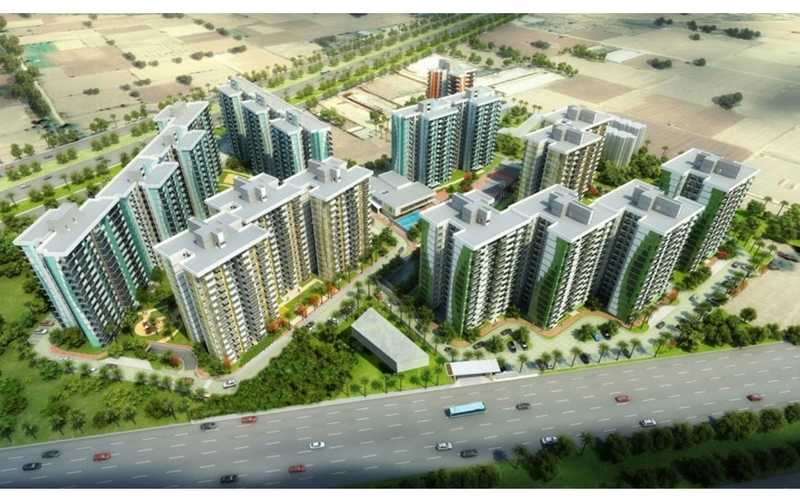
A whistleblower’s complaint over a Tata Group housing project in Haryana, pending since 2016, has been reopened after the President of India’s secretariat asked the state government to give it ‘appropriate attention’, reviving scrutiny of allegations that homebuyers were shown inflated floor area figures
Abir Dasgupta and Paranjoy Guha Thakurta
The Haryana government has reopened scrutiny of a decade-old complaint against a Tata Group-owned real estate company by its former employee-turned-whistleblower, Nitya Nand Sinha. The state’s Town and Country Planning Department had earlier closed the investigation. However, it revived the inquiry after the President of India’s secretariat forwarded Sinha’s representation. In emails sent on April 21 and May 21, which the authors accessed, the secretariat instructed the chief secretary to take appropriate action. It also directed that the action taken be communicated directly to Sinha. The intervention of the President’s secretariat has triggered fresh administrative movement in a case that had effectively been closed years earlier.
In 2015, Sinha alleged that his employer, a Tata Group real estate company, was defrauding buyers in its “New Haven” project in Bahadurgarh, Haryana. At the time, Sinha was working as Project Head for the Tata Group subsidiary responsible for executing the project. He alleged that the developer was inflating the floor area sold to homebuyers beyond the actual area they would be purchasing.
Sinha’s allegation was eventually investigated by two district-level authorities in Haryana’s Jhajjar district, where the project is located — the Additional Deputy Commissioner (ADC) and the District Town Planner (DTP). The ADC closed the investigation after considering the company’s response to the complaint and concluded that Sinha’s allegations had not been proved. According to Sinha’s representation to the President, a copy of which the authors have seen, the ADC did so without considering his rejoinder. The DTP, meanwhile, closed the investigation, saying that it could not proceed because it did not receive the requisite documents from the company and because a higher-ranking official, the ADC, had already issued a verdict on the complaint.
Following the President’s s
ecretariat’s intervention, the matter has been referred back to the office of the DTP, Jhajjar, according to a letter from Sinha to the Government that the authors have seen. When contacted, Sinha declined to comment on the case, citing a judicial gag order resulting from a defamation case filed by the Tata Group company against him
in Gurugram.
The Allegation
Sinha alleges that the Tata Group’s “New Haven” project defrauded homebuyers by inflating the saleable area of flats beyond the actual area sold to buyers.
In 2015, Sinha, a civil engineer, was working as Project Head on the “New Haven” project for HL Promoters Private Limited, which is majority-owned by the Tata Group company Tata Value Homes, a subsidiary of Tata Housing Development Company. In previous reports for the Economic and Political Weekly, NewsClick and Article-14, the authors, along with another co-author, detailed the substance of Sinha’s allegations in depth. Several other articles on his allegations have also been published.
According to a complaint filed by Sinha with the Delhi Police’s Economic Offences Wing in March 2016, which is annexed to his representation to the President, he received two sets of saleable-area figures for the project by email from Tata Value Homes management — one showing the actual area being sold to homebuyers and the other an allegedly inflated area. He alleges that the latter set of figures was ultimately used to determine the pricing of flats in the project and was presented to homebuyers in the project’s marketing material.
Attached to Sinha’s complaints are an email dated February 24, 2015 and another dated March 3, 2015, circulating the area statements finalised by the project’s architects and designers. These statements specify the carpet area and the saleable area for each category of flats in the project. Saleable area is the total area a homebuyer pays for, which adds to the carpet area of a flat the proportionate share of the building’s common areas, such as staircases, corridors, elevators and lobbies.
For the “small” two-bedroom, hall and kitchen (2 BHK) flats, the carpet area and saleable area were 911 square feet (sq ft) and 1,185 sq ft, respectively. For the “large” 2 BHK flats, the corresponding figures were 1,067 sq ft and 1,390 sq ft, while for the small 3 BHK flats, they were 1,356 sq ft and 1,750 sq ft, respectively. These figures reflected a loading factor—the additional area added to the carpet area to arrive at the saleable area—of 29–30 per cent. However, in another email sent on March 3, 2015, a senior Tata Value Homes executive wrote: “loading for 2 BHK decided @41% and for 3 BHK @39%.” In
response, on March 4, another detailed area statement was circulated, recalculating the figures according to the revised loading factors. The carpet areas for the small 2 BHK, large 2 BHK and 3 BHK flats were revised to 916 sq ft, 1,074 sq ft and 1,357 sq ft, respectively, while the saleable areas increased significantly to 1,292 sq ft,
1,514 sq ft and 1,886 sq ft, respectively, apparently in line with the revised loading factors.
In his complaint to the police, Sinha said: “This was not an honest act and would be causing wrongful gain from innocent intending purchasers.” He raised the issue internally, the complaint continues, writing to his superiors in the Tata Group, but to no avail. In November 2015, in the complaint, Sinha found that the company was advertising flats in the project using the allegedly inflated area statements. He calculated that the alleged inflation in area increased the cost of individual flats by about Rs 4 lakh to Rs 6.5 lakh, resulting in an overall gain of about Rs 30 crore across the project for the company.
Sinha was dismissed from his job in June 2015 and, soon afterwards, blew the whistle by making his allegations public on social media. In response, Tata Value Homes filed defamation cases against him in Mumbai and Gurugram. Although Sinha’s police complaint was closed by the Delhi Police, the matter was subsequently taken up by the Haryana government.
The Inquiries
In his representation to the President of India, Sinha said the company submitted its reply to the Jhajjar ADC’s inquiry only on November 15, 2019, “after an inordinate delay of 3 years and 8 months”, and that he filed a rejoinder on November 25, 2019.
In that rejoinder, according to the representation, Sinha argued, on the basis of the company’s own documents, that customers in the project had been “wrongfully deprived” of Rs 29.81 crore “by inflating the saleable area which, in fact, did not exist.” He further alleged that the ADC prepared a “non-speaking report” dated November 15, 2020 and closed the inquiry without considering the facts set out in his rejoinder.
The company’s defence has been two-pronged. First, it argued that Sinha had no locus standi to raise such allegations and that no homebuyers had made any complaints. Second, it maintained that determining the loading factor was the company’s prerogative, and that any allegation of cheating or fraud would arise only if the company promised buyers a particular area at the time of booking the flats but delivered something different when possession was handed over.
Unsatisfied with the ADC’s inquiry, Sinha escalated the matter to higher authorities in the Haryana government, according to his repres
entation. Eventually, the Haryana government’s Town and Country Planning Department took up his allegations. Sinha’s representation states that the DTP, Jhajjar, wrote to the company in March 2021,
calling upon it to furnish relevant information.
In a subsequent letter from the DTP, Jhajjar, to the Senior Town Planner (STP), Rohtak, the district authority recorded that HL Promoters Pvt. Ltd. had been asked repeatedly to provide the requisite documents in March, July and August 2021. “However, M/s HL Promoters Pvt. Ltd. has not submitted the requisite documents till date,” the DTP wrote in a letter sent in December 2022. “In the absence of documentary evidence, the enquiry could not be conducted.”
Sinha’s representation to the President stated that, following this closure by the DTP, he sought to escalate his complaint to the Senior Town Planner’s office in Rohtak.
While he continued to seek a response from the STP, Rohtak, the DTP, Jhajjar, wrote to the Jhajjar Superintendent of Police in September 2023. The letter stated that neither the Haryana Building Code nor the National Building Code defines “loading area” or “saleable area”, thereby rejecting Sinha’s allegation that these figures had been arbitrarily inflated beyond the actual area sold to buyers. It also stated that the company had been registering builder-buyer agreements in accordance with the Real Estate (Regulation and Development) Act, and that the ADC, Jhajjar, had already closed its inquiry into the same allegations.
After receiving this letter, Sinha’s representation says he pursued the matter for nearly two years through the Right to Information (RTI) Act. His RTI application seeking copies of official records relating to the action taken by the STP on his complaint received no response, forcing him to pursue the matter through the first and second appellate stages. Finally, following an order by the Haryana State Information Commissioner in January 2025, Sinha’s representation says he learnt that the STP had issued a memo closing its inquiry into his complaint in January 2023, but had never informed him of the decision.
What Happens Next?
After Sinha’s representation was forwarded by the President of India’s secretariat, the matter was sent back to the office of the DTP, Jhajjar, according to a letter sent by Sinha to the Haryana government’s chief secretary on July 13.
In the letter, Sinha objected to the DTP, Jhajjar, handling the inquiry once again, pointing to its “recorded inability” to secure the respondent’s cooperation. He argued that this should disqualify the same district-level authority from serving as the forum to which the reopened matter had once again been referred. His contention was not merely that the earlier inquiry had stalled, but that the state should not respond to a complaint about a failed process by sending
it back to the very authority where that failure had already been documented.
Instead, Sinha requested that the inquiry be entrusted to “any independent senior-level officer or to the Divisional Commissioner, Rohtak” so that it could be conducted in a fair, impartial and time-bound manner.
In the decade since filing his original complaint, Sinha has changed careers, qualified as a lawyer and is now a practising advocate. Will this strengthen his case in the reopened inquiry? Will the President’s Secretariat’s intervention alter the outcome? Will the state finally arrive at a clear and reasoned conclusion on whether homebuyers were cheated? And, if so, will any action follow? Only time will tell.
On August 3, the authors emailed questionnaires to Anurag Rastogi, chief secretary, Government of Haryana; Tata Housing Development Company; the government’s media relations department; and the DTP, Jhajjar. This article will be updated as and when responses are received.
(The writers are independent journalists)
