

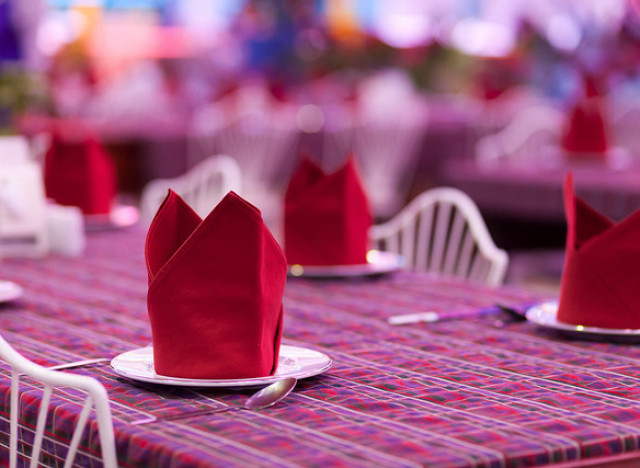
Imagine sitting at a high-stakes networking dinner or an executive leadership banquet. The room is charged with opportunity, the table setting is immaculate, and the dialogue flows smoothly. You have polished your elevator pitch, chosen your vocabulary with surgical precision, and ensured your posture projects confidence. Yet, before you even finish your starter, you might already be sending signals that silently undermine your authority.
How many times have you sat down at a restaurant, taken your cloth napkin, used it to thoroughly rub your hands, and then, at the end of the meal, tossed it onto your dirty plate?
Most people view a napkin as nothing more than a functional piece of fabric, a tool to catch falling crumbs or wipe away a stray drop of sauce. In reality, every micro-action you take at the table is an integral part of your Visual Voice. It is the silent language people observe long before they absorb what you have to say.
Mechanics of Non-Verbal Communication
We often spend hours refining what we say, crafting flawless arguments, polishing presentations, and selecting persuasive words. However, foundational research on behavioural communication highlights a striking breakdown of how impressions are formed:
- 55% of communication is conveyed visually through body language, physical poise, and micro-behaviours.
- 38% is communicated through paralanguage (tone, pitch, rhythm, and vocal energy).
- 7% relies solely on the literal words spoken.
When we talk about body language, we are talking about a visible voice. Our physical presence, spatial awareness, situational poise, and dining etiquette collectively construct our visual language. Deeply embedded within that visual language is our emotional intelligence (EQ)—the conscious awareness of our environment, our self-possession, and our respect for shared social spaces.
Objects around us are never truly neutral; they function as direct extensions of our non-verbal language. A napkin is not just a piece of linen. In a dining context, it acts as a silent instrument of communication that speaks volumes about your mindfulness.
Real-World Observations: The ‘Power Lunch’ Test
In modern executive recruitment and high-level client entertainment, the “Power Lunch” test is a well-documented evaluation strategy. Board members, recruiters and senior leaders frequently use fine-dining environments specifically to observe how prospective partners handle themselves when they are off the stage and away from a slide deck.
In these real-world settings, evaluators do not just listen to strategic answers; they observe unscripted behaviours:
1. Unconscious Friction: Candidates who otherwise present a polished persona often display surprising carelessness at the table. Wiping their hands aggressively with a linen napkin, treating fine table linen like a disposable paper towel, signals a lack of situational awareness.
2. Impatience and Agitation: Unfolding a napkin with a sharp, dramatic snapping motion or fidgeting with cutlery between courses reflects underlying anxiety or an inability to remain grounded in a formal setting.
3. Disrespect for the Environment: Dropping a heavily soiled, crumpled napkin onto a plate covered in sauce shows a lack of consideration for the service staff and a disregard for basic spatial aesthetics.
While these actions may seem minor in isolation, observers synthesise them into a broader profile. A professional who exhibits carelessness with silent dining protocols may be perceived as lacking the composure, attention to detail, and social grace required for high-stakes diplomacy.
Decoding Napkin Etiquette: Silent Rules
To turn everyday dining habits into a seamless reflection of your poise, it helps to understand how the napkin functions as an intentional communication tool.
| Moment | Proper Etiquette | What It Silently Communicates |
| Upon seating | Unfold gently, fold it in half, and place it across your lap | Poise, readiness, and situational respect |
| Dabbing the mouth | Gently blot or dab using the inside fold. Never scrub your hands or face | Refinement and self-possession |
| Excusing yourself | Place the napkin loosely on your chair seat or armrest | A clear signal to staff that you will return |
How to Avoid the Napkin Trap
The Lap Placement: Place the napkin across your lap immediately after being seated (or after the host does). The crease should face you. It should never be tucked into your collar or used to wipe cutlery.
Dab, Don’t Scrub: A cloth napkin is designed to absorb light moisture or protect clothing from accidental spills. Use the inner fold to dab the corners of your mouth before taking a drink of water or wine. This keeps any food residue hidden inside the fold.
Temporary Absence: If you must step away from the table during a meal, place the napkin loosely folded on your chair seat. This tells the server that your meal is still in progress and keeps dirty linen off the eating surface.
Ending the Meal: Placing a napkin directly on a dirty plate forces service staff to handle a soiled napkin. At the end of the meal, loosely fold the napkin so that no stains are visible, and place it neatly to the left of your place setting.
Mindful Presence Starts Before You Speak
Etiquette is not a collection of rigid, outdated rules meant to impose formality. Rather, it is a practical demonstration of emotional intelligence, self-control, and respect for your surroundings; how you handle an object as simple as a napkin reveals your capacity for mindfulness under subtle observation.
The next time you sit down at a dinner table, pause before reaching for your napkin. Remember that, long before you deliver your core message, your actions have already introduced you. Master the silent instruments around you, and let your visual voice reinforce the authority of your words.