

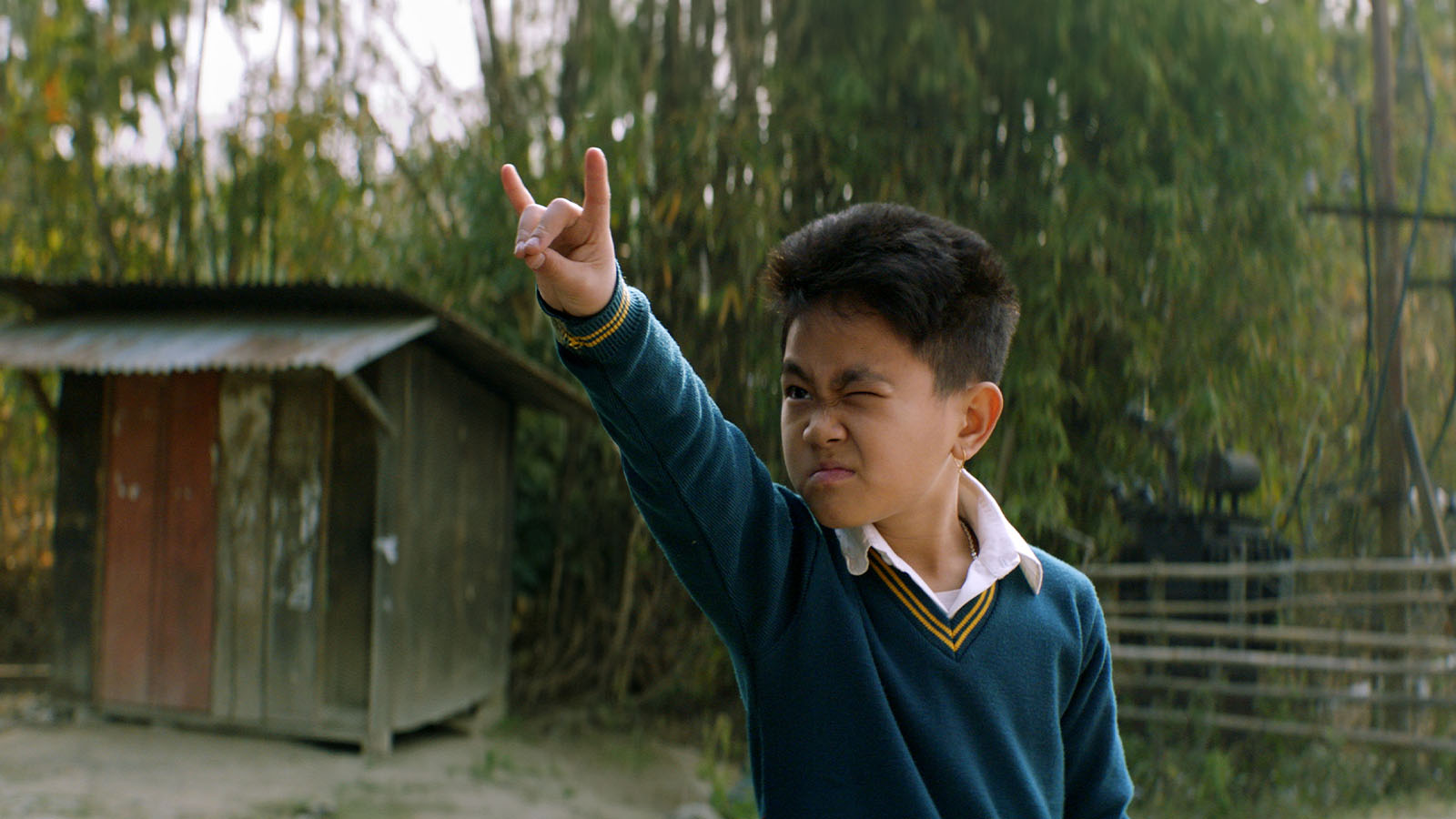
When a child’s mischief, curiosity, and innocent stubbornness combine with a surprisingly thoughtful mind, something unique takes shape, and it is that spirit which defines Boong. Directed by Lakshmipriya Devi, the BAFTA Award-winning children’s and family film offers a tender glimpse into life through the eyes of a young boy.
Rather than relying on dramatic storytelling, the film unfolds gently, opening with an act of mischief in which the protagonist, Brojendra Singh (Gugun Kipgen), breaks the main gate of his Manipuri school, distorting the school’s nameboard. Gradually, the film continues to meander, drawing the audience into the quiet rhythms of everyday life in Manipur—its villages, hills, and small towns, a region rarely represented with such authenticity in mainstream Indian cinema.
At the heart of the story is a simple yet deeply emotional premise. The film follows Brojendra Singh, affectionately called Boong, played by Gugun Kipgen. He is a mischievous, energetic yet kind-hearted boy who lives with his mother, Mandakini (Bala Hijam Ningthoujam). She works tirelessly to raise her son alone after Boong’s father leaves home with a promise that he will return soon. Years pass, and that promise slowly fades into uncertainty.
In fact, Boong’s extended family wants to perform death rituals, but his defiant mother questions this, reinforcing his belief that his father is alive and will come back to them. In Boong’s young mind, the solution seems straightforward: he must find his father and bring him back home so that his mother can finally be happy again.
Motivated by this innocent hope, Boong begins a journey that gradually turns into a quiet adventure. He sets out for Moreh, the border town near Myanmar, after checking his father’s old letters and meeting post office staff, among others. On this journey, he is supported by Juliana (Nemetia Ngangbam), a classmate from the English-medium school he recently joined. His friend Raju Agarwal (Angom Sanamatum) also becomes part of the journey. Raju’s father, Sudhir, played by Vikram Kochhar, is a Marwari businessman whose family has lived in Manipur for three generations, mirroring the region’s rich cultural diversity.
As the children move closer to the Myanmar border and eventually cross it in their search for Boong’s missing father, they begin to encounter people and situations that gradually reshape their understanding of the world. What initially feels like a playful mission ultimately becomes an experience of emotional growth. Boong starts to realise that life is not always as simple as he once believed through these encounters.
A major strength of the film lies in Gugun Kipgen’s performance. As a child actor, he delivers an impressively natural performance that makes Boong feel genuine and relatable. His expressions, reactions, and small moments of reflection capture the unpredictable blend of innocence and maturity that often exists in childhood. Whether he is being playful, stubborn, curious, or quietly thoughtful, Kipgen brings authenticity to the character, allowing the audience to fully believe in Boong’s journey.
Beyond the personal story, Boong also reflects the social realities of Manipur in a subtle and thoughtful manner. Without turning into a political narrative, the film touches upon themes such as migration, fractured families, and the uncertainties that often shape life in border regions. These elements are woven naturally into the storyline, allowing viewers to better understand the environment in which Boong grows up.
Visually, the film offers a calm and immersive experience. The landscapes of Manipur—its green hills, modest homes, small village roads, etc.—create a setting that feels absolutely authentic. The cinematography captures the beauty of the region without romanticising it, presenting everyday life in a way that feels simple, honest, and grounded.
The pace of the film is deliberately gentle, and at times the narrative may seem minimal. The story does not depend on dramatic twists or elaborate conflicts. Instead, it focuses on the emotional world of a child, including his hopes, questions, and his love and longing for family.
The emotional turning point arrives when Boong finally finds his father, only to discover that he has started a new life with another woman and children. The realisation quietly shatters the expectations he carried throughout his journey. In a particularly moving moment, Boong is seen lying down, tears flowing, making no attempt to meet his father despite being a stone’s throw away. Instead, he returns home and tells his mother that his father is metaphorically dead.
Children often see the world through a lens of hope and sincerity, even when the adults around them face complicated realities. Boong captures this perspective with warmth and sensitivity, reminding the audience that the most powerful stories are sometimes the simplest ones, especially those told through the eyes of a child.
(Praveen Nagda is festival director, KidzCINEMA and Culture Cinema Film Festivals)