


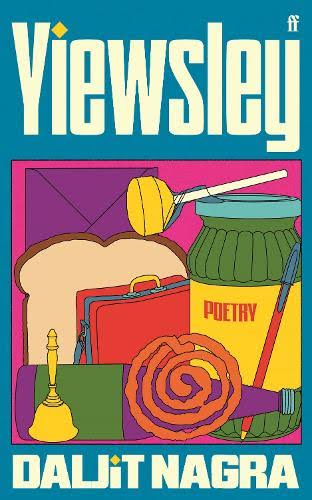
In his new collection of poems, Yiewsley, Daljit Nagra pulls English taut — then lets the recoil do the work
The British Raj conquered territory; it never conquered the Punjabi tongue. In Yiewsley, one of the UK’s most celebrated poets, Daljit Nagra, shows what happens when that tongue bends English instead, until the language of empire carries the music of Punjab within it. Here, he once again tests what English can contain, stretching it, reshaping it, and letting it snap back with force.
Nagra, who grew up in Yiewsley, a London suburb, during the 1970s and ’80s, returns to the terrain that shaped his distinctive place in British poetry. His earlier linguistic exuberance — that chirpy, defiant feast of hybrid English — unsettled some American readers. But this is not a nostalgic return to his earlier Punglish bravura. It is a re-examination of belonging itself, beyond the familiar tropes of displacement or migrant grievance. He describes his hometown as a “post-war/round-the-clock whistling factory town” where “incomers are welcomed … as they dream of bangles dressing the marital wrist”. The image holds industrial Britain and interior inheritance in the same frame.
After stepping down as Chair of the Royal Society of Literature, a tenure clouded by politics that he found difficult to accept, Nagra appears creatively re-energised. In “Owl”, he turns inward: “being you is how you’ve always held you from being / two.” The line signals a movement from performance towards introspection.
Readers who admired We Have Coming Dover (2007) and Ramayana (2014) will recognise the voice, though it feels more measured now; less flamboyant, more structurally assured. In one striking image, he writes of wanting “to make imaginary spellings / on the blackboard of the singing sky.” The playfulness remains, but it is anchored by control. British Museum (2019) felt like a detour. Yiewsley is a return: witty, alert and newly disciplined.
Nagra has long divided critics for his playful blending of Punjabi and English, what some called Punglish. In earlier work, that linguistic exuberance could feel deliberately disruptive yet inventive. Here, the energy is still present, but the syntax is more deliberate. What once appeared broken now feels carefully bifold. He calls himself “human and bifold”, and the phrase captures the structural entanglement of cultures in these poems: two registers held in balance, or, one might say, folded together.
For Indian readers, Yiewsley maps a strangely familiar psychic geography. In the title poem, a greengrocer’s marrows and turnips are described as “gaudy as the Golden Temple”. The comparison does more than decorate the scene; it overlays English suburbia with Sikh sacred heritage.
There are echoes here of Arun Kolatkar’s Jejuri. Where Kolatkar found the divine in the dust of a bus station, Nagra locates it in the “oiled swing” of a playground or a “box of kittens” outside a church. The poems move between outer and inner worlds with ease. He presents himself as a “passive watcher”, even a “gentleman on a peak”, yet never forgets the “brown, snotty boy” in the backstage.
This concern with inherited memory places him in quiet conversation with A.K. Ramanujan, who wrote of the interior and exterior realms: akam and puram. Nagra applies a similar duality to 1960s suburban Britain. The outer world consists of National Front thugs, National Express coaches and three-channel televisions. The inner world pulses with faith, food and familial codes, a private continuity running beneath public life.
In “Bread”, he describes his mother making rotis: “Each perfect circle, ideal as a halo.” Domestic labour becomes almost chronicled. When the roti “inflates, lung-like” inside a “narrow kitchen”, the metaphor carries the weight of cultural survival. The writing is precise and unsentimental. It avoids both grievance and nostalgia.
The collection also confronts uncomfortable truths. In “Lucozade”, a childhood incident reveals caste prejudice within the diaspora. His mother confronts a “cleaner-caste Sikh” shopkeeper; the moment exposes how “tamarind agony” hardened into “values rigid as pumped biceps”. Migration did not dissolve inherited hierarchies; it carried them into a new geography.
Nagra repeatedly foregrounds writing as physical labour. He speaks of composing with a “Bic biro”, calling it the “comeback tool of the underclass”. This is a refreshing take on an everyday object. His syntax can “scrape the page”, recalling how he once “Bic’d”— a noun turned into a verb — across his grandfather’s back before a wrestling match. Language here is tactile, even abrasive, like a “knuckle-splash of snapped ginger”.
The collection closes with “BASIC”, where early computer code becomes a metaphor: “10 how do you do new world’ and ‘in the next line you tell it 20 go to 10.” The slashes create an impression of computer language while also becoming telling of the cultural divide. The loop captures the immigrant condition: perpetual arrival, perpetual restart. Even the title resonates: BASIC as a programming language, as a foundation, as an origin point.
For readers in India, Yiewsley is not a book about assimilation. It is about a declaration. Nagra asks: “in which tone, I must declare, / my heroic kin crossed water, survived to form life”? The question is not whether one belongs, but how one remains true to oneself.
In these poems, he moves beyond the “tuxedo” of mannered rhyme to find a voice that is”vivid as skin”. What emerges is neither wholly English nor wholly Indian, but something self-forged: “a portion of the English, the Indian, / the greater glories that herald the twain.”
Yiewsley does not plead for acceptance. It reshapes identity through its remapped language.
