






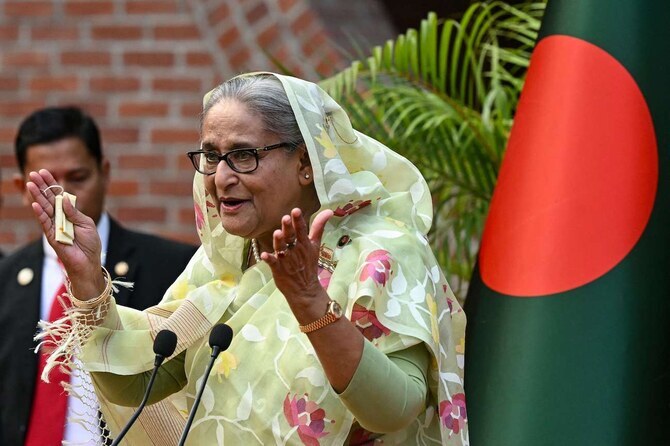
The announcement by former Prime Minister Sheikh Hasina that she intends to return to Bangladesh in December has once again placed the country’s political developments under international scrutiny. Whether interpreted as political confidence, a strategic message or a symbolic gesture, the declaration has reshaped public discussion. It has revived questions about democratic participation, political legitimacy, institutional resilience and Bangladesh’s evolving role in a rapidly changing regional order.
Bangladesh today occupies a far more significant position in South Asia than it did two decades ago. Once associated with poverty, natural disasters and development challenges, the country has transformed into one of the region’s most dynamic economies and an increasingly important geopolitical actor. Its strategic location between South and Southeast Asia, with direct access to the Bay of Bengal, has enhanced its importance for regional connectivity, maritime trade, economic cooperation and Indo-Pacific security. Political developments in Dhaka are therefore examined through a wider framework that includes regional stability, investment confidence, economic integration and the strategic interests of major powers.
Hasina’s announcement carries implications beyond conventional party politics. Whether or not her return materialises, it has generated renewed debate about the future of the Awami League, the direction of Bangladesh’s democratic institutions and the country’s broader political trajectory. It has also focused international attention on how Bangladesh manages domestic political competition while sustaining its expanding global partnerships.
Few political figures have influenced modern Bangladesh as significantly as Hasina. During her years in office, the country experienced sustained economic expansion, major infrastructure development, improvements in social indicators and increased international engagement. Bangladesh maintained average GDP growth of around 6–7 per cent for much of the decade before the Covid-19 pandemic, while poverty reduction, healthcare access, education expansion and human development indicators showed notable progress. Although global pressures, inflation, foreign-exchange challenges and post-pandemic disruptions have created new difficulties, Bangladesh’s development journey remains one of the most closely observed economic transformations in South Asia.
International financial institutions have recognised this progress. The World Bank, IMF and Asian Development Bank have highlighted achievements in poverty reduction, infrastructure expansion, economic resilience and human development, while stressing the need for financial-sector reforms, inflation management, institutional strengthening and responses to external pressures.
The Padma Bridge stands as one of the most visible symbols of transformation. Built through domestic financing after earlier international funding complications, it has become both an engineering milestone and a symbol of national ambition, connecting the southwestern region with major economic centres, reducing travel barriers, strengthening domestic trade and creating new investment opportunities. The Dhaka Metro Rail has modernised urban transport in one of the world’s most densely populated cities. Together with the Bangabandhu Sheikh Mujibur Rahman Tunnel, expanded expressways, modernised ports and improved railway links, these projects reflect Bangladesh’s ambition to build a more integrated and competitive infrastructure network.
Electricity generation capacity expanded substantially, supporting industrial growth, rural electrification and public services. Questions about energy costs, fuel dependency and long-term sustainability remain, yet wider access has underpinned industrialisation and the export-oriented manufacturing sector. Digital transformation—through broader internet access, digital financial services and technology-based administration—has advanced alongside the competitiveness of ready-made garments and growing pharmaceutical exports, diversifying opportunities and deepening integration into global supply chains.
Supporters cite these achievements as evidence of policy continuity, long-term planning and development-focused governance, arguing that political stability enabled large-scale projects and maintained investor confidence. Critics raise concerns about electoral competitiveness, institutional independence, media freedom, governance standards and democratic accountability. International organisations and rights groups have called for stronger institutions, greater transparency and more inclusive participation.
These contrasting views explain the attention surrounding Hasina’s proposed return. For supporters it signals political resilience and organisational confidence; for critics it raises questions of accountability, legal processes and the structure of democratic competition. In either case, the announcement has returned Bangladesh’s political future to the centre of national and international discussion.
Beyond domestic debate lies a critical regional dimension. Bangladesh has emerged as a significant actor in South Asia’s strategic landscape. Positioned between India and Myanmar with access to the Bay of Bengal, it holds growing importance for maritime trade, energy security, regional connectivity and the Indo-Pacific framework. As competition among major powers intensifies, political stability in Dhaka is closely monitored because developments carry implications beyond its borders.
No relationship is more consequential than that with India. Sharing one of the world’s longest borders, the two countries have expanded cooperation in security, energy, transport, trade, water management and connectivity. Cross-border electricity exchanges, railway links, inland waterways and road projects have strengthened interdependence. From New Delhi’s perspective, Bangladesh’s stability is tied to the security and development of India’s north-eastern states, initiatives such as BIMSTEC and BBIN, and broader Bay of Bengal connectivity.
Bangladesh has also expanded engagement with China through investment in infrastructure, industrial zones, transport, energy and technology. Yet it has historically pursued a balanced foreign policy, engaging India, China, the United States, Japan, Russia and others simultaneously to preserve strategic autonomy while seeking economic opportunity.
The United States remains an important partner in trade, development cooperation, maritime security and Indo-Pacific discussions, consistently emphasising democratic governance, institutional transparency, labour rights and credible political processes. Economic cooperation, especially in exports, continues despite periodic differences on governance and human rights. Russia plays a key role through the Rooppur Nuclear Power Plant; Japan is a major development partner in transport, infrastructure and industry; and Türkiye has expanded commercial and defence ties. These diversified relationships underline Bangladesh’s growing geopolitical weight.
Leadership changes in strategically located countries affect diplomatic calculations, investor confidence and regional planning. Bangladesh’s future challenges, however, are not confined to foreign policy. Inflation management, employment creation, foreign investment, banking-sector reform, climate resilience, export diversification and opportunities for a growing youth population will remain central priorities regardless of which force leads the country.
The prolonged Rohingya refugee crisis poses another major challenge. Hosting more than one million displaced people has created humanitarian, economic and security pressures. A sustainable solution requires continued international engagement aimed at safe, voluntary and dignified repatriation to Myanmar. Bangladesh’s handling of the crisis has shaped its image as a responsible regional actor.
The next phase of development will depend on institutional strength as well as economic performance. Competitive political participation, respect for the rule of law, an independent judiciary, effective public administration and credible democratic processes are essential foundations. Economic success and institutional credibility are most sustainable when they reinforce each other. Development achievements must be matched by stronger governance, social cohesion and confidence in democratic institutions if Bangladesh is to maintain its rising regional importance.
Hasina’s proposed return has altered the calculations of major political actors and introduced a new dimension into an already complex environment. The Bangladesh Nationalist Party (BNP), presenting itself as a central force in the new political landscape, must now respond to a narrative that has regained domestic and international attention. While the BNP has argued that Bangladesh is entering a new political era, the announcement has revived discussion of the Awami League’s future role and shown that the landscape remains highly competitive.
For the BNP administration, the challenge extends beyond electoral calculations. It must manage the economy, governance, institutional credibility and public expectations while demonstrating that stability can be maintained through democratic processes. Its ability to uphold the rule of law, protect civil liberties and retain international confidence will be closely watched. In a competitive environment government performance is measured not only by economic outcomes but by the strength of institutions and the meaningfulness of democratic participation.
Jamaat-e-Islami faces its own strategic questions. Renewed Awami League activity may reshape opposition dynamics, requiring reassessment of long-term positioning, electoral strategy and relationships with other actors. A more competitive environment will demand clearer policy alternatives, economic visions and governance models rather than reliance on anti-government mobilisation alone. Public support increasingly turns on practical solutions to employment, economic security, institutional reform and social development.
The announcement has shifted the national conversation from the Awami League’s relevance to the nature of future political competition. The central question is whether Bangladesh’s political system can accommodate genuine competition among all major forces. Stability does not require the absence of competition; it requires institutions strong enough to keep competition within democratic boundaries.
Supporters see possible return as a sign of resilience and continuity that could sustain development momentum amid global uncertainty. Critics insist the future must prioritise stronger institutions, wider inclusion, accountability and a more competitive electoral environment. These differing perspectives underscore the complexity of Bangladesh’s political reality and the importance of peaceful democratic engagement.
The significance of the announcement extends beyond any individual leader or party. It has reopened discussion of Bangladesh’s democratic evolution, economic aspirations and strategic position in South Asia. The country’s future will not be determined solely by electoral outcomes or personalities. It will depend on the ability to sustain economic progress, strengthen democratic institutions, maintain balanced diplomacy and preserve social cohesion.
The defining test is not simply whether one political leader returns to active politics, but whether Bangladesh can protect democratic stability while preserving the economic transformation and strategic importance achieved over recent decades. The strength of national institutions, rather than the influence of any single individual, will ultimately determine Bangladesh’s long-term position in South Asia and the wider Indo-Pacific region.
Bangladesh has entered a new phase. No longer viewed solely through the lens of development challenges, it is recognised as an emerging economic actor and strategically important state whose decisions carry regional consequences. As South Asia adapts to shifting geopolitical realities, Bangladesh’s choices will continue to attract international attention. The next chapter will be measured by the country’s ability to combine economic dynamism with institutional credibility, democratic resilience and responsible diplomacy.
In that context, Hasina’s announcement is more than a political headline. It is a reminder that Bangladesh’s evolving political landscape remains deeply connected to the wider strategic future of South Asia.


