


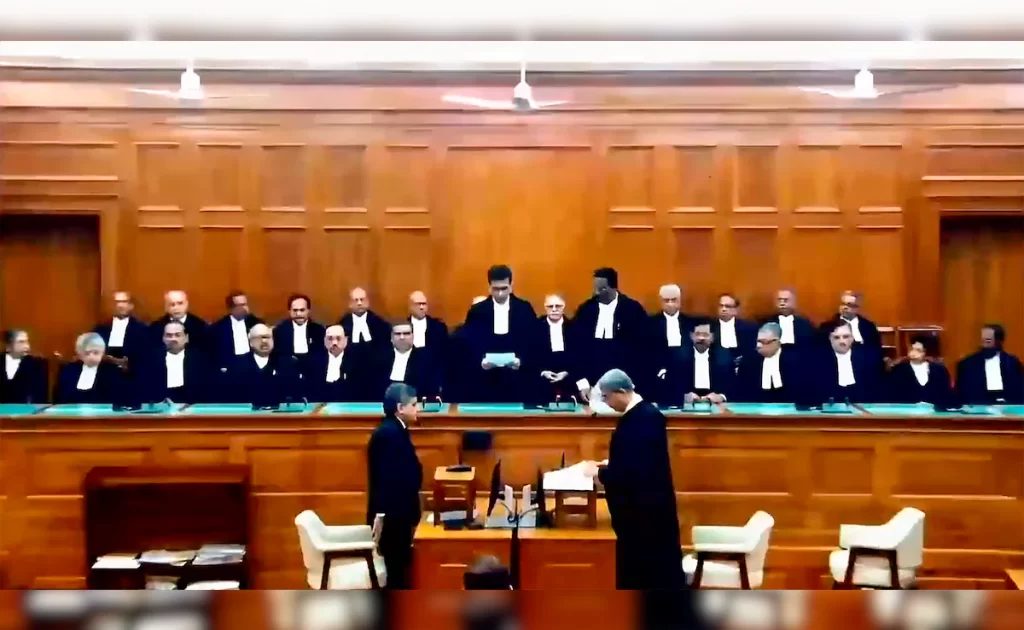
The Supreme Court of India is the highest seat of justice and the final arbiter of disputes in India. It is a guiding beacon for the rest of the judicial organs to emulate and follow while they hold office. But does the Indian judiciary also need to periodically look in the mirror?
The question assumes significance because the Supreme Court itself, at its Full Court meeting on May 7, 1997, adopted two resolutions aimed at upholding judicial standards and ensuring remedial action when those standards are violated.
The first was “The Restatement of Values of Judicial Life”, laying down a list of judicial standards and principles to be complied with and followed by the Judges of the Supreme Court and high courts. The second was an “In-house Procedure” for taking appropriate remedial action against judges who have violated these universally accepted values of judicial life, as well as all other principles that flow from them.
The effectiveness of these salutary principles cannot be judged merely by those who adhere to them. It must also be assessed against the numerous reported and unreported violations, which suggest that their values have not been adequately upheld or strictly adhered to at all levels of the judiciary.
That gap between principle and practice raises a larger question: Does the Indian Judiciary need institutional periodic introspection and review?
The above efforts of the apex court seem to have influenced and led to global initiatives that became the basis for the enunciation of the globally acclaimed “Bangalore Principles of Judicial Conduct” of 2002. The initiatives were primarily under the auspices of the UN, while the global NGO, Transparency International, also played a role in efforts to formulate universal judicial standards.
These initiatives gave the needed impetus for the 2001 Conference of Chief Justices in Bangalore to initiate the drafting of the Code of Judicial Conduct. Finally, the Bangalore draft was adopted by the Judicial Group on Strengthening Judicial Integrity and was further revised at the round table meeting of Chief Justices held at the Peace Palace, The Hague, on November 25–26, 2002. The draft was then christened the “Bangalore Principles of Judicial Conduct”, 2002.
These hallowed principles were primarily doctrinaire under the following six heads, termed the “Core Values”:
- Independence: Exercising judicial functions free from external pressure or influence.
- Impartiality: Applying fair, unbiased judgment to both the decision and the process.
- Integrity: Maintaining moral and ethical conduct beyond reproach.
- Propriety: Behaving in a manner that reinforces public trust in the office.
- Equality: Guaranteeing equal treatment to all individuals before the courts.
- Competence and Diligence: Possessing legal proficiency and executing duties efficiently.
These principles were elaborated extensively and came to occupy the position of fundamental constitutional standards and values, universally accepted and revered today, through their adoption by various United Nations organs.
The UN Commission on Human Rights adopted the “Bangalore Principles of Judicial Conduct” via Resolution 2003/43 and subsequent resolutions, recognising integrity as vital to judicial independence and human rights.
In July 2006, the United Nations Economic and Social Council (ECOSOC) adopted a resolution recognising the “Bangalore Principles” as a further development of, and complementary to, the 1985 United Nations Basic Principles on the Independence of the Judiciary. ECOSOC invited states to encourage their judiciaries to consider the principles when reviewing or developing rules on judicial conduct.
UNODC (United Nations Office on Drugs and Crime), Vienna, Austria, convened expert groups in March 2007 and officially published the finalised Commentary on the Bangalore Principles of Judicial Conduct in September 2007, further strengthening the status of the Bangalore Principles as part of its guiding mechanism.
Legal scholars and international jurists have since debated mechanisms for strict implementation of these principles. The 2010 draft “Lusaka Measures on the Implementation of the Bangalore Principles on Judicial Conduct” noted that areas of concern remain.
In his article “Quest for Universal Standards of Judicial Integrity: Some Reflections on the Bangalore Principles”, Prof. Dejo Olowu of the Faculty of Law, North West University, South Africa, has argued that “a plethora of pertinent questions, advocating that the mechanisms for judicial integrity should not be entirely controlled by the judiciary but should be made to accommodate sufficient lay representation, and furthermore, that current codes of judicial conduct be formulated as enforceable rules and procedures in ways that would sustain public confidence in judicial processes.”
This goes to the core of the present debate. If judicial integrity is a matter of public confidence, can the mechanisms for ensuring that integrity remain entirely within the judiciary?
These cherished milestones have been achieved proudly on the touchstone of the Bangalore Principles of Judicial Conduct, 2002, through thought processes evolved and shaped in India and permanently etched into the annals of human legal history. As progenitors of the principles, we as a nation have the moral responsibility to further test their various aberrations and the overall judicial conduct in India in order to ensure strict compliance.
India needs to stand tall and be once again recognised as the leader and the flag-bearer of exemplary judicial functioning and conduct. The sine qua non of this is exceptional appointments, transparent appointment processes and swift punitive action in cases of violations and serious dereliction of duty, coupled with effective mechanisms for removal from office where warranted.
If we review more mundane aspects, the gap between theory and practice of the Bangalore Principles is yawningly wide. To take a few recent examples, the judicial system did not emerge with flying colours when bold, honest and enthusiastic IAS officers such as Tukaram Munde were discouraged by judicial obiter, received a dressing down or saw their orders hastily stayed. Questions do indeed arise as to whether we have only a theoretical system. Is there a free run for judicial activism, many times resulting in judicial overreach?
The recent finding of cash at a judge’s residence has shaken public confidence, especially because it was not addressed quickly enough. Can judges indulge in commercial activities during their tenure of office?
Recently, judges in the apex court have had to repeatedly write to the CJI regarding the misconduct of a judge, or even of a Chief Justice of a high court, to highlight such issues. Many incidents of judicial misconduct, some even after retirement, are reported in the press, shaking the faith and confidence of the people, but never seem to reach a just conclusion.
A recent, deeply disheartening story of a mother-in-law, a retired judge, causing the dowry death of her daughter-in-law severely tarnished the image of the judiciary. Numerous unreported incidents, which amount to corrupt practices, spread through social media and reach every nook and corner of the country, yet no one seems to face the full force of judicial enforcement. This does not augur well for the system.
These are not merely isolated questions of individual conduct. They go to the larger issue of whether the institutional mechanisms created to uphold judicial values are adequate to ensure accountability when those values are breached.
The judiciary lost the golden opportunity to monitor the system more effectively when it quashed and set aside the Government’s proposal to establish a “National Judicial Appointments Commission” (NJAC), which was adopted by way of a Constitutional Amendment, passed with near unanimity by all state legislatures and the Parliament.
Has the time come to revive such proposals to establish an Independent Commission comprising the most eminent and distinguished retired members of the judiciary, upstanding citizens from the bureaucracy, print and electronic media, legislatures, and even industry?
Do we need an independent, expeditious mechanism, outside the judicial establishment, to regularly and systematically examine complaints regarding misconduct by judges from across the country?
The question is no longer merely whether the judiciary has the principles. It is whether the system has the institutional will and mechanism to ensure that those principles are followed. The fact is that the system needs to be regulated and managed better, without a second thought.