

The Baghdadi Jewish community of India is one of the three oldestJewish communities in the country. There are the Jews of Cochin, well known for the Paradesi Synagogue, which stands at the head of bustling Jew Street, a popular destination for local and international tourists. There are also the still older Bene Israel Jews of Maharashtra, whose legends state that they fled Judea to escape persecution under Antiochus Epiphanes in 175 BCE. They settled on the Konkan coast and were called Shanvaar telis, meaning seventh-day oil pressers.
The Baghdadi Jews, that is, Jews who came from the Middle East, came to India at the tail end of the eighteenth century in search of economic opportunities. In the mid-twentieth century, a new group of Jews in India emerged. These are the Bene Menashe of Manipur and Mizoram, who claim descent from the Biblical Tribe of Menasseh. They were officially recognised by the Sephardi Chief Rabbi of Israel in 2005, and the majority have immigrated to Israel.
From the Middle East to India
The Baghdadis have been called the “Jews of the Raj” because they came and prospered under British rule. The first settler, Shalome Obadiah Ha Cohen, came to Calcutta from Syria in 1796. Many Jews from the Middle East followed. The Jews from Baghdad were most numerous because they came in waves in response to persecution under the Ottoman Governor Daud Pasha between 1817 and 1831.
The community followed the liturgy of Baghdad, which was a great centre of Jewish learning. Thus, the Jews of the Middle East who settled in the port cities of India, namely Calcutta and Bombay, came to be referred to as Baghdadi Jews.
The Baghdadi Jews expanded their trading network from Baghdad to Shanghai between the eighteenth and twentieth centuries. In key port cities across this large network, members of key Baghdadi families played important mercantile roles.
Most illustrious among the Baghdadis were the Sassoon family of Bombay, who were known as the “Rothschilds of the East”. While this mercantile community first made its money through the opium trade, namely the shipping of opium, it rapidly expanded its enterprises to include large real estate holdings and trade in indigo and jute, as well as the development of factories and other businesses.
Thus, prominent Jewish families, such as the Sassoons of Bombay, the Ezra family of Calcutta, the Menasseh Meyer family of Singapore, the Kaadoori and Belilios families of Hong Kong, and the Sassoons of Shanghai, dominated the finance and real estate landscape in each of these port cities. They also established philanthropies and endowed synagogues, schools and hospitals that still mark the Jewish presence. Across “Jewish Asia”, this presence remains.
Calcutta’s Jewish Community
Calcutta was an important hub in this trading network that spread from London to Shanghai from the eighteenth to the mid-twentieth century. While the Jews of Calcutta were never more than 5,000 in number and the Baghdadis of Bombay were about 2,000, they made a considerable mark on the city.
They were well integrated into the cosmopolitan financial, social and cultural landscape. While some Jewish families, like the families of Sir David Ezra, the Gubbay family and the Belilios family, were exceedingly wealthy, fifty per cent of the community were always poor, as new immigrants kept coming to Calcutta. Due to the extensive charity provided by the community, in one generation, most families were able to ascend to the middle class. Jews made their presence felt in many fields, and among them were many famous personalities.
They were sheriffs, lawyers, teachers and businessmen, and there were colourful luminaries like Edwyn Myers, better known as Ezra Mir, who founded the Indian Documentary Producers Association in 1956 and worked on over 700 documentary films. He was also the Chief Producer of the Ministry of Information’s Film Division. He was awarded the Padma Shri in 1970.
Eddie Joseph was an internationally acclaimed magician. He wrote many books on magic, and his magic effects are still used today. He was the Indian representative of the International Brotherhood of Magic, and the Eddie Joseph Ring in Mumbai is named after him.
Esther Victoria Abraham, whose screen name was Premila, was the first Miss India in 1947 and the first major woman film producer in India. Silver Productions bankrolled 16 films. Furthermore, her daughter, Naqi Jahan, won Miss India in 1967, making them the only mother-and-daughter duo to win this title.
While the personalities highlighted above made their mark in media and entertainment, other members of the community, such as the Guha sisters, distinguished themselves in politics and law. Regina Guha was the first woman to fight a notable case in 1916 that challenged the interpretation of the law that prohibited women from practising law. Her sister, Hannah Sen, was a prominent leader in the Congress party and a member of the first Indian Rajya Sabha from 1952 to 1957, as well as an advocate for the rights of women and children.
Lieutenant General J. F. R. Jacob is remembered for the pivotal role he played in the 1971 Bangladesh Liberation War. He was a recipient of the Param Vishisht Seva Medal and served as the Governor of Goa and Punjab.
The Great Exodus
Though the Baghdadis flourished during the two and a half centuries they lived in India, the community rapidly dwindled after India’s independence in 1947. This was due to some national and international reasons, including the presence of British and American troops in Calcutta, which resulted in many community members marrying outside the community; the Partition riots in Bengal; fear of new monetary policies being considered by the new government; the ability to emigrate to England under the British Nationality Act (1948); the ability for some to emigrate to Australia; and the establishment of Israel in 1948.
Today, members of the Baghdadi Jewish community of Calcutta and Bombay mostly live in the UK, the United States, Canada and Australia, with a lesser number in Israel. The Baghdadi Jews continue to make waves internationally. Famed Indian artist Anish Kapoor’s mother was a Baghdadi Jew from Bombay. Gerry Judah, the artist and designer well known for his gigantic sculptures for the Goodwood Festival of Speed, is from the Calcutta Jewish community, and the Reuben brothers are known for their philanthropy in the areas of healthcare, education and community initiatives.
A Community Reduced to a Handful
In Calcutta, only a handful of Jews remain – most of them elderly. Most have married into other communities. While few in number, the Jewish footprint remains and is increasingly acknowledged and known.
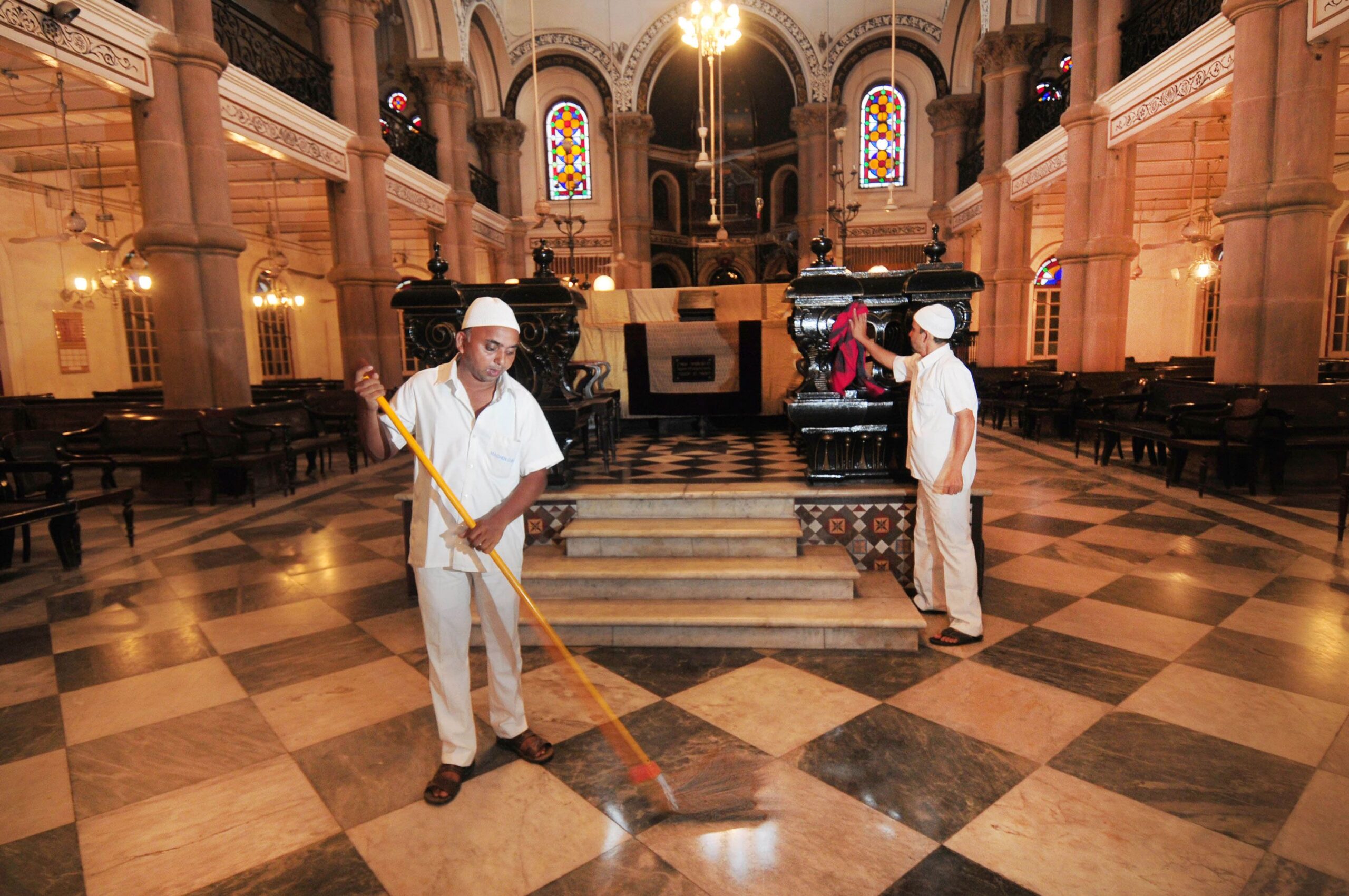
There are three synagogues, two of which the Archaeological Survey of India (ASI) has designated as Grade 1 Heritage buildings. Two schools are still managed by boards constituted of the few Jewish community members who remain. There is also a sprawling and well-maintained cemetery with more than 8,000 graves amidst grand old trees, flowering shrubs and two small ponds.
The Ezra Hospital is part of Medical College, Kolkata. Two enclosures in the zoo are still named after their benefactors: Gubbay and Ezra. Ezra Street, once one of the busiest streets of the empire, has not yet been renamed, and Belilios Park lies in Howrah.
A remarkable new school in Tikiapara, Howrah, is built on Belilios property and is named the Rebecca Belilious English Institution. There are many magnificent buildings built by Jews that define the skyline of the city, such as Esplanade Mansions and Chowringhee Mansions.
A Legacy That Outlived the Community
This Jewish legacy is important not only because of the significant roles that Jewish community members played across sectors, their extensive philanthropy and the magnificent buildings that still exist. The schools continue to serve their mission despite there being no Jewish children in attendance.
The Jews of India, including the Baghdadis, are singular and unique among Jewish communities across the world. This is because of the way in which India treated them. India is the only country in the world where Jews never faced any antisemitism, except during a brief period in Goa under Portuguese rule.
There was no position to which Jews in India could not aspire. Jews and Muslims in India enjoyed, and still enjoy, close working relationships, as Jews did with other minority communities, as well as the majority Hindu community.
