

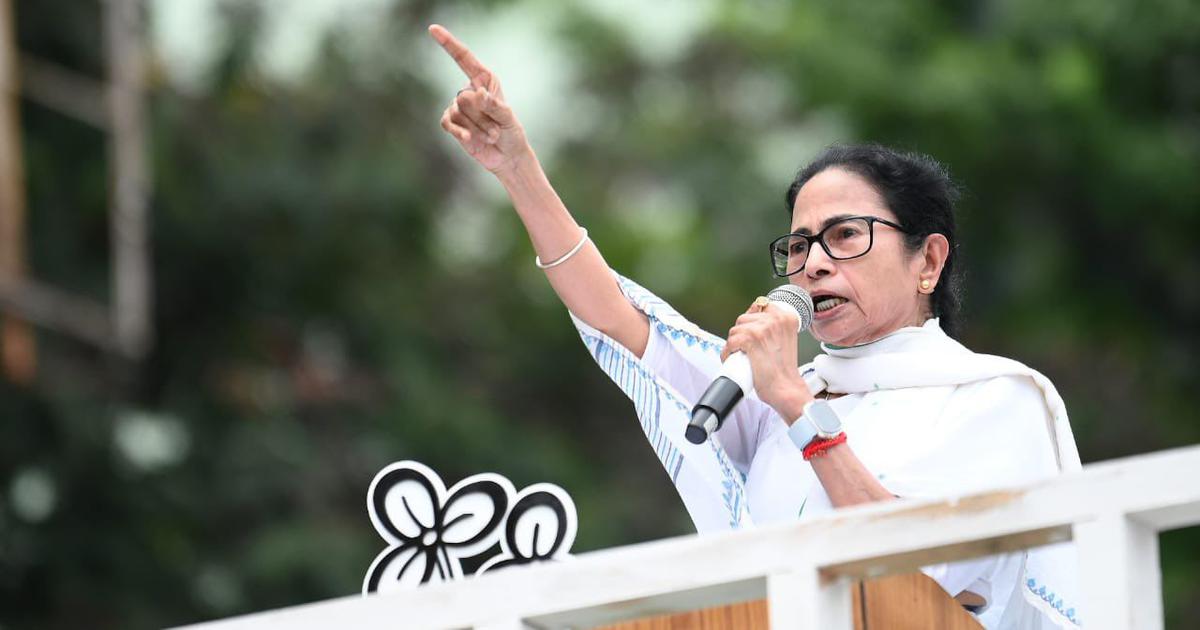
There is a particular kind of political death that happens not in a single catastrophic moment but across a series of fractures, each one small enough to explain away until, suddenly, there is nothing left to explain. Mamata Banerjee is experiencing that death now. The breakaway faction of the Trinamool Congress, spreading its roots through both the West Bengal assembly and Parliament, is not merely a split. It is a verdict. When your own people, people you elevated from obscurity and protected through scandal, choose to walk out the door, they are not making a tactical calculation. They are making a historical one. They are saying: the future is elsewhere.
The political obituary of Mamata Banerjee does not require an election result to be written. It is written in the body language of legislators who no longer bother to pretend. It is written in the arithmetic of a breakaway faction large enough to matter. And it is written, most decisively, in the irreversibility of age. She is not a young politician who has stumbled and can rebuild over a decade. The window for reinvention has closed. West Bengal, which she remade in her own furious, combative image over more than a decade, is moving on without her.
Into this vacuum, the Bharatiya Janata Party enters as the obvious beneficiary. With TMC fracturing, the temptation will be overwhelming: absorb the breakaway legislators, offer them safety and relevance, and accelerate the collapse of the Trinamool house. This is the classic BJP playbook — the one that has worked in Meghalaya, in Goa, in Maharashtra and elsewhere — and it will be dangled before the party’s Bengal leadership as the obvious path to power. It must be resisted. Firmly and permanently.
The breakaway group is not a collection of reformed democrats making a principled stand against Trinamool’s authoritarian culture. Many of them are products of that culture. They carry the same baggage, the same allegations of cut money, post-poll violence, syndicate rackets and administrative overreach, that the BJP spent years cataloguing against the ruling dispensation. To absorb them wholesale into the saffron fold would be to inherit not just their votes but their taint. It would hand the opposition, particularly a possible resurgence of the Left, exactly the narrative it needs: that the BJP came to Bengal not to clean house but to move into the same house with different furniture.
Bengal voters are not naive. They have watched this script play out before. The credibility the BJP has painstakingly built over the years as the party that stood against the syndicate raj, that documented the violence, that made the case for institutional accountability, is a finite asset. It can be spent quickly and foolishly on opportunistic absorption. Or it can be invested in something more durable: a genuine political alternative rooted in governance, not just opposition.
There is another force calculating its return, and it is one that the BJP would be unwise to dismiss. The Communist Party of India (Marxist) and its Left Front partners were not merely defeated in 2011 when Mamata swept them from power after thirty-four years. They were humiliated. They lost the organisational structures they had spent generations building. They lost their trade union dominance. They lost the cadre. Most devastatingly, they lost the moral high ground — because by the end, the Left Front’s rule had become indistinguishable from the thing it once claimed to oppose: entrenched power protecting itself through violence and patronage.
But a decade and a half of opposition has done something unexpected. It has given the Bengal Left what it hadn’t had since the 1970s: the freedom to be idealistic again. The CPI(M) that returns to relevance now is not the calcified bureaucratic machine of the Buddhadeb Bhattacharjee years. It is a leaner, angrier, ideologically coherent force — one that has shed the cynicism of incumbency and rediscovered the language of rights, of economic justice, of resistance to corporate capture.
More importantly, the Left benefits from a structural advantage that neither the BJP nor the remnants of Trinamool can claim: it has no association with the disorder of the last decade. Every riot, every rape that was minimised, every opposition worker who was killed, the Left can point to all of it and say, accurately, that it happened on someone else’s watch. Historical memory in Bengal is long, but it is not static. A new generation that knows the Left only as the underdog, not as the oppressor, is a political asset.
This does not mean the Left is on the verge of returning to power. It means it is on the verge of becoming an important opposition in a state that desperately needs one.
What makes the coming years in Bengal genuinely fascinating and genuinely consequential is the nature of the contest that is taking shape. This will not be a fight between two variants of patronage politics dressed in different colours. It will be, or it has the potential to be, something rarer in contemporary Indian democracy: an actual ideological contest.
The BJP represents a Hindu nationalist, developmentalist vision — market-oriented, culturally assertive, centralising in its instincts, deeply uncomfortable with the Bengali intellectual tradition’s historic scepticism of Delhi. The Left represents a redistributive, secular, class-based politics — suspicious of capital, rooted in a labour politics that still has some traction in the state’s industrial belt, and with a cultural affinity for the Bengali identity that the BJP, for all its efforts, has never quite been able to simulate convincingly.
The decades of Trinamool dominance had suppressed this contest by making every election a referendum on Mamata herself: her energy, her combativeness, her identification with a certain subaltern Bengali dignity. With her removed from the equation, the contest must now be fought on substance. For a state that has often preferred personality to programme, this is unfamiliar territory.
The people of West Bengal have lived through thirty-four years of Left Front rule that began with genuine promise and ended in sclerosis. They have lived through fifteen years of Trinamool governance that began with liberation and ended in predation. They deserve something different from both.
Bengal’s political grammar is being rewritten. The tigress is down. That much is settled. The question that will define the next decade of one of India’s most politically consequential states is simpler and harder than it looks: what kind of politics rises in her place?
(Bikash C Paul is a Delhi-based senior journalist and executive editor of ‘New Delhi Post’)