

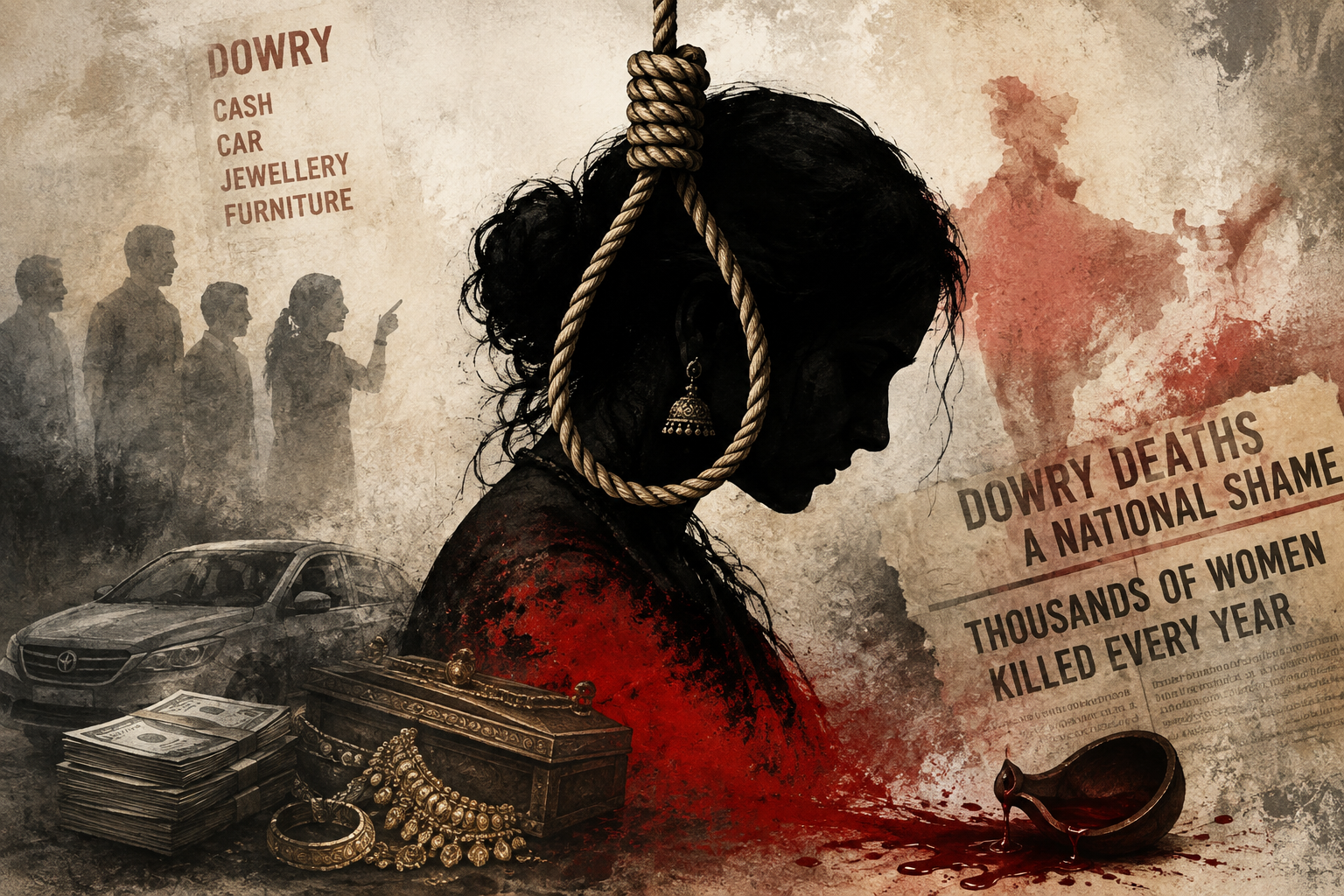
In late July 2026, 25-year-old government school teacher Srishti Kandhari died by apparent suicide in Doiwala, near Dehradun, roughly eight months after her marriage. Before taking her life, she recorded a 90-second video, sobbing and wiping tears from her face, managing to utter her first words only after 35 seconds. Between sobs, she blurts out: “Everything has become so strange. I have been enduring this for six months… Now I can’t endure it anymore. Their mindset can never change. They keep blaming me for things that happened after our marriage. (Calling me) ‘manhoos, manhoos’ (cursed).” The video ends. Her final message was an apology to her mother, and a damning testimony against those who should have protected her.
Srishti’s story is not an anomaly. It is part of a continuing series of dowry deaths in India, mostly reported from the northern states. According to India’s National Crime Records Bureau (NCRB), more than 5,737 dowry deaths were recorded in 2024 as a result of harassment by husbands or in-laws, an average of 16 women dying each day from dowry-related abuse. The national rate stands at 0.8 cases per 100,000 women. Though the practice of giving or taking dowry has been prohibited under the Dowry Prohibition Act 1961, the custom has persisted, as has the violence stemming from dissatisfaction over dowry demands.
The Mechanics of Violence
Dowry, marriage payments made by a bride’s family to the groom’s family in the form of cash, household items, vehicles and other financial assets, has been illegal in India for over six decades. Yet the practice has transformed from a traditional symbolic gift into a predatory exchange where grooms carry a monetary market value, and demands continue long after the wedding ceremony. Deeply entrenched patriarchal views treat women as financial and social burdens, leaving brides with little bargaining power inside joint families. When a bride’s family cannot fulfil escalating demands, husbands and in-laws subject women to severe domestic abuse, psychological torture and physical violence, often ending in fatal burning, hanging or forced suicide. Some women are directly murdered through strangulation, poisoning, or being doused in kerosene and set on fire, with perpetrators attempting to disguise the murder as a kitchen accident. Others, worn down by relentless daily taunts, starvation and beatings, take their own lives by hanging or consuming poison inside the marital home.
Although the Dowry Prohibition Act outlaws the practice, enforcement remains weak. Thousands of cases filed under legal frameworks such as Section 80 of the Bharatiya Nyaya Sanhita (formerly IPC Section 304B) face years of trial delays and low conviction rates. Victims’ families often face intense community pressure to drop charges or alter testimonies, allowing abusers to escape accountability. The law exists on paper; justice does not.
Insights from Research: Understanding the Persistence
Dr Kriti Kapila, Senior Lecturer in Social Anthropology and Law at King’s College London, in her 2026 research paper Infrastructures of Inattention and Necropolitical Kinship: Ritual, Capital, and the Time of the Law in India, offers a compelling explanation for why the dowry system persists despite its prohibition. Kapila characterises dowry as “a form of marriage payment that is inextricably tied to the ideology of ritual purity and pollution”, an extractive practice that is “today primarily an articulation of the premium on the male child”. In Hindu kinship, the ritual formulation of marriage involves the exchange of pollution with gift-making: the “pollution” of having a daughter is taken on by the wife’s family (better: the groom’s family) in return for dowry payments.
Kapila’s study traces the survival, and even the intensification, of dowry to two other laws passed around the same period as the Dowry Prohibition Act: the Hindu Marriage Act 1955, which introduced divorce into Hindu marriage for the first time, and the Hindu Succession Act 1956, which granted women inheritance and property rights.
Traditionally, the study argues, marriage between Hindu families carried a lasting imbalance. A family with a daughter was treated as ritually tainted simply for having her, and dowry functioned as the price paid to the groom’s family to accept her and remove that stigma. This obligation was one-sided: the bride’s family owed, while the groom’s did not. The ritual logic framed daughters as a burden from birth.
The Hindu Marriage Act made divorce legal, meaning a marriage could now end within a person’s lifetime rather than perpetuating ritual arrangements across generations. B R Ambedkar had hoped this change would help dismantle the caste system, but that did not happen. Marriage remained governed by caste rules in practice, and dowry persisted, but its meaning shifted. It ceased to be payment for ritual stigma and became a price tag, one that families could place on a groom and demand in cash, sometimes for years after the wedding.
The Fading of Public Outrage
The dowry protests of the 1970s and 1980s marked the first time Indian women mobilised as women, without male intermediaries. Yet by the late 1990s, dowry deaths had faded from public attention, driven by two related changes. First, suicide rates among young women rose through the 1990s, and many of these deaths — though not officially linked to dowry — had the effect of masking dowry-related killings. Brides who might once have been killed by their husbands’ families began instead to take their own lives, making it harder to build cases against the relatives who drove them to do so. Second, kerosene stoves, once common in Indian kitchens and often used to stage dowry killings as accidents, became rarer in cities, rendering that cover story less plausible. As killings increasingly took the form of suicide rather than murder, public grief and anger gave way to private shame.
Kapila calls this an “infrastructure of inattention”. When dowry deaths became suicides, protest became uniquely difficult: it is hard to campaign against a death for which no living person can be clearly blamed. The research observes that the uneven unfolding of post-Independence laws designed to free Indian women from the constraints of Hindu kinship inadvertently created the conditions in which their killing could go publicly unmourned.
The Parallel Crisis: Female Foeticide
The study contrasts dowry deaths with female foeticide — a second, larger form of what Kapila calls “structural femicide”, achieved through prenatal sex selection. Despite claiming more lives than dowry deaths, female foeticide has never produced mass protest or public mourning.
India’s 1991 Census first recorded an adverse national sex ratio. The 2001 Census recorded 927 girls for every 1,000 boys in the 0–6 age group, down from 945 a decade earlier, with some northern states showing as few as 884 females per 1,000 males. Parliament criminalised female foeticide under the Prenatal Diagnostic Techniques Act 1994, which was amended in 2004.
Yet female foeticide presents an even starker version of the same problem. Sex-selective abortion is a decision made by the foetus’ own parents and grandparents, leaving no outside party to hold accountable. The relatives who might otherwise grieve and protest are themselves complicit in the decision to end the pregnancy. The study frames this not as simple neglect but as enforced inattention: families become unable to acknowledge their own role in a killing, and that inability, multiplied across the country, has prevented female foeticide from becoming a matter of mass protest.
Why the Silence?
The dowry protests of the 1970s and 1980s remain the only time women in India mobilised en masse against this horrific social custom. By the 1990s, society had entered a new phase of consumerism with the advent of neoliberalism. This led to the growth of a new aspirational middle class that widened the scope of dowry extraction and the commodification of marriage. Mirroring the inflationary tendencies of commodities at the time, the ‘price’ of the commodified male child also increased, leading to a vastly expanded scale and scope of dowry extraction. Despite increased levels of education and participation in the workforce, daughters continued to be regarded as expensive to raise.
It remains enigmatic why Hindutva ideologues tend to ignore this intrinsic structural flaw of traditional Hindu society, deflecting criticism from the ritual framework itself. Is it because strict caste and community endogamy remain central to their social vision, and these marriage markets, based on arranged marriages involving dowry transactions, reinforce traditional social boundaries? The silence is not merely passive; it is active, deliberate and complicit.
A Collective Shame: Economics of Patriarchy
The unmourned deaths of thousands of women like Srishti Kandhari in Dehradun, Akriti Sikka in Delhi, Twisha Sharma in Bhopal and Vismaya Nair in Kollam, Kerala, along with countless other young women, are not simply statistics. They are daughters, sisters, teachers and professionals whose dreams have been extinguished by a system that values male children as assets and female children as liabilities. The legal prohibitions exist. The data are recorded. The research is published. Yet the deaths continue, and the silence deepens.
The “silence” is not accidental; it is functional. In a deeply patriarchal, hyper-capitalist society, a daughter is still widely perceived as an economic liability because of dowry and marriage expenses, and an emotional asset that “belongs” to another family. A son is an investment: a caregiver in old age, a carrier of the family name and a performer of last rites. This calculus is so deeply embedded that even educated, urban families unconsciously reproduce it. When a daughter is killed — whether through dowry harassment, sex-selective abortion or neglect — the grief is real, but it is often private, contained and quickly “moved on from” because the system offers no public ritual of accountability. There is no equivalent of a national day of mourning for our murdered daughters.
The question “Why No One Is Bothered” is itself a damning indictment. When a society ceases to mourn its daughters, it ceases to be a society worth defending. The “infrastructure of inattention” must be dismantled, not by laws alone but by a fundamental cultural reckoning. Until then, the shame belongs not to the victims but to all who look away.
We rightly condemn Afghanistan and its religious leaders for their atrocious and inhuman treatment of the country’s women. We condemn the Taliban’s overt, state-sanctioned brutality: the banning of girls from schools, the forced covering and the public floggings. And we should. It is grotesque. But India’s violence is structural and intimate. It happens in the ultrasound clinic, the kitchen, the marital bedroom and the hospital ward. It is carried out not by religious police but by mothers-in-law, husbands and even biological parents. This form of violence is harder to see, harder to prosecute and easier to dismiss as “family matters”. In some ways, it is more insidious because it wears the mask of culture, tradition and “honour”. We are comfortable condemning the other because it is foreign; we are uncomfortable confronting ourselves because it requires us to look in the mirror.
A Fundamental Cultural Reckoning Required
The PCPNDT Act (Pre-Conception and Pre-Natal Diagnostic Techniques Act) has been on the statute books for decades, yet the sex ratio in many states remains abysmal. The Dowry Prohibition Act exists, yet dowry demands remain routine. Why? Because laws without cultural legitimacy are merely words on paper.
A fundamental cultural reckoning would require a change in societal attitudes towards this crime. We need public funerals, memorials and collective outrage for every Akriti and Srishti, not just when a high-profile case goes viral. We need to name the perpetrators, not just the victims. Until a daughter is seen as an equal inheritor, an equal earner and an equal decision-maker within the family, her life will remain contingent.
This means enforcing property rights, ensuring equal pay and promoting shared parental leave. Schools and colleges must teach not only gender equality as a concept, but also consent, empathy and critical thinking about patriarchy. Boys must be raised to see their sisters not as “someone else’s responsibility”, but as full human beings. The media and civil society must shift the shame from the victim — “What was she wearing? Why was she out late?” — to the perpetrator and the complicit society. The question must change from “Why did she die?” to “Why did we let him kill her?”
A Vishwa Guru (‘Universal Teacher’) cannot be a nation that preaches to the world while its own daughters are unsafe in their own homes. The title is not a birthright; it is an aspiration earned through moral leadership. Right now, on the metric of women’s safety, dignity and survival, India is not a teacher; it is a student in dire need of remedial education.
The deaths of Srishti, Akriti, Twisha, Vismaya and thousands of unnamed daughters are not “unmourned” because they are unimportant. They are unmourned because mourning them would force us to change. And change is harder than silence.