

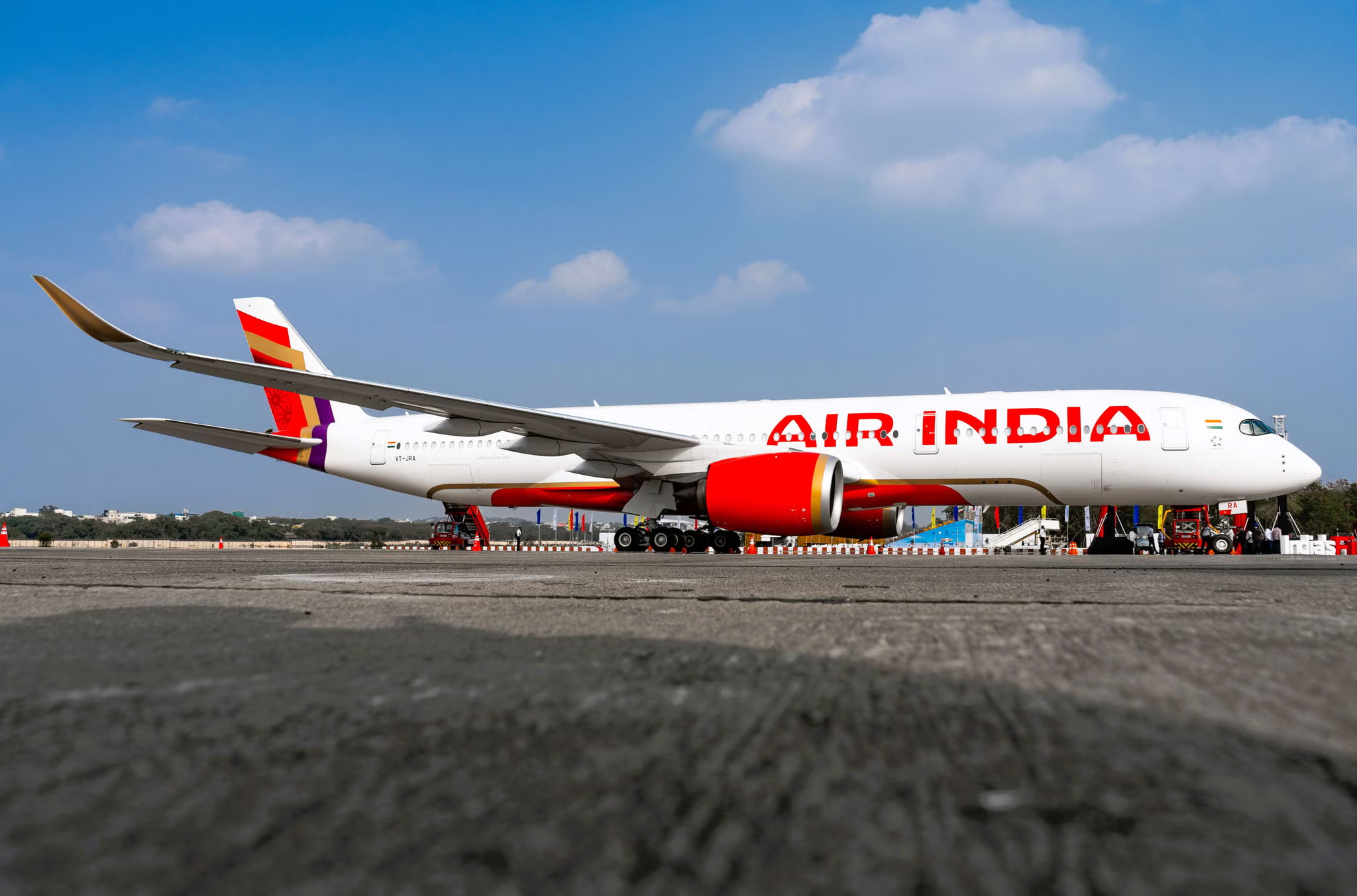
The Air India saga leapfrogs from one sad lilypad to the next. What was supposed to be aviation’s rescue of the century by the Tata Group now has a muddy loss of Rs 2660 crores and counting. The departure of CEO Campbell Wilson has the stench of dumping a sinking ship. The man who was supposed to turn this baby around looked at the horizon and decided to jump into a lifeboat. He glibly says, as he is tiptoeing away, that his leaving is a “natural transition point”, whatever that means.
Then there is the sad cold shoulder given to Tata Sons Chairman Natarajan Chandrashekharan by his in-house peers, and it smacks of corporate boardroom intrigue. He is walking away, head held high, from a takeover he had masterminded.
The continual slide has made a mockery of the Maharajah, and this once proud Emperor has been denuded of his clothes over the years.
Once an example of luxury air travel to the world, the rot set into the carrier the day JRD Tata was robbed of his airline. By sheer coincidence, I was interviewing him that very day, February 1, 1978, at the Taj Sea Lounge in Mumbai. In a moment of silence, he said, “I might be mildly distracted in answering your questions. Earlier today, Prime Minister Morarji Desai relieved me of my duty as Chairman, a post I held for 25 years. I must now call Air Chief Marshal P C Lal and congratulate him for taking over.”
Like the man, so his most loved project …both class acts. How crassly has the power and glory deteriorated since that arbitrary dismissal.
In June 2023, Air India had placed landmark orders to purchase 470 aircraft from Airbus and Boeing as part of its ongoing Vihaan.AI transformation programme that prioritises modernising its fleet among other monumental changes. Reaffirming its commitment to building a modern airline that India can be proud of, it has recently placed an additional order to purchase 100 more Airbus aircraft, taking the total number of aircraft ordered to 570.
These sentiments are reflective of its own thought process. Now it is scrabbling just to stay in the game. They are retrofitting planes with new seats, but the supply chain for first-class seats is delayed by two years. That is just pathetic. You cannot sell premium seats if you don’t have premium products.
While the loss of AI 171 on June 25, 2025, in Ahmedabad en route to Gatwick was the cruel low point with the inquiry still shrouded in confusion and contradiction, there are many other contributory reasons for the mess.
In all fairness, Tatas inherited an entity mangled by bureaucratic and political abuse. By then the airline was systematically destroyed. Staff morale was dealt a hatchet job, and after the 1974 pilot guild strike and surrender, the Maharaja’s moustache drooped for good.
There is also a visceral disappointment in that the public was made to believe the Tata magic would be enough to turn things around. With no recent aviation experience except for a pale deal in Vistara, which was run by SIA, the magic went poof. Two 747 losses, one on Jan 1 1978 and the other bomb-blasted over Shannon on June 23, 1985 added to the dismantling of the dream airline.
The financials are now in free fall. The numbers are not just bad. They are criminal. A loss of nearly $3 billion in a single year. They are cutting domestic flights, scaling back international ambitions, and even asking McKinsey to draft a miracle cure, all proof of being severely on the back foot.
Air India is also now trying to renegotiate terms with the manufacturers. They want to slow down deliveries largely because they are out of money. You shout about being the next big thing, you place a record order, and then you have to beg the manufacturers to take their jets back because you can’t afford the lease.
When you grandstand with such huge orders, you must also invest in simultaneous support systems and trained staff as well as a viable route map that is viable. There is not much evidence of any of this, especially international airport slots which are already stretched globally by congested skies.
With 1.6 billion passengers slated for 2026 in a system that is functional for half that, the stress factor is tangible.
One day in May this year, flights were delayed or cancelled across Europe. Not because of a strike. Not because of a war. Because the system is so overloaded, so brittle, that a spring squall sent the entire network into a tailspin.
Let us take Chicago O’Hare as a case study —it is now under a formal scheduling reduction process. Why? Because airlines scheduled over 3,080 daily operations on peak days. The airport can handle maybe 2,680. That is a gap of 400 flights a day. Four hundred. Every day. The FAA had to step in and say, “Enough. You cannot fly what you cannot land.”
I won’t list them, but the top twenty airports are all choked up. Air Traffic Control is pushed to its limits. This means safety is a beanbag up for grabs. Ironically, there aren’t enough trained personnel in ATC. The humans who guide the planes are exhausted, underpaid, and in short supply. And in many landing fields work with obsolete equipment.
There is no comfort in having free slots in subsidiary airports if there are not enough pax uplifts. You lose it. So airlines fly ghost flights—empty planes burning fuel just to keep their precious slots. They fly when they should be grounded. They pollute when they should be parked. All because the rules were written in a different era, for a different sky.
Here is the truth. The world is ordering planes faster than it can build airports. India alone has ordered over 1,350 new aircraft. The manufacturers cannot deliver them fast enough. And even if they could, where would they park? Where would they land? The runways are full. The gates are full. The skies are full.
Into this murky mix comes the tragicomic issue of flight 2379 from Phuket to Delhi. The Keystone cops couldn’t have done worse. Tragic because Providence and a 26-year-old three-stripper saved it from doom, and comical because what the hell was going on in the flight deck with the commander out of his seat and now suspected of being on a psychedelic high. I repeat the sentiment: what the hell is going on?
And the future. Much will depend on the largesse and accommodation from Boeing and Airbus to rework the deal and give Air India the fiscal break. Till then, it will stay a mess. Just hope there are no more lilypads.