

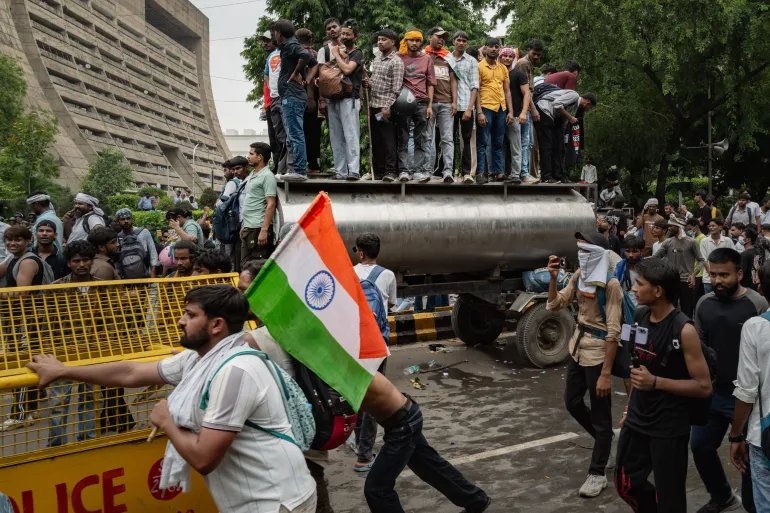
At a time when institutional dissent within campus spaces is being violently curbed, the demand for governmental accountability in the face of a crumbling educational infrastructure is surely needed. Why, to state the very obvious before its opposite gets normalised: students must protest against the lack of freedom of expression at the local and institutional levels, and it must be taken up before a national arbiter to which its local counterpart is essentially accountable.
That was the premise on which the Cockroach Janta Party (CJP) protestors, ridden by tear gas, pellet guns, internet blackouts and the blocking of strategic roads leading to the protest sites, mobilised themselves, starting from a mere internet satire to successfully demanding the resignation of a federal minister heading the national Department of Education. This was all in the face of a lack of accountability and transparency from both local institutions and ultimately, the national level.
However, one often forgets the fact that the power to reason and that of consciousness comes from people’s education, an embedded reality that blurs these local-national boundaries of distinction. Education houses the “people” from which the various “pillars” of democracy, whether the legislature, judiciary, executive or media, draw their clout and hence cannot be separated from these.
So, the real question that haunts all of us is: Can one at least mentally separate the educational enlightenment imparted to ordinary students in institutions under the aegis of the State’s machineries, a part of which runs through their own streams of consciousness? This question is important because it reflects the condition of one side standing on trial against the other, exhorting the latter to consider their worth and innocence in return for the others’ closure.
Determination and Grit of Young Blood
The Jharkhand protests, inspired by and in the aftermath of the nation-wide CJP Movement, centre around the demand by the state’s youth to cancel and reconduct the recruitment exams afresh, like JPSC and JSSC, in the light of paper leaks and unfair markings, for which an irresponsible testing agency is responsible. While the CJP was attempting to hold the BJP-led Modi Government accountable for the examination lapses at the centre, the Jharkhand agitation’s target was the JMM-led Congress government at the state level. However, when education rots, it rots across party lines, not caring about political affiliation or colour.
A recent conversation between two university scholars over the negligent maintenance of their library and reading hall infrastructural amenities spiralled into everyone signing a joint petition for the restoration of the services in question. When a couple of weeks’ waiting did not revert things back to the usual, a protest erupted at the common entry and exit points, during which the students urged the librarian not to turn a public space into an empty trash can of unanswered responses.
It is imperative to remember that many young students resisting institutional onslaught today will be staff members of the permanent and political executive tomorrow. One can, however, see cracks and fissures in the continuities of the great chain of imparting education as a democratically modern system advances and flourishes further: the younger blood does not want to repeat the mistakes of its older counterparts and puts the State machineries to trial before itself, to demand their worth. As Nelson Mandela said, “May your choices reflect your hopes, not your fears.” It is essentially this statement that coalesces very well with Gen Z’s exhortation to one another, not to be history-sheeters, not to dwell on the same erroneous paths of the previous generations.
While the newbees of Gen Z have challenged the conventional modes of petitions, prayers and mendicancy by robustly embracing pejorative slurs like “cockroach” as an embodiment of their grit, they also remain at the cusp of narrowing down on a common minimum programme of support. Although grit is one thing, a programme is quite another. Wearing the cockroach attribute as a symbol of pride does not necessarily translate into a common minimum programme of action. That not being accomplished, the newly brought out manifesto of the young cockroaches, “Voice of the Lazy and Unemployed”, then only becomes a call to include a handful of privileged people within the folds of its manifesto, while scooping out many underprivileged and marginalised youth across a significant cross-section.
A striking example of how specific voices at Jantar Mantar were not peopled together under a common minimum umbrella of support involved slogans for the women’s reservation bill being raised by a group of women at the site, saying that a government that cannot provide reservation for women is “good for nothing”. These women were hardly getting enough coverage from news and media houses, despite the reservation issue also being intrinsically related to the youth and therefore the future of the country’s education.
Cut to the day of Dharmendra Pradhan’s resignation on July 25, 2026, Devendra Nath Mahato, the face of the Jharkhand agitation, who went on an indefinite hunger strike with many aggrieved candidates in connection with the Jharkhand State-level examination irregularities in Jaipal Singh Munda Stadium, Ranchi, also had a dying mother to tend to while showing his solidarity for the swarm of dejected aspirants. They were ready to fight for their educational rights, and Mahato chose to channelise his efforts toward the latter. Physically weakened by one week of no food and not being able to hospitalise his mother, who passed away, Mahato went on record saying that the peace of his mother’s soul would be incumbent upon the success of the larger cause he sacrificed her life for. It would also be impacted by the kind of anti-corruption movement that the whole youth of the country was waging.
From Passion to Reconstructing the ‘People’
However, the Jharkhand agitation, much like the CJP too, is standing on a border of spontaneous agitation that Antonio Gramsci delineated and warned against in his prison reflections as a “war of manoeuvre”, which must be followed by and coupled with the trenches of civil society as part of the more long-drawn “war of position”. A mere resignation of a federal minister does not end the misery of lakhs and crores of students who had invested their futures and prospective careers in the dreams that they had envisioned.
A ground report by Lalantop features a JSSC candidate, Brahmananda Kumar, who was weathering the rain and sun to bring to the surface how the student’s movement in Jharkhand is factioned between the coaching centre mafias who are politicising students’ issues and the political parties who are sponsoring the movement in various capacities, to internally hijack it.
Moreover, recounting the tale of how the sericulture recruitment process has given shelter to unaffiliated technical institutes where weaving, sericulture, printing and dyeing as technical processes are being taught, Brahmananda Kumar, the man in the video, claims to have first-hand experience of the political corruption in the state recruitment processes on account of having served as faculty in one of these technical institutes.
As a present PhD student in another university, he has also received encouragement from Jairam Mahato and Babulal Marandi, two far-apart leaders, who continue to support his quest for trying to voice his grievance against the unfair recruitment in Jharkhand even though he has been discouraged by movement workers on grounds that they are not the “main subject matter of the protest”. Brahmananda’s experiences raise the issue of who gets to be peopled and housed as part of the State’s education policies, a question deferred for long.
Education Faces a Litmus Test
Therefore, it is only when the war of position, as per Gramsci, addresses the real fragmented tendencies within the political economy of education, riddled by privatisation, coaching mafias, paper leaks and buying and selling of seats and posts as a syncretic whole, that a movement linking the JPSC/JSSC aspirant in Ranchi, the one concerning the medical entrants and that of the scholars demanding restored services within their reading hall, gets understood as part of a seamless educational promise that the State had promised but is unilaterally withdrawing by its own betrayal.
The real test of the education system, therefore, has now begun. From a ministerial resignation to qualitative reconstruction, who are the people housed by the education a question that was not addressed for long will be addressed soon once the educational infrastructure is again put to the litmus test, written out in its future syllabi.