


There is no debate about the state of government schools. Even the government’s own report confirms this. The debate now centres on who is allowed to audit and film these conditions.
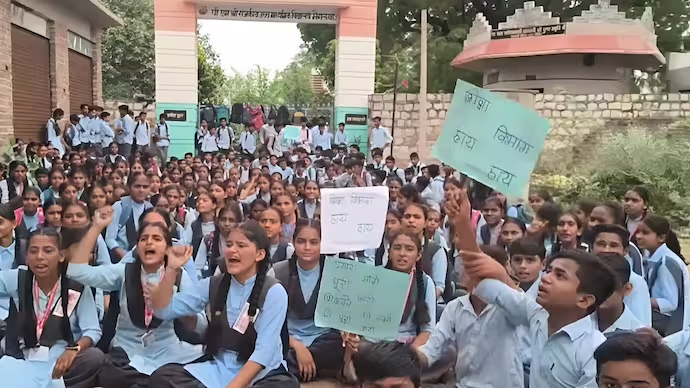
Inspired by the success of the Jantar Mantar protests, school students in at least 10 states and 25 districts held protests. They demanded more and qualified teachers, access to clean drinking water, working toilets, working fans and lights, safe school buildings, better mid-day meals, and roads they could use during the monsoon.
Most of these students were born after 2010. They are younger than Gen Z and belong to Generation Alpha.
According to the UDISE+ 2025-26 report published by the Union Ministry of Education on 17 August, 93.5 per cent of schools nationwide have electricity. Several states perform below this national benchmark, including Uttar Pradesh (88.8 per cent), Madhya Pradesh (90.7 per cent), and Rajasthan (91.5 per cent). In contrast, southern states record high access rates, with Tamil Nadu at 100 per cent, Kerala at 99.8 per cent, Andhra Pradesh at 99.7 per cent, and Telangana at 99.4 per cent.
A similar trend is evident in toilet availability: against a national average of 95.8 per cent, Kerala and Tamil Nadu lead at 99.6 per cent, while Madhya Pradesh and Rajasthan lag at 92.3 per cent and 86.8 per cent, respectively. Additionally, the data highlights that over one lakh schools across the nation operate with only a single teacher.
The ministry’s latest official report, released earlier this month, validates these concerns, confirming that the poor state of government schools is an established reality rather than a mere allegation.
While public discourse on school conditions is widespread, the main conflict centres on who has the authority to conduct audits or record videos on campus. To date, official restrictions remain far narrower than rumours imply, making a clear examination of actual developments essential.
After a CJP spokesperson announced on 17 August upcoming inspections of dilapidated schools across Jaipur, Kota, Jodhpur, Ajmer, and other districts, Rajasthan took action at the state level. That same day, the directorate of secondary education issued a directive prohibiting non-authorised individuals from entering government school premises without the principal’s explicit permission. Under these new rules, any form of recording (including photography, videography, interviews, audio recording, or live streaming) is strictly barred unless formal written approval has been granted. Principals must maintain a visitor log and may deny entry to anyone who might disrupt academic activities or discipline; if an individual refuses to leave the premises, school leaders must notify law enforcement.
In Uttar Pradesh, restrictions were imposed at the district level, despite the Chief Minister’s public stance. Earlier, the Chief Minister Yogi Adityanath welcomed the “School Theek Karo” campaign, encouraged filming, and cited the achievements of Operation Kayakalp. Shortly thereafter, Ayodhya’s District Basic Education Officer prohibited external individuals, specifically highlighting YouTubers and social media creators, from conducting unauthorised photography or videography on school grounds. Comparable directives were subsequently introduced in Ballia and Balrampur, with authorities citing the prevention of classroom disruptions as the primary rationale.
No comparable measures have been enacted in any other state so far. The reported wave of restrictions remains limited to a single statewide circular alongside three district-level directives.
In contrast, multiple districts chose to address the grievances directly. The district inspector of schools in Fatehpur promised swift action following student protests over missing desks, electricity, fans, toilets, and water facilities. In Lucknow, a road blockade by hundreds of female students demanding adequate hostel facilities and more teachers dissolved after the district collector personally visited and pledged to resolve the issue. After a roof collapse on 13 August, 174 students in Alwar staged a demonstration, prompting an official visit that not only addressed the immediate hazard but also resolved several other long-standing issues. Meanwhile, in Gaya, roughly fifty middle-school students (Classes 6 to 8) marched nearly four kilometres to the sub-divisional magistrate’s office to report shortages in uniforms, fans, toilets, drinking water, and mid-day meals.
In these districts, no formal order was needed. An official arrived to address the issue.
This movement has already become a political weapon. This aspect has changed the fastest, which may be why the audit will not last much longer.
The campaign started as a way for citizens to document school conditions. Within a week, it turned into a tool for political parties to use against each other.
The BJP countered CJP founder Abhijeet Dipke by challenging him to visit AAP-ruled Punjab and audit its claimed “world-class” schools. Highlighting Dipke’s prior role on AAP’s social media team, the party framed the campaign as an AAP-backed initiative. Meanwhile, in BJP-governed West Bengal, a party spokesperson questioned whether volunteers had conducted similar social audits during the TMC’s tenure, calling the effort a joint smear tactic by the TMC and the Left against the current administration.
The counter-argument from the same direction is that a private individual has no legal authority to enter a public institution and inspect it, that established channels exist for demanding accountability, and that children are being used as props for a political spectacle. That objection deserves a hearing. No statute makes a volunteer with a phone an inspector, and a campaign that films children will eventually have to answer for how it does so.
Yet, the opposing side holds an equally long list of examples. The campaign’s videos span schools across Congress-ruled Karnataka, as well as NDA-ruled Bihar, Mizoram, Madhya Pradesh, and Uttarakhand. Meanwhile, protests over teacher shortages have flared up in Punjab, a state where the BJP challenges the initiative to inspect, as well as in Jharkhand, Odisha, Maharashtra, and Chhattisgarh. The beauty of mobile phone cameras in citizens’ hands is that they recognise no political boundaries.
None of this is new either. In June 2022, ahead of the Himachal Pradesh assembly election, the Aam Aadmi Party launched a campaign asking people to photograph dilapidated government schools and post them with the hashtag #selfiewithschools, and set up a WhatsApp number to collect the material. Its target was both the BJP and the Congress.
In September 2022, after AAP legislators live-streamed visits to schools run by the Municipal Corporation of Delhi, then controlled by the BJP, the corporation issued an order restricting outsiders’ entry and directing that no visitor be allowed to photograph or film school campuses.
Four years ago, one party led the camera campaign while another issued the official orders. The tools remain the same; only the people using them have changed.
When such documentation is used as a weapon, three things happen, and all of them are already visible.
The process becomes selective. Parties do not film schools in the states they control, so the focus shifts to opposition areas rather than to where help is most needed. UDISE+ data shows the worst problems are in certain states for structural reasons, but a biased approach will not reveal this.
It also changes how the government responds. When a citizen complains, it may prompt repairs. But if the complaint is seen as political, the response is defensive or even offensive. This may explain why one Chief Minister welcomed filming, while three district officers tried to stop it. The officers were reacting to the people behind the campaign, not to the students themselves.
When it happens, participation comes at a steep price. During the campaign in West Bengal’s Bankura district, a 26-year-old alumnus revisited his former primary school. The CJP alleged that local BJP workers later targeted his residence, physically assaulting both him and his father while forcing them to erase the recorded footage. The young man’s father subsequently died on 15 August. A local senior police official said no formal complaint or FIR had been lodged, though BJP representatives said they would enforce strict disciplinary measures if they identified party members in a complaint.
Whatever the investigation finds, it is clear these events affect whether ordinary people feel safe filming their local schools.
If you set aside the politics, one fact remains clear. Students across 10 states staged walkouts, demanding basic necessities. Published the same week as the prohibitory orders, an official central government report validates the very deficiencies highlighted by the protesting students. The substantial disparity between top-performing and lagging states remains an undeniable reality that no administrative directive can erase.
Since 2009, the RTE Act has required all-weather buildings, separate toilets for boys and girls, safe drinking water, and one teacher for every 35 children in the middle grades. Seventeen years later, children are on the road asking for the same list.
India has about 1.5 million government schools. No state can fix them all before someone comes to film them, and none can hide them from view.
The most important lesson this month did not come from official orders. It came from places like Fatehpur, Lucknow, Alwar, and Gaya, where an officer showed up, listened, gave assurances, and the protests stopped.
The protests did not end because the buildings were fixed. They ended because someone in authority came to listen.
The only thing a state can fully control is how quickly it responds once it notices a problem. The longer the delay, the more others fill the gap with their own stories, often with political motives.
Rajasthan and three districts in Uttar Pradesh have limited who can visit schools. Four other districts have focused on responding faster. Only the second approach helps children get working toilets while also improving the government’s image.
