
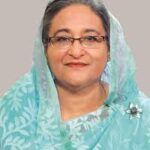
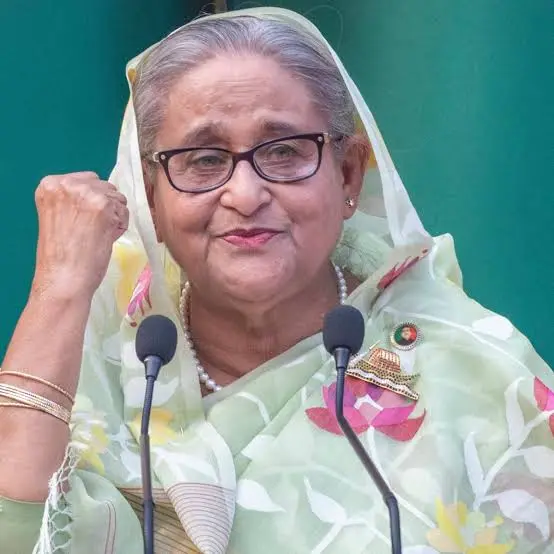
Sheikh Hasina, Bangladesh’s former prime minister and currently in exile in India, writes for the Indian press for the first time since receiving a death sentence in Dhaka. In this exclusive article, Hasina expresses her perspective on the verdicts and the crisis gripping Bangladesh
“The country’s future belongs to its people, and the next election must be free, fair and inclusive. That principle—simple yet fundamental—is what now stands threatened in Bangladesh. And it is why I must speak plainly.”
Verdicts of Convenience
The verdicts recently announced against me were not the outcome of a fair judicial process, nor the consequence of an independent tribunal acting within constitutional limits. They stem from an extraordinary legal architecture fashioned by an unelected authority — one without a democratic mandate and with no accountability to the people of Bangladesh. The International Crimes Tribunal (ICT), created with solemn national intent, has been transformed into an instrument of political sanitisation: a mechanism to eliminate elected leadership and legitimise those who assumed power without a single vote cast in their name.
The recommendation of the death penalty marks a grave departure from judicial restraint. It reflects not the reasoning of jurists but the ambitions of individuals determined to extinguish the last vestiges of an elected administration.
A parallel verdict on corruption against me only reinforces this pattern. Corruption is a challenge in every nation, but accountability cannot be selective, nor can investigations themselves be corrupt. The Anti-Corruption Commission (ACC), now entirely under the control of an unelected leadership openly hostile to the Awami League, has targeted only our members and supporters while disregarding the cronyism that has characterised the tenure of Dr Mohammad Yunus and his precarious interim government.
The ACC no longer performs the function for which it was constituted. It has become a façade, a device deployed to suffocate a political party that has won nine national mandates since Independence, including the last election in which the people of Bangladesh freely voted.
This decision serves the narrow interests of an unelected coalition of extremists and political opportunists, while endangering Bangladesh’s relationships with partners abroad who have long viewed stability and democratic credibility as essential to engagement.
A Tribunal of partiality
The allegations presented to the tribunal deserve outright rejection. Every life lost in July-August 2024 is a national tragedy, and no responsible government can remain indifferent to such suffering. However, the judicial process initiated against me has been flawed from the beginning: irregularities in bench formation, restrictions on my legal defence, limited access to case documents, and the suppression of evidence that contradicted the prosecution’s narrative.
A tribunal that bars international legal observers, restricts defence rights, and selectively interprets facts cannot credibly claim to dispense justice. If the interim authorities are confident in their accusations, they must permit an independent process under recognised international scrutiny. Their refusal speaks louder than their verdicts.
Violence and Misrepresentation
The events of July-August 2024 continue to be weaponised to sustain a politically convenient narrative. From the outset, restrictions were eased to allow students to express concerns peacefully, and their initial demands were reviewed with urgency. The escalation occurred only after coordinated disruptions of communication systems, attacks on police installations, and the looting of weapons from state armouries — actions that bear the hallmarks of calculated sabotage rather than spontaneous civic protest.
It is significant that several individuals involved in violent episodes later admitted their roles, yet these admissions are absent from tribunal reasoning. Competing casualty figures have been accepted uncritically, while official records remain neglected. Transparency, essential to any national reconciliation, has been discouraged.
While the United Nations issued an estimate of 1,400 fatalities, the Ministry of Health documented 834 confirmed deaths. The inflated figures include unverified cases, as well as police personnel and Awami League activists killed by violent groups. Only 614 families were formally recognised as families of martyrs. Investigations identified 52 deaths unrelated to gunfire, and 19 individuals reported as deceased were later found alive. The interim authorities have refused to publish an official list of the deceased, a refusal that deepens mistrust and prevents closure.
The allegation that Bangladesh, under my leadership, violated human rights stands unequivocally rejected. The country’s record speaks for itself through verifiable actions: accession to international justice mechanisms, firm commitments to humanitarian protection, provision of shelter for more than a million Rohingya refugees, and the rapid expansion of electricity, education, and healthcare infrastructure. Over the past decade, sustained economic growth has lifted millions out of poverty and expanded opportunities for women and young people.
These gains were neither accidental nor rhetorical. They emerged from a deliberate national project anchored in secularism, justice and human dignity. Attempts to erase this legacy through politically orchestrated verdicts cannot alter the lived experiences of the people of Bangladesh.
Democratic Mandate Abandoned
Bangladesh today is governed by a leadership that neither sought the electorate’s consent nor feels answerable to it. Over the past year, state institutions, from the ACC to local administrative bodies, have been recalibrated to pursue political vengeance. Judicial fairness is increasingly compromised under political pressure. Investigations are designed not to uncover wrongdoing but to construct a narrative of guilt around one political tradition.
Dr Yunus has now banned the Awami League from contesting the next election, disenfranchising millions and extinguishing any possibility of reconciliation or national stability. The exclusion of the Awami League from the upcoming electoral process is the clearest demonstration of constitutional abandonment. Denying the country’s largest and oldest political party the right to participate is not reform; it is the dismantling of pluralism.
Bangladesh risks being perceived globally as a nation where elections are held without genuine representation, a contradiction no democracy can sustain without long-term damage. Elections have been repeatedly deferred. Political pluralism has been strangled.
A Nation Left Exposed
Since the interim takeover, the administrative fabric of the country has steadily unravelled. Basic governance has all but collapsed. Economic momentum, built painstakingly over a decade, has stalled. Public services are in disarray, and police presence has thinned on crime-ridden streets. Millions of Bangladeshis now find themselves in an environment marked by volatility, violence and social regression.
Law-enforcement agencies struggle to maintain public order, while attacks on political workers, minorities and women go frequently unpunished. Journalists are intimidated or detained. Members of the Awami League are assaulted without consequence, and minorities, particularly Hindu communities, face renewed vulnerability. Even the hard-won gains of women’s empowerment show alarming signs of reversal.
A permissive atmosphere has allowed extremist voices to seep into spaces once anchored in moderation, secular values and institutional integrity. Elements like Hizb-ut-Tahrir, a banned transnational group advocating the re-establishment of a global caliphate, have begun to exert influence within segments of the administration. The extremists’ resurgence in Bangladesh is an ominous development for South Asia and the world.
A Final Word
My return to Bangladesh is not a personal ambition; it is inseparable from the restoration of constitutional governance. The country requires the revival of political inclusiveness, the reinstatement of the Awami League’s right to participate in elections, and the organisation of a credible, fully participatory democratic process. No transition will hold legitimacy if exclusion, intimidation and fear continue to define the political climate.
Responsibility now lies not only with the interim authorities but also with the international community. Bangladesh has long enjoyed global respect for its democratic aspirations. That respect must not erode through silence in the face of procedural injustice, repression, and the dismantling of institutions that once upheld citizen rights.
Bangladesh deserves more than legal theatre and political vengeance. It deserves accountability, stability and a democratic mandate rooted in the people’s will. The future of the nation belongs to its citizens. The next election must be free, fair and inclusive. Only then can Bangladesh begin to heal from the political violence, social fragmentation and administrative breakdown imposed by an unelected regime.