

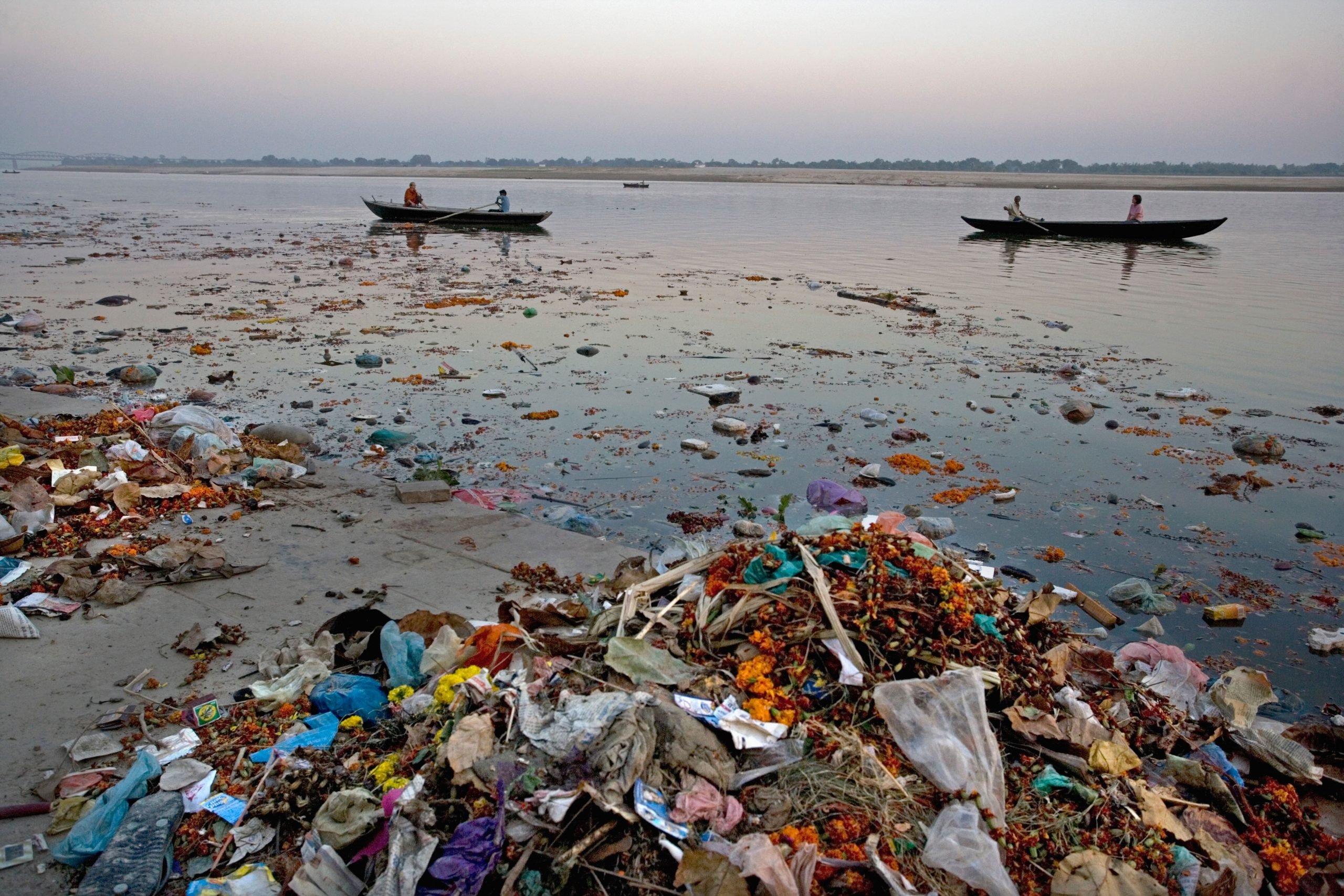
As Bihar gears up for the state elections, the Namami Gange Programme continues to be a politically charged and socially significant topic. The Ganga, India’s national river, flows over 400 kilometres through the state, yet previously undisclosed official documents reveal a sobering reality: the river remains far from achieving the programme’s stated goal of “Nirmal Dhara” (unpolluted flow). This is despite the central government having spent over Rs 3,900 crore in Bihar over the past decade under the initiative.
The documents available with New Delhi Post make it clear that “Nirmal Dhara” in Bihar remains a distant goal largely because the primary tools intended to treat sewage from riverside habitations, Sewage Treatment Plants (STPs), have not been properly utilised by the companies tasked with operating them. These STPs, installed at various points along the river, were intended to prevent untreated sewage from entering the Ganga.
The importance of STPs is undeniable. According to the National Mission for Clean Ganga (NMCG) in its annual reports, “Sewage from the habitations along the entire length of the Ganga accounts for 70% of the pollution flowing into the river. Hence, to achieve Nirmal Dhara, top priority has been accorded to creating sewage treatment capacity in towns and cities along the main stem of the river Ganga and its tributaries after carrying out a comprehensive feasibility assessment exercise.”
Of the 13 newly installed STPs in Bihar by October 2024, Prime Minister Narendra Modi personally inaugurated seven last year, according to the Ministry of Jal Shakti’s 2024–25 annual report. These seven plants, along with the interception and diversion networks essential for their operation, cost taxpayers over Rs 2,100 crore.
But multiple inspections and assessments carried out by the NMCG and the Bihar State Pollution Control Board (BSPCB) into the functioning of the STPs revealed three key problems: some of the sewage treatment plants were non-functional; all functional ones were not performing at maximum capacity; and some were performing below capacity while also violating standards.
For instance, NMCG officials inspected two STPs inaugurated by the Prime Minister. They found that one was completely non-functional, while the other operated below capacity. These inspections underscore a persistent issue: even newly inaugurated STPs face the same challenges as older plants once they are handed over to private operators.
The NMCG’s further investigations were prompted by a strongly worded order from the National Green Tribunal (NGT) on October 15, 2024. While hearing a case on the prevention and control of Ganga pollution, the Tribunal criticised the NMCG for merely sending letters to Bihar authorities rather than taking action. The Tribunal reminded the mission that it holds strong legal powers under Section 5 of the Environment (Protection) Act, 1986, empowering it to undertake any measures deemed necessary to clean the river. At the time, faecal coliform concentrations were so high that the river water was unfit even for bathing, according to Central Pollution Control Board (CPCB) data.
Following the NGT directive, the NMCG was compelled to take direct, concrete action. On December 28, 2024, officials inspected the Saidpur STP in Patna and found that the private STP operator was “wilfully violating environmental laws by discharging untreated/partially treated sewage into the river Ganga due to damaged and defective technological equipment.” In a January 29, 2025 letter to the Bihar government, NMCG Director General Rajiv Kumar Mital documented the violations: the STP failed to meet discharge standards; decanters of SBR tanks were out of order and chained; the chlorination system and sludge dewatering machine were non-operational. Mital directed the government to file a police complaint against the company and recover environmental compensation.
In response, Animesh Kumar Parashar, MD of the Bihar Urban Infrastructure Development Corporation (BUIDCO), issued a show-cause notice to Toshiba Water Solution Pvt. Ltd., demanding an explanation as to why the company should not be blacklisted or penalised. The Collector of Patna was also instructed to lodge a police complaint.
On June 19, 2025, the NMCG inspected the Danapur STP in Patna and found it non-operational. The reason for this was that the NMCG PLC-SCADA system of SBR technology was out of order. In a letter to the Bihar government, sent the following month, Mital expressed concern about the fact that the plant was not functional. The letter also mentioned, “The required number of trained and qualified personnel for operation and maintenance was not present at the site during the visit.” The person in charge of operating the plant “was from a non-technical background and lacked knowledge of how STPs operate, which is a violation of the contract agreement.” This, he added, “poses a risk to the effective operation of the plant.”
In July, Mital directed the BSPCB to issue a show-cause notice and instructed the Bihar government to take “immediate penal deterrent action under law” against the same company.
These inspections highlight a stark reality: little has changed in Bihar since 2024. Most STPs remain underperforming and fail to comply with acceptable faecal coliform limits, even though more plants have been inaugurated and additional taxpayer funds have been spent. The two inspected plants alone, along with supporting sewerage systems, cost over Rs 200 crore.
For the first four months of 2025, water quality in the Ganga showed a relative improvement in faecal coliform levels, according to the NMCG. “As reported by the CPCB based on January–April 2025 data, the entire stretch of the Ganga in Bihar conforms with primary water quality criteria for bathing, except at three of 33 locations with marginal variation,” the NMCG stated in a July affidavit to the Tribunal. This suggests that faecal coliform levels were within prescribed limits, technically making the water fit for bathing.
However, Advocate Katyayani Choubey, representing environmentalist M.C. Mehta, contested this interpretation. She argued that median values may not accurately reflect the river’s true water quality, noting that even the reported figures indicated high levels of faecal contamination.
When reached for comment, the Bihar government’s lawyer in the case, Rishi Awasthi, expressed his inability to provide one. The BUIDCO chief, Animesh Kumar Parashar, and NMCG’s Anup Kumar Srivastava, officers personally handling the issue, were also unavailable for comment.
Meanwhile, the Centre has taken notice of Bihar’s poor performance in the Prime Minister’s pet project. Union Jal Shakti Minister C.R. Patil and the departmental Secretary, V.L. Kantha Rao, held meetings in June and July 2025, respectively, instructing Bihar officials to improve STP performance.
During a meeting on June 24, 2025, Patil directed state officials to “ensure proper operation and maintenance of the STPs.” On July 17, Secretary Rao directed state officials to “take measures for improving the capacity utilisation and compliance status of the existing STP infrastructure.”
The poor performance of the Namami Gange initiative in Bihar underscores a broader reality in governance, which remains a highly visible political and administrative challenge. With top government functionaries—both at the Centre and the state—acknowledging the problem, along with judicial pressure from the NGT, the authority faces a long and complex path ahead to ensure that the vision of “Nirmal Dhara” becomes a reality.
(Akshay Deshmane is an environmental journalist)