

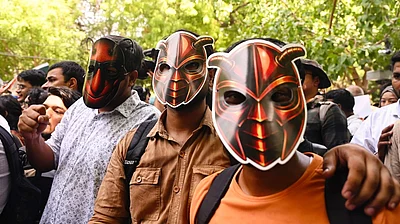
India’s latest youth uprising is not merely about NEET, CBSE, OSM, coaching centres or yet another demand for ministerial accountability. It reflects a far deeper rupture: a generation that was told to study hard, compete relentlessly, sacrifice comfort, pay exorbitant coaching fees, trust institutions and wait patiently for merit to be rewarded is discovering that the gate itself may be compromised.
NEET-UG 2026 was cancelled following allegations of a paper leak, with a re-examination scheduled for June 21 for more than 22 lakh students. That fact alone illustrates the scale of the crisis. When an examination of such magnitude collapses, it is not a technical malfunction; it is a social earthquake.
The State’s response has largely been procedural. The youth response has been emotional, moral and increasingly political. Students are no longer asking only, “Will the re-examination be fair?” They are asking, “Who compensates us for lost months, shattered confidence, psychological distress, travel expenses, coaching fees, family debt and missed opportunities?” That is where frustration turns into anger.
From Aspirants to Auditors
Perhaps the most striking feature of the present crisis is that young people are no longer passive victims of institutional failure. They are becoming investigators.
CBSE’s On-Screen Marking (OSM) controversy illustrates this shift. Students have alleged blurred scans, mismatched answer scripts, technical inconsistencies and questionable evaluation outcomes. One Class XII student publicly claimed that the Physics answer sheet uploaded against his name was not his own. Many students described the OSM process as a “lottery”, while the Ministry defended the system as secure and efficient.
The controversy deepened when Class XII student Sarthak Sidhant examined CBSE’s OSM tender documents. His analysis pushed the debate beyond marks and into questions of governance. Allegations concerning changes in eligibility criteria, performance clauses and certification requirements sparked a wider discussion about whether examination technology is enhancing transparency or merely outsourcing opacity.
The Centre has since transferred CBSE Chairman Rahul Singh and Secretary Himanshu Gupta and ordered an inquiry into the procurement of OSM services. This is no minor bureaucratic adjustment. It is evidence that teenagers armed with documents, data and social media can compel the education establishment to respond.
Khan Sir and Politics of Diversion
The Khan Sir episode adds another dimension to the crisis: when popular educators become public voices of student anger, they inevitably become political actors.
Available reports indicate that Faisal Khan, popularly known as Khan Sir, runs the coaching institute in Patna that was attacked. Reports suggest that 15–20 individuals allegedly vandalised the premises; police detained two security guards following the circulation of a purported firing video; and three individuals, including a rival coaching-centre director, were arrested in connection with the incident. According to available reporting, Khan Sir has faced legal pressure through FIR-related proceedings and anticipatory-bail applications. He subsequently surrendered before the court, was arrested and is currently in judicial custody.
Yet the broader political pattern is familiar. Whenever a youth-facing voice becomes inconvenient, attention shifts from the grievance to the individual. The debate ceases to be about examination failures and instead revolves around Khan Sir’s identity, past remarks, business rivalries, influence and motives.
It is a classic political manoeuvre: personalise the dissent, communalise the dissenter and obscure the original grievance. The fundamental question remains unchanged: why do repeated failures within the examination system not result in accountability at the highest level?
Insult That Became a Movement
When Chief Justice Surya Kant was reported as comparing some unemployed youth, media persons, social-media users and RTI activists to “cockroaches” and “parasites”, the remarks struck a raw nerve. He later clarified that he had been misquoted and was not referring to young people in general. Yet political language often acquires a life beyond clarification.
A generation already grappling with unemployment heard an insult and transformed it into a rallying cry. That transformation explains the emergence of the Cockroach Janta Party (CJP). What made the movement remarkable was its ability to convert perceived dehumanisation into satire. Its message was simple: if the powerful see you as cockroaches, become the most organised cockroaches in Indian democracy.
Within weeks, CJP became a significant online phenomenon. Associated Press reported that the movement had amassed more than 22 million Instagram followers and organised its first street protest in Delhi on June 6, 2026. Founder Abhijeet Dipke travelled from the United States, protesters assembled at Jantar Mantar, and one demand dominated the gathering: the resignation of Education Minister Dharmendra Pradhan.
Reuters also reported that the movement’s X account had been blocked in India, although its Instagram following remained above 22 million. Politically, that is significant. Restricting a platform may slow a movement, but it can also reinforce the perception that the establishment fears its message.
Meme Steps Into Politics
There is disagreement about the size of the June 6 protest. News agencies described the turnout as numbering in the hundreds, while supporters claimed a far larger digital and moral mobilisation.
The numerical dispute matters only to a point. The more important reality is that a meme crossed into street politics, secured police permission, brought Sonam Wangchuk to Jantar Mantar and issued a seven-day ultimatum demanding a Union Minister’s resignation.
This is how modern protest movements increasingly begin, not in party offices or trade-union halls, but through humiliation, humour, viral symbolism and a clear demand.
The government appears aware of the risks. A heavy-handed crackdown could have transformed the protest into a national spectacle. Images of students wearing cockroach masks and carrying books while facing the police force would have travelled rapidly across social media and international news platforms.
For now, the strategy appears to be containment: permit limited physical protest, restrict parts of the digital ecosystem, question motivations, invoke the spectre of a “foreign hand” and wait for the news cycle to move on. But youth movements rarely follow the rhythms of the news cycle. They follow the accumulation of grievances.
Why Pradhan Has Become the Symbol
The demand for Dharmendra Pradhan’s resignation has become central because young Indians understand a simple truth: failure in India is often individualised at the bottom and institutionalised at the top. A student who makes a single mistake may lose a year. A family that misses a fee deadline may lose an educational opportunity. A candidate who arrives late may lose the examination altogether.
Yet when national examination systems fail, responsibility is dispersed across agencies, contractors, vendors, committees, software platforms, state police forces, cyber threats and “technical issues”. That asymmetry fuels anger.
The National Testing Agency may face criticism. CBSE officials may be transferred. Vendors may be investigated. But the Ministry remains the apex authority within this architecture. If the system repeatedly fails under the same political leadership, demanding ministerial accountability is not extremism; it is a legitimate democratic expectation.
Economic Anxiety Beneath the Anger
The examination crisis has become combustible because it sits atop a broader employment crisis. The government points to improving indicators. According to PLFS data, youth unemployment fell to 10.2 per cent in 2023–24, while the youth worker-population ratio rose from 31.4 per cent in 2017–18 to 41.7 per cent in 2023–24. Yet statistics do not erase lived experience.
The State of Working India 2026 report by Azim Premji University notes that India’s young workforce is becoming more educated and aspirational, while the transition from education to employment remains the critical challenge in converting demographic potential into economic advantage.
That is the contradiction at the heart of the crisis. Macro-economic indicators may show improvement, but the student in Kota, Patna, Ranchi, Delhi, Indore, Hyderabad or Guwahati experiences life as a narrowing funnel.
More degrees. More examinations. More fees. More coaching. Fewer secure jobs. Then comes a paper leak. A re-examination. A portal crash. A ministerial assurance. And finally, silence. No democracy should underestimate the political consequences of that psychology.
Opposition Politics and Missed Opportunity
This is where the opposition’s response becomes significant.
The BJP understood the political potential of public anger during the India Against Corruption movement of 2011–12. It did not obsess over the ideological purity of every activist or scrutinise every slogan. It recognised a wave and aligned itself with it. Its ecosystem amplified anti-UPA sentiment, occupied protest spaces and helped shape the political climate that preceded the 2014 election.
Today, Congress appears far more cautious. NSUI and the Youth Congress have organised protests over NEET and CBSE, while senior Congress leaders have demanded Pradhan’s resignation. Yet sections of the broader opposition ecosystem have treated CJP with suspicion, focusing on past affiliations and old social-media posts rather than the issues driving the movement. That approach risks missing the larger point.
A youth movement does not need to originate within a party office to become politically consequential. Indeed, its strength often derives from precisely the opposite.
Co-option, Crackdown or Credibility
The government now faces three broad choices. The first is co-option: establish committees, promise reforms, transfer officials and rely on procedural remedies to dissipate public anger.
The second is confrontation: pursue legal cases, block accounts, intensify scrutiny, invoke foreign-interference narratives and seek to delegitimise the movement.
The third is credibility: embrace accountability, commission independent examination audits, ensure transparency in vendor selection, protect whistle-blowers, compensate affected candidates and rebuild public trust.
The first may buy time. The second may provoke backlash. Only the third can restore legitimacy.
For CJP and the wider youth movement, the challenge is equally formidable. Viral reach is not organisation. Satire is not strategy. A successful social-media campaign is not a durable political structure.
To retain credibility, the movement must remain peaceful, transparent, democratic and focused on specific demands: examination integrity, independent audits, student compensation, transparent re-evaluation processes, vendor accountability, mental-health support and a coherent youth-employment agenda.
The moment it becomes merely anti-Modi rhetoric, it becomes easier to dismiss. The moment it remains centred on fairness, accountability and opportunity, it becomes considerably harder to ignore.
The Question Has Changed
The most important development is not that students are angry. Indian students have been angry before.
The real development is that they are technologically literate, document-driven, legally aware, politically impatient and connected across state boundaries in ways previous generations never were.
They file RTIs. They scrutinise tenders. They challenge answer scripts. They expose software failures. They build satirical movements. They crowdsource evidence. They embarrass institutions that once assumed young people would remain silent.
That is why this moment matters. It is not a riot. It is not a conventional party mobilisation. It is not a campus protest that can be geographically isolated. It is a crisis of institutional legitimacy spreading through examination halls, coaching centres, WhatsApp groups, Instagram reels, YouTube streams and family dining tables across the country. India’s youth are not demanding privilege. They are demanding fairness. And when fairness begins to fail, democracy receives a warning. That warning has now been delivered.
(Prof Ujjwal K Chowdhury is an academic and a political commentator)