

By Abhinav Mehrotra and Amit Upadhyay
The Special Intensive Revision (SIR) exercise in Bihar has brought renewed attention to the rights-based framework of governance in India, sparking debate about documentation requirements and procedural fairness. The rights-based governance framework is a model of public administration that places the protection, promotion and fulfilment of human rights at the heart of policy-making and governance. Unlike traditional welfare or developmental approaches, which focus on delivering services or economic goods, a rights-based framework treats citizens as rights-holders and the state as a duty-bearer, making it accountable for ensuring these rights.
In this context, the SIR enables citizens to exercise their right to vote, as it is a unique voter list verification process in India. It is essential to ensure accurate, fraud-free elections through a comprehensive voter validation framework. Such functions are carried out by the Election Commission of India (ECI), a constitutional body established under Article 324 of the Constitution. It is responsible for conducting free and fair elections to Parliament, the State Legislatures, and the offices of the President and the Vice-President. The case of Bihar is particularly significant, as the state continues to face challenges in the form of structural poverty, high population growth and migration, as well as the imbalance between development and government policies.
The rights-based approach in law is not purely symbolic; it represents a transformation in state-society relations. Under this model, citizens are not passive beneficiaries of government schemes but active stakeholders who can demand accountability. In this regard, the SIR aims to “ensure that no eligible citizen is left out while no ineligible person is included in the Electoral Roll.”
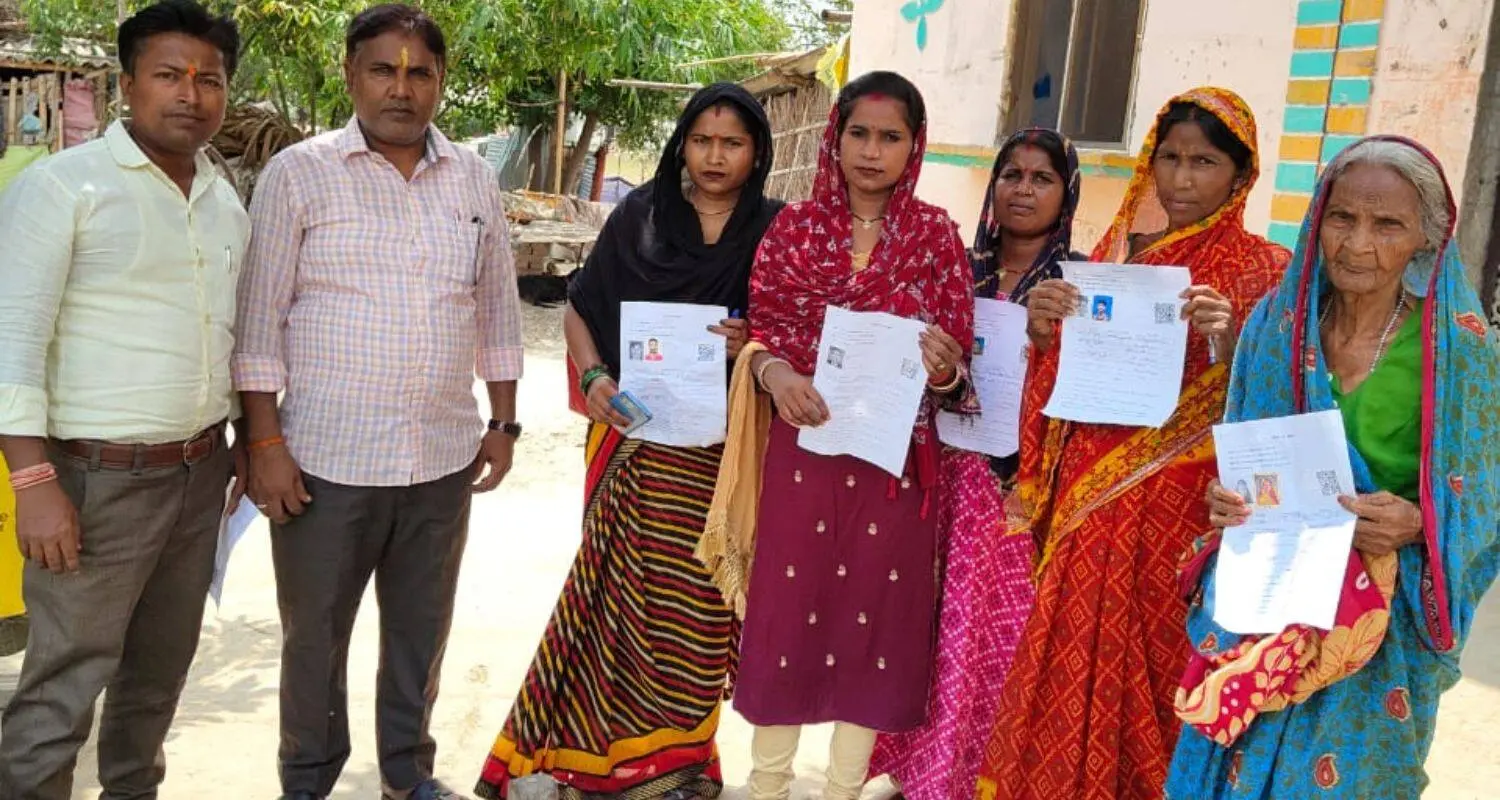
The SIR process entails house-to-house enumeration to prepare new electoral rolls as part of an extensive revision. Without consulting current rolls, enumerators visit each home to list eligible voters as of a qualifying date. Such an exercise is undertaken when the ECI determines that the current rolls must be wholly rebuilt or are erroneous. This usually happens before significant elections or following administrative procedures such as constituency delimitation, which is also the case in Bihar, where elections are due in November.
However, the ECI’s requirement that even current voters, if enrolled after 2003, provide documentary proof to establish their date or place of birth has met with widespread political opposition. The controversy is compounded by disputes over Aadhaar as valid proof of identity, leading to a challenge to the ECI’s revision of electoral rolls in Bihar in the case of Association for Democratic Reforms v. Election Commission of India. The Supreme Court will decide whether the ECI’s Special Intensive Revision (SIR) of Bihar’s electoral rolls is arbitrary and unconstitutional. This exercise highlights the ongoing tension between electoral integrity and inclusiveness, and the need for rights-based governance grounded in legal reforms, social inclusion and transparency.
Scholars and critics have warned that this exercise risks excluding and disenfranchising individuals belonging to marginalised communities, including Dalits and economically weaker sections, due to their inability to produce documents such as birth certificates. Furthermore, the exercise is scheduled a few months before the state assembly polls, raising feasibility concerns given the scale of the task.
Despite these challenges, a rights-based framework is integral to just and inclusive development in Bihar. The Election Commission is duty-bound to ensure both the accuracy of the electoral list and inclusiveness by making efforts to include the disabled and other vulnerable groups. It should enhance efforts to reach the elderly, the economically weak and other marginalised groups by adopting more inclusive and empathetic measures while carrying out this exercise. The SIR mechanism, if strengthened, can act as a check on arbitrary state action and protect vulnerable communities from losing their right to vote.
Stakeholder participation in such a massive exercise must be substantive, involving consultations in local languages and including women and marginalised groups. Local civil society organisations and panchayats can also play a key role in bridging the gap between government agencies and affected communities. Meaningful participation not only ensures accountability and transparency but also strengthens trust in state institutions. Integrating legal empowerment, capacity-building initiatives and awareness campaigns will safeguard democratic rights and promote sustainable governance.
Ultimately, the effectiveness of Bihar’s development trajectory will depend on how successfully these mechanisms protect the most vulnerable while ensuring genuine public participation in democratic processes. The Election Commission must adopt the SIR as a tool for consensus-building and inclusive participation. The ongoing exercise provides an opportunity to reaffirm the centrality of rights in governance and to ensure justice, dignity and the social contract between the state and its citizens.
Going forward, embedding rights in development governance ensures accountability, protection and equitable progress. Strengthening participation, raising awareness, enhancing institutional capacity, ensuring accessible grievance redressal and reframing the perception of the SIR are critical steps. Bihar’s challenge is integrating development with rights, not as parallel tracks but as mutually reinforcing objectives that ultimately secure justice, dignity and inclusion for all.
(Abhinav Mehrotra is an associate professor of O.P. Jindal Global University; Amit Upadhyay is also an associate professor of O.P. Jindal Global University)