

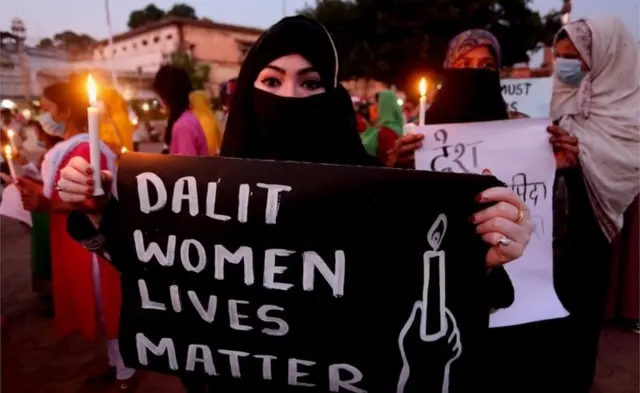
In the nondescript, far-away villages of Madhya Pradesh, a silent war rages. Its victims are not soldiers but some of India’s most vulnerable citizens: tribal and Dalit women. The weapons are not guns but caste venom, political apathy, and institutional desertion.
Madhya Pradesh’s records on Dalit atrocities paint a chilling picture. Between 2022 and 2024, Madhya Pradesh registered 7,418 rapes of Scheduled Caste (SC) and Scheduled Tribe (ST) women, 338 gang rapes, 558 murders, and nearly 6,000 cases of molestation. In total, 44,878 crimes against Dalit and tribal women, including sexual violence, murder, and domestic abuse, were registered in just three years. That amounts to 41 atrocities every day, with seven Dalit or tribal women raped daily. The figures, tabled in the Madhya Pradesh Vidhan Sabha, are stark evidence not of any random crime but of systemic oppression.
This is no statistical fluke. Madhya Pradesh has a dubious record of violence against Dalit women stretching back many years. According to the NCRB report, in 2022 alone, the state reported 2,979 cases of atrocities against ST women, far ahead of Rajasthan (2,498) and Odisha (773). Of 9,735 cases nationwide, more than 30 per cent came from Madhya Pradesh.
Despite a spate of gruesome rapes of Dalit women in recent months, the nation’s collective conscience remains disturbingly unmoved, with outrage failing to travel beyond district boundaries. New Delhi Post made visits to the affected villages and families to examine the underlying causes and the full extent of the crimes. We visited three villages—Balaghat, Khandwa, and Sidhi—dispersed by hundreds of kilometres but united by the very same grisly pattern: brutal rapes of tribal women.
On 23 April, Balaghat, 450 km from Bhopal, had one of the darkest nights. Four girls, three of them minors, were taken to the fields by seven men, including their employers. Their uncle, who tried to protest against the brutality, was beaten up. Police verified the fact that the girls had worked as daily wage labourers for one of the accused.
“One accused is a minor, the rest are adults,” admitted Additional SP Vijay Dawar. Charges were filed under the POCSO Act and the SC/ST Atrocities Act. But in this Naxal belt bordering Maharashtra, fear talks louder than law. “The accused belong to influential families. People were warned not to speak,” whispered a local. Families keep silent, afraid of reprisals.
Barely a month later, 270 kilometres away in Khandwa, a 45-year-old Korku tribal woman was raped and battered to death. “When we saw her body, it was clear she had been beaten with extreme violence. Her intestines were exposed,” said a relative. ASP Rajesh Raghuvanshi conceded, “Prima facie it appears she was assaulted and bled to death.” A villager lamented that “even the bare minimum was denied in her dying hours.”
The savagery drew comparisons with the Nirbhaya gang rape in Delhi in 2012. What shook a nation in the national capital has been buried in Madhya Pradesh under layers of neglect and apathy.
The pattern repeated in Sidhi, 500 kilometres north-east of Bhopal. On 6 August, a Dalit teenager was gang-raped while walking home. “Our girls cannot walk freely, cannot speak freely. They are punished for being born Dalit,” said a mother in the neighbourhood. Another resident explained the silence: “The police will leave, the media will leave, but we will still have to live here.”
The vulnerability of tribal women in Madhya Pradesh is also a story of geography. Tribal-dominated and notoriously remote districts like Jhabua, Alirajpur, Dhar, Mandla, Betul, Barwani, Khargone, Khandwa, Burhanpur, and Balaghat exemplify this harsh reality. Basic state functions—policing, healthcare, and jurisprudence—are often out of reach. A young Bhil woman from Alirajpur described the ordeal: “When we go to file a complaint, the police station is 20 kilometres away. By the time we reach, they say it is too late, the evidence is gone.”
Some argue that the state’s large tribal population—1.53 crore or 21.1 per cent of the population—is a factor contributing to the high rates of Dalit rapes. Others explain that the figures are the result of marginally improved reporting after years of mobilisation by rights activists and NGOs. Unlike in Jharkhand or Odisha, where crimes often vanish into silence, more women in Madhya Pradesh may be approaching the police.
But activists and sociologists stress this does not change the underlying reality: sexual violence here is not merely an individual crime but a collective exercise of power fuelled by caste prejudice, patriarchy, and institutional failure.
“These crimes are deliberate tools of control that are used to silence and suppress marginalised communities, especially those who ask for better wages or object to land exploitation,” said Meera Singh of the Adivasi Adhikar Manch, an NGO working at the grassroots.
JNU sociologist Professor Vivek Kumar echoed the observation: “Atrocity spikes generally follow periods when Dalits and tribal groups assert legal or political rights to land or forest, along with dignity. The ruling classes and powerful landlords strike back with violence to humiliate and send stern messages. Such acts cannot be seen in isolation; they are designed to punish and deter mass assertion.”
Institutional complicity entrenches the crisis. Police often discourage complaints, urging families to “compromise”. Settlements are brokered with promises of preserving marriage prospects. Even when cases are registered, judicial delays and weak prosecution make convictions rare. Political patronage shields perpetrators, leaving victims trapped in a hostile system.
Madhuri Behan of the Jagrat Adivasi Dalit Sangathan added that migration and displacement strengthen vulnerability: “Women are attacked not merely because of patriarchy but because social collapse has eliminated all inhibitions. Nobody seems to care about the consequences.” The result is ominous: perpetrators operate with near-total impunity.
Politically, the surge in crimes against Dalit women in Madhya Pradesh has triggered fierce debate. Citing the state’s own figures, opposition leaders argue that the BJP government has failed to enforce the law and protect its most vulnerable citizens. Congress state president Jitu Patwari criticised: “Despite claims of promoting women’s empowerment, real change is lacking on the ground.”
The ruling party counters with claims of “improved” law and order. In the Vidhan Sabha, Chief Minister Mohan Yadav, who also holds the home portfolio, insisted: “The government is committed to the protection and safety of Scheduled Caste and Scheduled Tribe communities. Police have been instructed to act with zero tolerance.” He added that patrolling had been intensified in crime-prone regions.
On the ground, however, New Delhi Post found the government’s response to be mostly symbolic. The gulf between rhetoric and reality is stark. For Madhya Pradesh’s tribal and Dalit women, violence functions as a tool of control, exploitation, and intimidation. Officialdom has reduced these crimes to a “law and order” issue, ignoring their deeper roots in entrenched injustice. Real remedies require structural reform, not gestures. Until then, the state’s red soil will remain stained with the blood and tears of Dalit women denied dignity and justice.