


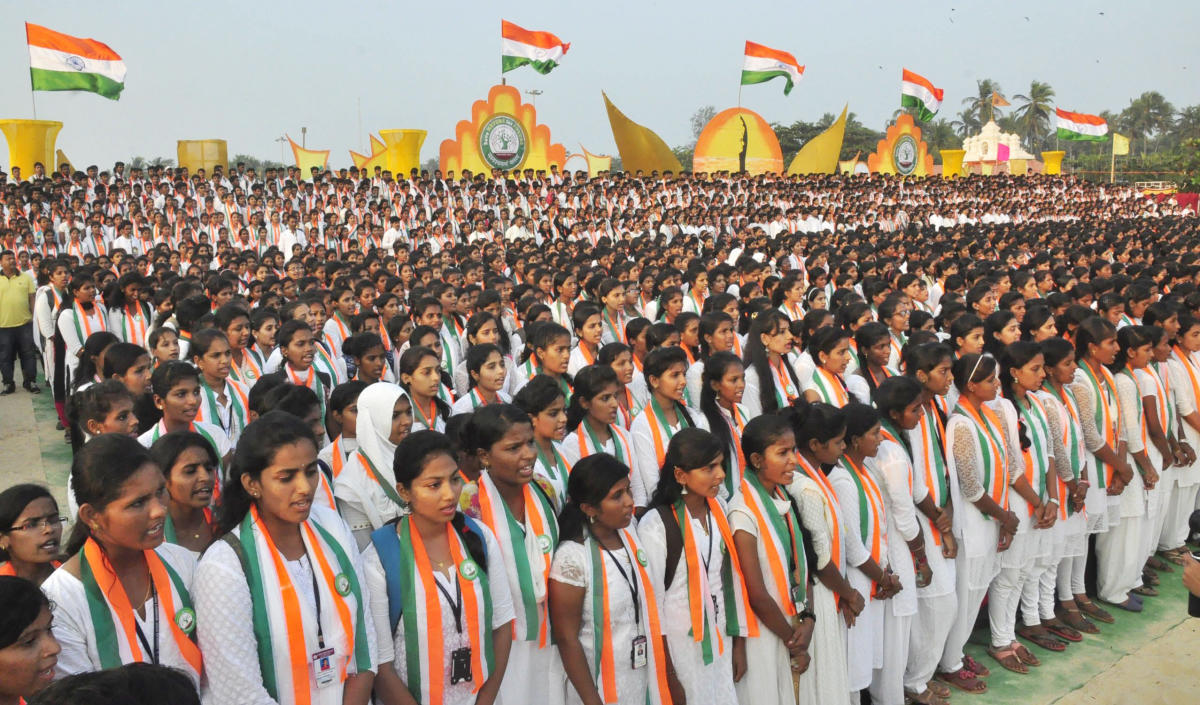
There is a moment in every Indian school assembly when patriotism mysteriously runs out of battery.
It begins magnificently. Vande Mataram, Sujalam Suphalam. Four hundred children suddenly find their voices, their posture and, occasionally, their patriotism. Chins go up. Chests come out. The collective expression suggests that the country may need them to defend the border immediately after assembly.
And then, somewhere around the third line, something happens. The volume drops. The words become approximate. The mouths keep moving, but nobody is entirely sure what they are saying. It is no longer singing. It is participation by lip movement. And the remarkable thing is that every single child does it.
I have come to believe this is not a school problem. It is an India problem. I call it the Greatest Hits Syndrome: our extraordinary national ability to embrace the first ten per cent of something with complete conviction and quietly abandon the remaining ninety.
The first verse is where our patriotism lives
Take Vande Mataram. Most of us know the familiar opening, which is where our memory has decided the song should politely end. But the poem, as it appears in Bankim Chandra Chattopadhyay’s Anandamath, goes beyond the portion most of us can sing without either humming, improvising or looking at the person next to us for help.
Nobody deliberately forgot the rest. We simply developed a national understanding that the first verse would do.
We have read the terms. Allegedly
This is the Terms and Conditions Principle at work. We have all clicked “I agree” on forty pages of terms and conditions without reading more than the first sentence. We do this with extraordinary confidence. We have no idea what we have agreed to, but the little box has been ticked, and therefore the matter is settled.
Vande Mataram has received much the same treatment. We know the opening. We know when to stand. We know when to look suitably solemn. The rest? Someone somewhere probably knows it.
The wedding buffet: our true national itinerary
Then there is the Indian Wedding Invitation Effect. An Indian wedding invitation is rarely an invitation anymore. It is a project plan. Mehendi on Thursday. Sangeet on Friday. Haldi at 10.30. Cocktail at 7.45. Wedding at some auspiciously precise time that requires three astrologers and a spreadsheet.
The invitation will list five ceremonies across three days, complete with dress codes, locations and instructions that could easily be mistaken for the itinerary of a diplomatic summit.
And yet most guests will arrive for the reception. And the buffet. The rest of the wedding schedule is not ignored. It is simply stored under “if required”, along with the missing verses of Vande Mataram.
Forwarded as received. Read at your own risk
The same principle governs the Family WhatsApp Group. Every Indian family has that one uncle who sends a six-paragraph message in a font large enough to be read from the next room. It contains ancient wisdom, a warning about modern civilisation and, inevitably, the instruction: “SEND TO 10 PEOPLE OR MISS BLESSINGS.”
The message is forwarded within four seconds. It has been read for approximately one line. Nobody knows what the blessing is. Nobody wants to risk finding out. We have somehow built an entire communication culture around the principle that intent counts as completion.
January 1: the director’s cut of ourselves
And then there is perhaps the greatest exhibit of all: the New Year’s resolution. January 1 arrives, and we become people of breathtaking ambition. This year, we will go to the gym, eat healthy, save money, read more, sleep early, learn a language and finally finish that book lying beside the bed since 2023.
The resolution is not a resolution. It is an epic poem. By January 15, however, several verses have quietly disappeared. The gym membership remains. The gym attendance does not. The diet has been moved to Monday. The book has become a bedside accessory. The savings plan has been revised to “be more careful”.
What survives is the chorus: wake up, survive, repeat. And, of course, the monthly auto-debit continues faithfully, making the gym perhaps the most committed relationship in our lives.
We are a nation of magnificent shortlisters
Put all these things together and a rather amusing pattern emerges. We are magnificent shortlisters. We take enormous, complicated things and instinctively reduce them to the bits that fit into our mornings, our memories and our attention spans.
We know Ram, Sita and Hanuman. Ask about the Uttara Kanda and the room suddenly becomes very interested in its collective ceiling. We know the Preamble of the Constitution. Ask about the rest and you can almost hear the sound of several brains politely closing their shutters.
We like our epics in greatest-hits editions, our weddings in highlight reels, our WhatsApp forwards under ten lines and our resolutions with an escape route.
Maybe we aren’t forgetful. Just selective
But perhaps this is not entirely a national character flaw. Perhaps it is simply how people deal with things that are too large to hold all at once.
You remember the song you sang at school, the story your grandmother told you, the wedding you actually attended and the promise you genuinely made to yourself on January 1. The rest remains somewhere in the background. Unmemorised, perhaps. But not entirely forgotten.
Which brings us back to those four hundred children in the morning assembly. They sing the first line as though the fate of the nation depends on them. Then they hum the rest.
And perhaps that is the real Greatest Hits Syndrome. We may not remember everything. But we remember enough to keep singing.
