

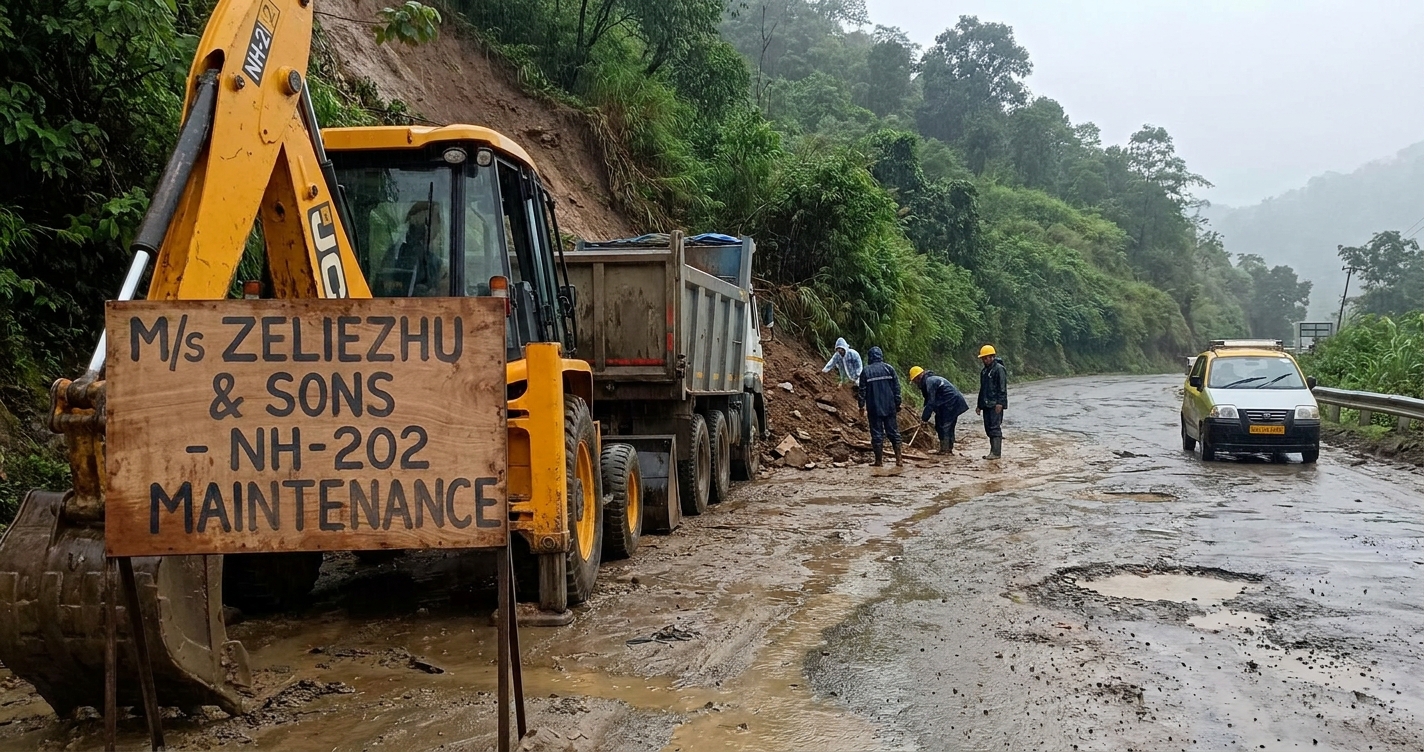
Five tribal organisations in eastern Nagaland have asked the State Government to complete unfinished maintenance work on National Highway 202 before implementing the latest maintenance contract and have urged the authorities to move ahead with the long-pending two-laning of the highway.
The Chang Khulei Setshang, United Sangtam Likhüm Pümji, Khiamniungan Tribal Council, Yimkhiung Tribal Council and Tikhir Tribal Council submitted the joint representation.
The organisations said that work under the short-term maintenance contract, covering the period from June 16, 2025 to June 19, 2026, remained incomplete. They have given the agencies concerned until the first week of October 2026 to complete the outstanding work and have called for the work to be carried out to proper standards.
The representation also refers to a new one-year Short Term Maintenance Contract for 2026–27, covering 244 kilometres of NH 202 across Tuensang, Shamator, Kiphire and Meluri districts. The organisations have asked that its implementation remain in abeyance until the earlier maintenance work is completed.
They have also pressed for early implementation of the two-laning of NH 202, citing the highway’s importance to communities across eastern Nagaland.
The demand comes as the Ministry of Road Transport and Highways moves ahead with the preparation of a detailed project report for widening the Chare to Akhegwo section of NH 202 to two lanes with paved shoulders over 244 kilometres.
The joint representation describes NH 202 as one of the oldest and most important highways serving the populations of Tuensang, Shamator, Noklak and Kiphire. The organisations have pointed to the continued need for its upgrading and urged the competent authorities to initiate the two-laning project at the earliest.
The condition of the highway has direct consequences for people living along its route. Poor roads can make journeys to hospitals, schools, markets and administrative centres longer and more expensive. They can also raise the cost of transporting agricultural produce and essential commodities.
For farmers and traders, road connectivity affects access to markets. For students and patients, it affects access to educational and medical institutions. For families, it influences the cost and time involved in travelling to district and state centres.
The highway has therefore become an important part of the development discussion in eastern Nagaland. The issue comes at a significant stage in the region’s wider institutional development. On February 5, 2026, the Government of India, the Government of Nagaland and the Eastern Nagaland Peoples’ Organisation signed a Memorandum of Agreement for the constitution of the Frontier Nagaland Territorial Authority (FNTA).
The proposed FNTA covers Tuensang, Mon, Longleng, Kiphire, Noklak and Shamator and is intended to provide an institutional framework for addressing the region’s social, economic, educational, cultural and linguistic aspirations.
The legislative process for establishing the authority remains underway. The FNTA Bill, 2026 was introduced in the Nagaland Legislative Assembly in March, but its consideration was deferred after the Ministry of Home Affairs sought additional time to examine provisions concerning the proposed legislative powers of the authority.
The Nagaland Government has subsequently indicated that it will convene a Special Session of the Assembly to enact legislation for the constitution of the FNTA, with the relevant provisions to be worked out in consultation with the Centre and within the constitutional framework.
Against this backdrop, infrastructure remains an immediate concern for communities in eastern Nagaland. The five tribal organisations are seeking completion of work already covered by the previous maintenance contract. They are also pressing for progress on the two-laning project, which has the potential to provide a more durable improvement in connectivity.
The immediate timeframe identified in their representation is the first week of October 2026. The next stages of the highway project will depend on the completion of the DPR process, decisions on implementation, land acquisition and subsequent construction.
For eastern Nagaland, these stages have practical importance. Reliable roads can improve access to public services, reduce transportation difficulties, strengthen links between producers and markets and support economic activity.
The future of NH 202 will therefore be closely watched by communities that have long sought better connectivity. The road has become a visible measure of development expectations in a region undergoing significant institutional change. Its maintenance, upgrading and eventual two-laning will determine how quickly improved connectivity reaches communities across eastern Nagaland.