


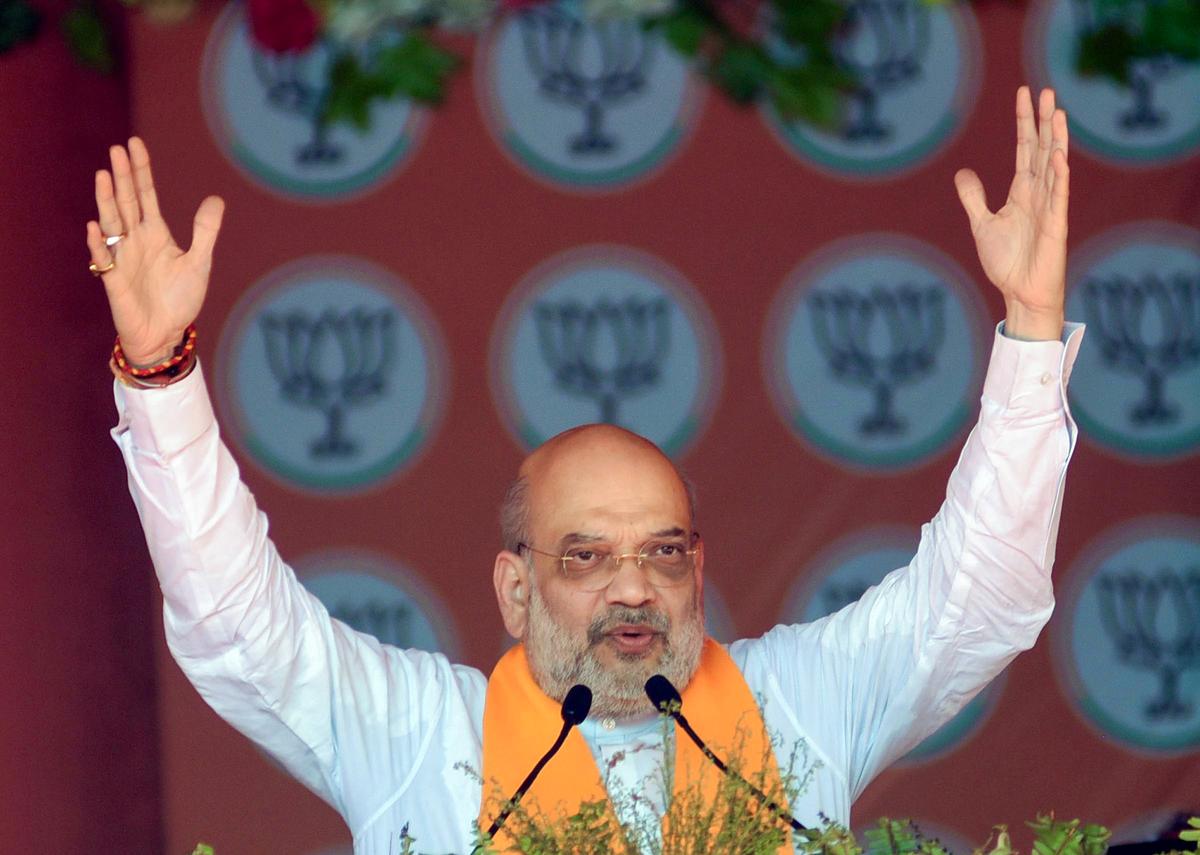
Cracks in the Shah Fortress
Along with the Prime Minister’s image, the Gen Z movement has dented the image of Union Home Minister Amit Shah too. But it does not justify saying that his position is in immediate danger. What it does show is that his risk profile has changed sharply.
For more than a decade, Shah’s political power has rested on three interlocking assets: proximity to Narendra Modi, command over the BJP’s electoral machinery and an aura of ruthless competence. As Union home minister, he also sits at the political apex of the internal-security architecture that includes Delhi Police and the central armed police forces. That combination made him more than a cabinet minister. He became a system within the system: strategist, enforcer, negotiator and succession contender.
That is why the events since July 20 matter. A home minister can survive an opposition demand for resignation; such demands are routine. A strategist can survive a bruising protest. What becomes dangerous is convergence: street anger, court scrutiny, parliamentary pressure, coalition unease, ideological discomfort inside the Sangh ecosystem and an internal succession rival all beginning to point in the same direction. Shah has not reached the endgame. But for the first time in years, the political market is pricing in the possibility that he could become a liability rather than an asset.
July 20 Changed the Script
The July 20 “Sansad Chalo” mobilisation over exam leaks, education failures, recruitment insecurity and the demand for Education Minister Dharmendra Pradhan’s resignation turned violent as protesters moved towards Parliament. Police used tear gas and batons; Delhi Police reported injuries to around 130 security personnel and 65 students.
The more serious accountability question concerns the use of pellet rounds by RAF personnel, reported by The Indian Express and supported by medical records of pellet injuries. The Supreme Court has since sought preservation of RAF ammunition logs while examining crowd-control protocols. The exact number and severity of injuries remain disputed, but the pellet controversy is now part of the documentary and judicial record.
Delhi’s constitutional structure puts the Union Home Ministry at the centre of the accountability debate. The elected Delhi government does not control the police or public order; the force ultimately operates through the Lieutenant Governor and the Home Ministry. Police commanders may take operational decisions, but political accountability rests with the ministry overseeing the system.
That is the basis of Rahul Gandhi’s “culpability or incompetence” argument. If Shah knew sensitive crowd-control munitions might be used, what did he authorise or fail to prevent? If he did not, why did the Home Ministry lack visibility over a major confrontation in the capital? The issue is not whether Shah has been proved guilty. He has not. It is who authorised the escalation and what the ministry knew.
There is a political precedent. In 2011, the BJP demanded P Chidambaram’s resignation after police action against protesters, arguing that responsibility followed the Home Ministry’s control over Delhi’s law and order. The principle is therefore neither new nor partisan.
The police leadership change also merits scrutiny. Anurag Kumar became Delhi police commissioner on July 17, a day before Sonam Wangchuk was removed from Jantar Mantar. The timing warrants examination of deployment orders and the command chain, but does not establish causation. The legitimate question is whether the sequence merits parliamentary or judicial scrutiny.
Throughout much of the Monsoon Session, Kiren Rijiju became the government’s principal shield as the opposition demanded a statement from Shah. The optics were damaging: a home minister identified with command and control allowed another minister to absorb the daily fire over a controversy centred on policing and internal security.
But the criticism must reflect the later record. Shah did not avoid the entire session. On August 12, he offered an extended debate and said he was ready to answer questions; on August 13, he was present in Parliament before the Lok Sabha was adjourned sine die. The sharper indictment, therefore, is delay. Weeks passed before Shah directly entered the confrontation, allowing his critics to shape the narrative.
For a minister whose political brand rests on pre-emption, that delay carried symbolic cost: the strategist who usually sets the battlefield found himself answering on terrain chosen by others.
Dharmendra Pradhan’s resignation on July 25 is the hard fact around which much of the new youth politics turns. Whether he was “forced out by Modi-Shah” as an internal manoeuvre is unproven. But politically, the distinction barely matters. A movement demanded a minister’s resignation; a minister resigned. The demonstration effect is clear: sustained mobilisation can produce a ministerial consequence.
That is why the demand for Shah’s resignation cannot simply be dismissed as theatre. It does not make a second resignation likely; it makes it imaginable.
The claim that Gen Z will command more than 60 per cent of the electorate in 2029 does not withstand demographic scrutiny. Reuters estimates nearly 400 million potential Gen Z voters. That is not 60 per cent of the electorate, but it remains a formidable political bloc.
The BJP-RSS risk is not that young voters will suddenly become uniformly anti-BJP. It is that paper leaks, costly education, recruitment delays, weak job creation and police action merge into a generational narrative: the system does not hear us until we disrupt it. Even a modest youth swing could reshape marginal constituencies.
The government’s response is revealing. Reuters reported a Modi-led digital outreach aimed at younger voters, with a looser Instagram style and more culturally native messaging. The recalibration itself suggests that the constituency matters.
Pressure Is Spreading Beyond the Street
RSS chief Mohan Bhagwat’s August 6 interaction with around 2,000 Gen-Z and Gen-Alpha participants in Mumbai was politically notable. He called protest a legitimate form of democratic dialogue, acknowledged young people’s grievances and said that, if asked whom he trusted, he would choose Gen Z.
This does not establish that the RSS is preparing to remove Shah, nor does it prove claims of weak Sangh recruitment among 15-30-year-olds. But the timing and tone matter. As the government faced criticism over its handling of young protesters, the RSS chief was signalling that they should not simply be delegitimised.
The Sangh thinks in generational terms. Its larger concern is whether it can reproduce its political appeal among citizens shaped by digital networks, examinations, employability, dignity and distrust of opaque institutions. Shah’s risk is becoming the face attached to the wrong side of that generational argument.
The pressure is also decentralised. Rahul Gandhi is trying to occupy the opening through “Chhatron Ki Goonj”, with programmes in Kota, Dehradun and Prayagraj focused on paper leaks, jobs and student insecurity. But youth anger is not owned by Congress.
The Cockroach Janta Party (CJP), led by Abhijeet Dipke, has shown how online culture can become physical mobilisation. Reuters described it as a youth movement that rattled the Modi government while resisting conversion into a conventional electoral party. On August 12, Dipke announced “Jantar Mantar Season 2” and alleged pressure on venue owners, though that claim remains unproven. CJP has also alleged police harassment, disputed by police.
AISA president Neha Bora has opened another front through “Gen Z Rising”, demanding Shah’s resignation and linking July 20 to fair examinations and testing-system reform. The significance lies less in organisational size than convergence. CJP, AISA, Congress outreach, independent creators and youth networks need not merge to create a shared vocabulary of grievance.
That decentralisation is harder for the state to contain. One leader can be negotiated with or isolated; a grievance ecosystem spread across campuses and digital platforms has no single switch to turn off.
Nagina MP Chandrashekhar Azad adds another axis, connecting youth anger with a constitutional language of Dalit dignity, police excess and equal citizenship. It would be overstated to say Dalits nationally are organising against Shah as a unified bloc. But if Azad frames July 20 as part of a wider experience of coercive state power, Shah becomes a potent symbolic target, particularly in Uttar Pradesh.
The political significance is clear: mobilisation becomes more durable when it crosses identities. An exam-leak protest is episodic; a coalition of students, job aspirants, Dalit activists, civil-liberties groups and opposition parties can become a broader argument about the character of the state.
The same logic applies to the NDA. There is talk of discomfort within the TDP and JD(U) over action against young protesters, but as of August 13 there is insufficient on-record evidence that Chandrababu Naidu or Nitish Kumar has demanded action against Shah. The real test is whether private complaints become parliamentary behaviour, public statements or bargaining demands.
The Bengal churn matters for a similar reason. Defections and realignments depend heavily on perceptions of power. If Shah’s aura weakens, defectors become less reliable and allies more demanding.
Yogi Adityanath remains the most consequential internal variable in any post-Modi succession conversation. Neither he nor Shah openly declares the other a rival, but both occupy the same succession map.
The Ayodhya donation-theft case has also allowed Yogi to project probity and administrative authority. Any rise in his stature as an autonomous Hindutva power centre changes the succession balance. If Shah’s image is simultaneously damaged by the youth-policing controversy, Yogi benefits from the comparison without having to attack him.
Why Modi Cannot Easily Sacrifice Shah
Judicial scrutiny is narrowing the government’s room for manoeuvre. The Supreme Court is examining allegations of police excesses and pellet-gun protocols while also hearing claims by injured security personnel and journalists. The process is not one-sided, but it is forcing the state to preserve and disclose evidence.
That makes a “Season 2” more politically dangerous. A second mobilisation would come after Pradhan’s resignation, judicial scrutiny of the pellet issue, Bhagwat’s youth outreach and weeks of opposition pressure on Shah. Another crackdown could no longer be treated as an isolated law-and-order episode.
Removing Shah would carry a political cost far beyond one minister. It could be read as an admission of failure at the centre of the government’s command structure, unsettle BJP succession politics and raise questions over control of the Home Ministry and party machinery.
Pradhan’s resignation cuts both ways. It showed that the government can yield, but may also make Modi reluctant to concede a second cabinet scalp to the same movement. Shah survives as long as his value to the government exceeds the political cost of defending him.
Four developments could fundamentally change that calculation: credible institutional evidence linking senior political or Home Ministry officials to improper authorisation or concealment; a larger “Season 2” making Shah’s resignation its central demand; explicit RSS criticism of the Home Ministry; and NDA allies telling Modi that Shah has become an electoral liability. Two together would put Shah in serious difficulty; all four could fundamentally alter Modi’s calculus.
Calling Shah’s exit “highly probable” would outrun the evidence. There is no resignation announcement, RSS ultimatum, NDA revolt or judicial finding implicating him personally. His value to Modi and the BJP remains enormous.
But dismissing the exit question would also be complacent. July 20, the pellet controversy, judicial scrutiny, Pradhan’s resignation, Bhagwat’s signalling and decentralised youth mobilisation have weakened the political aura around Shah.
The decisive question is whether “Amit Shah must answer” becomes shorthand for a wider generational revolt over examinations, jobs, institutional opacity and state coercion. That day has not arrived. But after July 20, it is no longer difficult to imagine.
